Zhang Yuqin, Zhang Min, Cai Meili, Shao Xiaowen, Dilimulati Diliqingna, Lu Jiayi, Zhu Cuiling, Chen Haibing, Li Changbin, Qu Shen, Zhang Manna
Department of Endocrinology and Metabolism, Shanghai Tenth People's Hospital, School of Medicine, Tongji University, Shanghai, China.
Department of Obstetrics and Gynecology, Shanghai Tenth People's Hospital, School of Medicine, Tongji University, Shanghai, China.
J Ovarian Res. 2025 Jul 11;18(1):148. doi: 10.1186/s13048-025-01730-2.
While the specific effects of bedtime on androgen levels and lean muscle mass remain understudied, circadian misalignment and sleep disturbances have been well-established as risk factors for various metabolic disorders. The present study aimed to investigate the relationship between bedtime, androgen-associated traits, and dual-energy X-ray absorptiometry (DEXA)-based lean mass (LM) in polycystic ovary syndrome (PCOS).
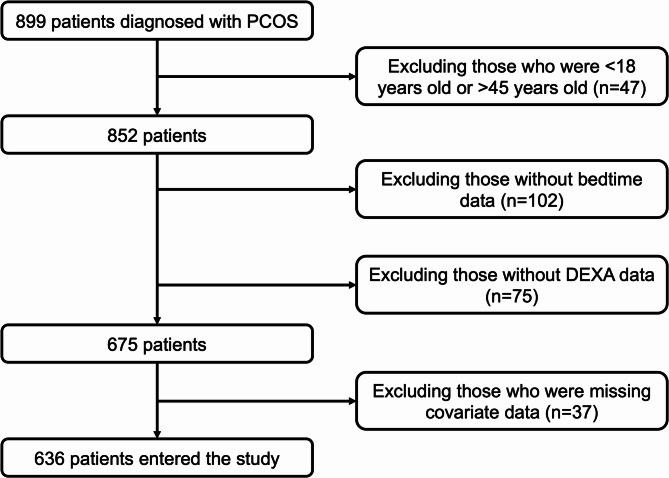
This cross-sectional study recruited 899 reproductive-aged women with PCOS from the PCOS subspecialty clinic at Shanghai Tenth People's Hospital, and finally, 636 women were included in the study. Anthropometric, metabolic, sex and reproductive hormonal characteristics, and body fat and lean composition measured by DEXA were collected. The information on bedtime was adapted from the Pittsburgh Sleep Quality Index, and bedtime was categorized into three aspects: early bedtime (≤ 23:00), intermediate bedtime (> 23:00 to 24:00), and late bedtime (> 24:00) according to the time of falling asleep.
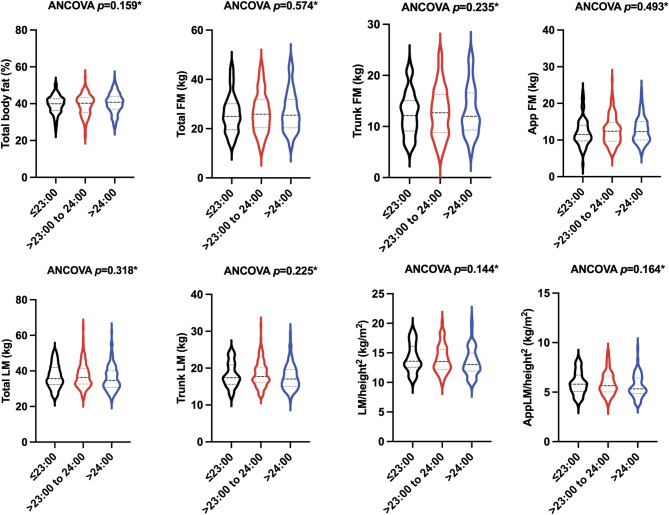
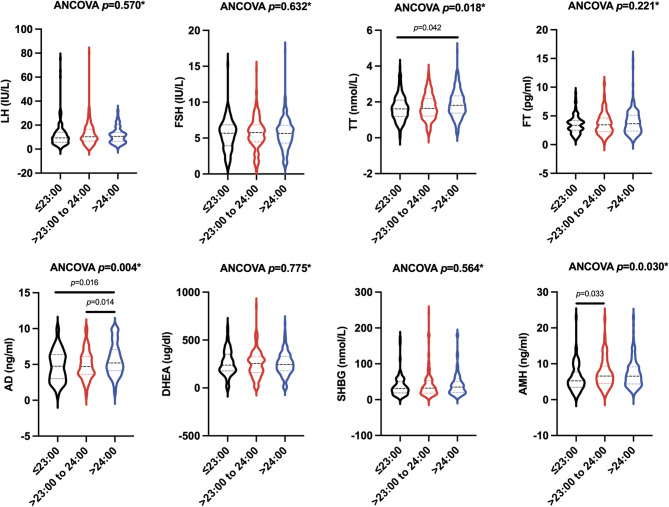
The study included 636 women with PCOS (mean age 27.50 ± 4.93 years; mean body mass index [BMI] 25.00 ± 5.46 kg/m²), with 24.4% having early bedtime (≤ 23:00), 36.8% intermediate bedtime (> 23:00 to 24:00), and 38.8% late bedtime (> 24:00). After adjusting for age in covariance analysis, the late bedtime group had fewer annual menstrual cycles and higher total testosterone (TT), and the intermediate bedtime group had higher anti-Müllerian hormone (AMH) than the early bedtime group. Compared with the early and intermediate bedtime groups, those with late bedtime had higher androstenedione (AD) levels. After controlling possible confounding factors (age, BMI, homeostasis model assessment of insulin resistance, alanine aminotransferase, triglyceride, and serum uric acid), multiple liner regression analysis found that compared with early bedtime, late bedtime was independently associated with higher levels of TT and AD, meanwhile, intermediate bedtime was independently associated with higher levels of AMH. Following further adjustment for the above confounders and TT, late bedtime was independently correlated to reduced muscle mass index and appendicular muscle mass index compared with early bedtime.
This study provided novel insight that late bedtime (after 24:00) was independently related to elevated androgenic hormones and reduced LM in individuals with PCOS.
虽然就寝时间对雄激素水平和瘦肌肉量的具体影响仍未得到充分研究,但昼夜节律失调和睡眠障碍已被确认为各种代谢紊乱的危险因素。本研究旨在探讨多囊卵巢综合征(PCOS)患者的就寝时间、雄激素相关特征与基于双能X线吸收法(DEXA)的瘦体重(LM)之间的关系。
这项横断面研究从上海第十人民医院PCOS专科门诊招募了899名育龄期PCOS女性,最终636名女性纳入研究。收集了人体测量、代谢、性和生殖激素特征以及通过DEXA测量的体脂和瘦体重组成信息。就寝时间信息改编自匹兹堡睡眠质量指数,根据入睡时间将就寝时间分为三个方面:早睡时间(≤23:00)、中等就寝时间(>23:00至24:00)和晚睡时间(>24:00)。
该研究纳入了636名PCOS女性(平均年龄27.50±4.93岁;平均体重指数[BMI]25.00±5.46kg/m²),其中24.4%为早睡时间(≤23:00),36.8%为中等就寝时间(>23:00至24:00),38.8%为晚睡时间(>24:00)。在协方差分析中调整年龄后,晚睡时间组的年月经周期较少,总睾酮(TT)较高,中等就寝时间组的抗苗勒管激素(AMH)高于早睡时间组。与早睡时间组和中等就寝时间组相比,晚睡时间组的雄烯二酮(AD)水平更高。在控制可能的混杂因素(年龄、BMI、胰岛素抵抗稳态模型评估、丙氨酸转氨酶、甘油三酯和血清尿酸)后,多元线性回归分析发现,与早睡时间相比,晚睡时间与较高的TT和AD水平独立相关,同时,中等就寝时间与较高的AMH水平独立相关。在进一步调整上述混杂因素和TT后,与早睡时间相比,晚睡时间与较低的肌肉质量指数和附属肌肉质量指数独立相关。
本研究提供了新的见解,即晚睡时间(24:00以后)与PCOS患者雄激素水平升高和瘦体重降低独立相关。