Caesar Robert
The Wallenberg Laboratory, Department of Molecular and Clinical Medicine, University of Gothenburg, Gothenburg, Sweden.
Diabetes Obes Metab. 2025 Mar;27 Suppl 1(Suppl 1):3-14. doi: 10.1111/dom.16129. Epub 2024 Dec 26.
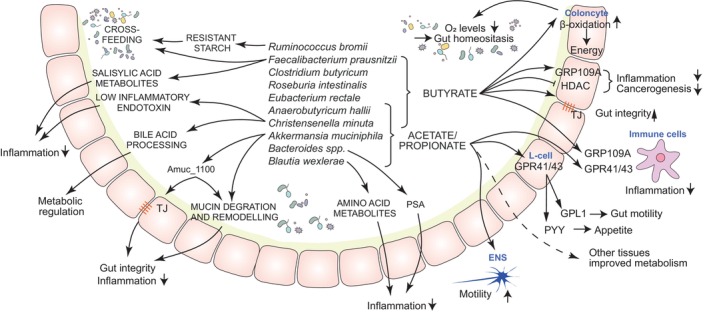
The gut microbiota plays a pivotal role in influencing the metabolism and immune responses of the body. A balanced microbial composition promotes metabolic health through various mechanisms, including the production of beneficial metabolites, which help regulate inflammation and support immune functions. In contrast, imbalance in the gut microbiota, known as dysbiosis, can disrupt metabolic processes and increase the risk of developing diseases, such as obesity, type 2 diabetes, and inflammatory disorders. The composition of the gut microbiota is dynamic and can be influenced by environmental factors such as diet, medication, and the consumption of live bacteria. Since the early 1900s, bacteria isolated from food and have been used as probiotics. However, the human gut also offers an enormous reservoir of bacterial strains, and recent advances in microbiota research have led to the discovery of strains with probiotic potentials. These strains, derived from a broad spectrum of microbial taxa, differ in their ecological properties and how they interact with their hosts. For most probiotics bacterial structural components and metabolites, such as short-chain fatty acids, contribute to the maintenance of metabolic and immunological homeostasis by regulating inflammation and reinforcing gut barrier integrity. Metabolites produced by probiotic strains can also be used for bacterial cross-feeding to promote a balanced microbiota. Despite the challenges related to safety, stability, and strain-specific properties, several newly identified strains offer great potential for personalized probiotic interventions, allowing for targeted health strategies.
肠道微生物群在影响机体代谢和免疫反应方面发挥着关键作用。平衡的微生物组成通过多种机制促进代谢健康,包括产生有益代谢物,这些代谢物有助于调节炎症并支持免疫功能。相反,肠道微生物群的失衡,即生态失调,会破坏代谢过程并增加患肥胖症、2型糖尿病和炎症性疾病等疾病的风险。肠道微生物群的组成是动态的,会受到饮食、药物和活细菌摄入等环境因素的影响。自20世纪初以来,从食物中分离出的细菌已被用作益生菌。然而,人类肠道也是一个巨大的细菌菌株库,微生物群研究的最新进展已导致发现具有益生菌潜力的菌株。这些菌株源自广泛的微生物分类群,它们的生态特性以及与宿主的相互作用方式各不相同。对于大多数益生菌而言,细菌结构成分和代谢物,如短链脂肪酸,通过调节炎症和增强肠道屏障完整性,有助于维持代谢和免疫稳态。益生菌菌株产生的代谢物也可用于细菌间的交叉喂养,以促进微生物群的平衡。尽管存在与安全性、稳定性和菌株特异性特性相关的挑战,但几种新发现的菌株为个性化益生菌干预提供了巨大潜力,从而实现有针对性的健康策略。