Wang Alec, Walden Madeline, Ettlinger Romy, Kiessling Fabian, Gassensmith Jeremiah J, Lammers Twan, Wuttke Stefan, Peña Quim
Institute for Experimental Molecular Imaging, RWTH Aachen University Hospital, Forckenbeckstrasse 55, 52074 Aachen, Germany.
BCMaterials (Basque Centre for Materials, Applications & Nanostructures), Bld. Martina Casiano, 3rd. Floor UPV/EHU Science Park Barrio Sarriena s/n, 48940 Leioa, Spain.
Adv Funct Mater. 2023 Nov 21;34(43). doi: 10.1002/adfm.202308589. eCollection 2024 Oct.
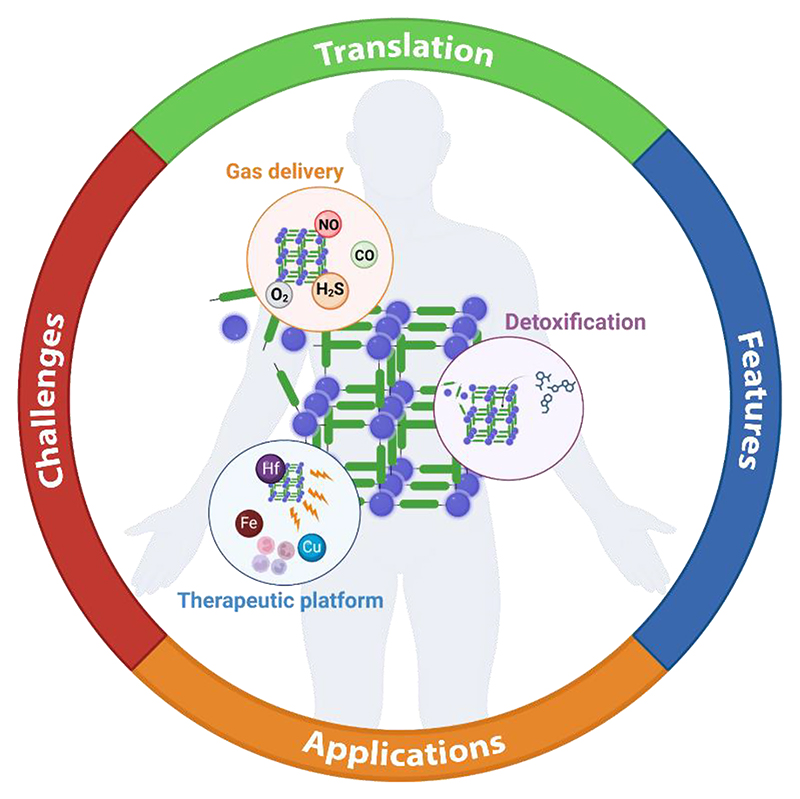
Metal-organic framework (MOF) materials are gaining significant interest in biomedical research, owing to their high porosity, crystallinity, and structural and compositional diversity. Their versatile hybrid organic/inorganic chemistry endows MOFs with the capacity to retain organic (drug) molecules, metals, and gases, to effectively channel electrons and photons, to survive harsh physiological conditions such as low pH, and even to protect sensitive biomolecules. Extensive preclinical research has been carried out with MOFs to treat several pathologies and, recently, their integration with other biomedical materials such as stents and implants has demonstrated promising performance in regenerative medicine. However, there remains a significant gap between MOF preclinical research and translation into clinically and societally relevant medicinal products. Here, we outline the intrinsic features of MOFs and discuss how these are suited to specific biomedical applications like detoxification, drug and gas delivery, or as (combination) therapy platforms. We furthermore describe relevant examples of how MOFs have been engineered and evaluated in different medical indications, including cancer, microbial, and inflammatory diseases. Finally, we critically examine the challenges facing their translation into the clinic, with the goal of establishing promising research directions and more realistic approaches that can bridge the translational gap of MOFs and MOF-containing (nano)materials.
金属有机框架(MOF)材料因其高孔隙率、结晶性以及结构和组成的多样性,在生物医学研究中引起了广泛关注。其有机/无机杂化化学的多功能性使MOF能够保留有机(药物)分子、金属和气体,有效传导电子和光子,在低pH等恶劣生理条件下存活,甚至保护敏感生物分子。人们已对MOF进行了广泛的临床前研究以治疗多种疾病,最近,它们与支架和植入物等其他生物医学材料的结合在再生医学中显示出了良好的性能。然而,MOF的临床前研究与转化为临床和社会相关的医药产品之间仍存在巨大差距。在此,我们概述了MOF的内在特性,并讨论了它们如何适用于解毒、药物和气体递送或作为(联合)治疗平台等特定生物医学应用。我们还描述了MOF在不同医学适应症(包括癌症、微生物和炎症性疾病)中如何进行设计和评估的相关实例。最后,我们批判性地审视了它们转化为临床应用所面临的挑战,目标是确立有前景的研究方向和更现实的方法,以弥合MOF和含MOF(纳米)材料的转化差距。