Rahman Marcia S, Wu Olivia Y, Battaglia Kyra, Blackstone Nicole Tichenor, Economos Christina D, Mozaffarian Dariush
Gerald J. and Dorothy R. Friedman School of Nutrition Science and Policy, Tufts University, Boston, MA, United States.
Front Nutr. 2024 Dec 12;11:1508530. doi: 10.3389/fnut.2024.1508530. eCollection 2024.
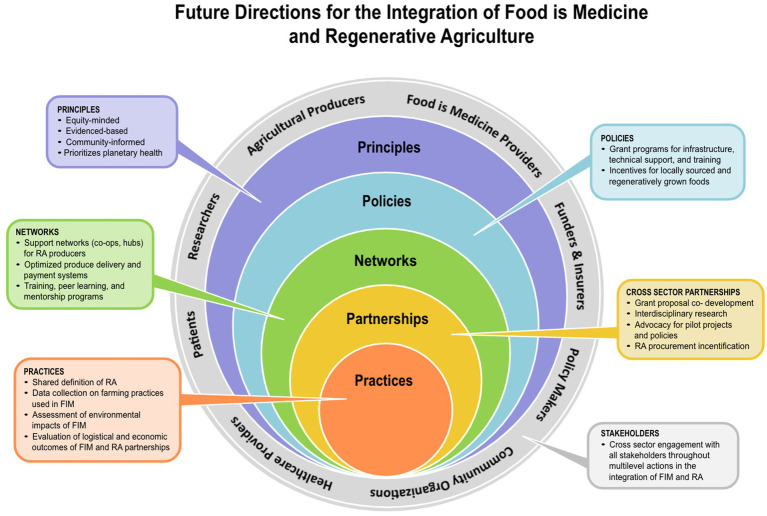
The urgent need to address both human and environmental health crises has brought attention to the role of food systems in driving climate change, biodiversity loss, and diet-related diseases. This paper explores the intersection of Food is Medicine (FIM) and regenerative agriculture (RA) as an emerging approach with the potential to help address the interconnected challenges of human and ecological health within healthcare and food systems. FIM programs, such as produce prescriptions and medically tailored meals, aim to improve health outcomes by increasing access to nutritious foods and promoting nutrition equity. RA, focusing on soil health, biodiversity, and reduced reliance on synthetic inputs, offers more sustainable agricultural practices that can align with FIM goals. This paper highlights key opportunities, recent policy developments, and evidence gaps, calling for concerted efforts to clearly define RA practices and foster collaboration between community, healthcare, agriculture, and policy stakeholders. Strengthening these interconnections could lead to more resilient food systems and improved health outcomes at both individual and population levels.
应对人类和环境健康危机的迫切需求,已使人们关注到食物系统在推动气候变化、生物多样性丧失以及与饮食相关疾病方面所起的作用。本文探讨了“食物即药物”(FIM)与再生农业(RA)的交叉点,这是一种新兴方法,有潜力帮助应对医疗保健和食物系统中人类与生态健康相互关联的挑战。FIM项目,如农产品处方和医学定制餐食,旨在通过增加获得营养食物的机会和促进营养公平来改善健康结果。RA注重土壤健康、生物多样性并减少对合成投入物的依赖,提供了更可持续的农业实践,能够与FIM目标相一致。本文强调了关键机遇、近期政策发展以及证据空白,呼吁各方共同努力,明确界定RA实践,并促进社区、医疗保健、农业和政策利益相关者之间的合作。加强这些联系可能会带来更具韧性的食物系统,并在个体和群体层面改善健康结果。