Papagiannis Grigoris, Karatrantou Konstantina, Batatolis Christos, Ioakimidis Panagiotis, Gerodimos Vassilis
Department of Physical Education and Sport Science, University of Thessaly, 42100 Trikala, Greece.
Sports (Basel). 2024 Dec 19;12(12):353. doi: 10.3390/sports12120353.
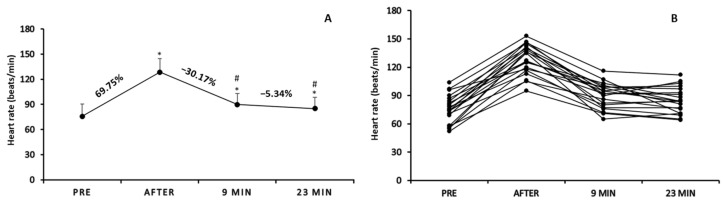
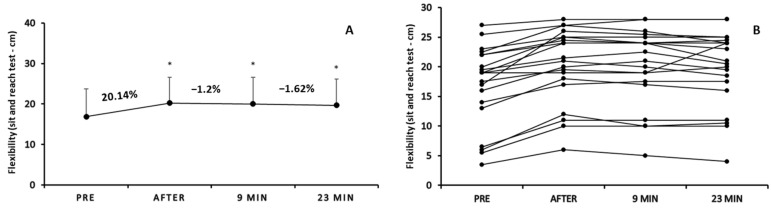
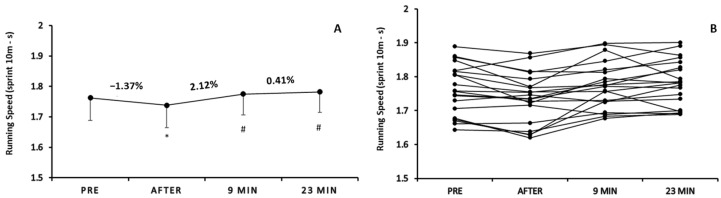
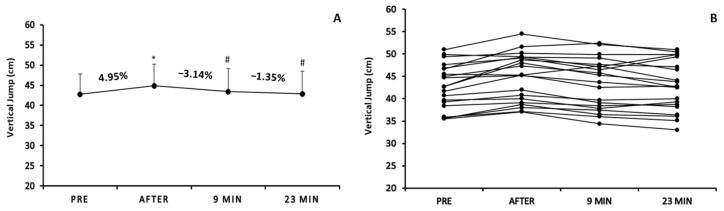
Pre-game warm-up is integral to athletes' preparation before a basketball game. The main objectives of this study were to compare specific performance indicators before and immediately after a basketball pre-game warm-up, and examine the individualized players' responses. The impact of rest intervals after warm-up (9-23 min) was also examined. A total of 20 male basketball players (age: 21.15 ± 2.2 years; body mass: 82.23 ± 10.78 kg; body height: 184.18 ± 7.9 cm) performed a pre-game warm-up and were assessed in selected indicators such as heart rate (HR), flexibility, running speed, and countermovement jump with arm swing (CMJAS) before, immediately after, 9 min and 23 min after warm-up. Immediately after warm-up, HR increased to all players (mean change: 69.78%), while flexibility (mean change: 20.14%) and CMJAS (mean change: 4.95%) increased to the majority of players (except one and two players, respectively). The individualized results regarding speed were conflicting, showing a decrease or increase. However, 9 and 23 min after warm-up, there was a decrease in HR, speed, and CMJAS ( < 0.5), while flexibility remained stable ( > 0.5) in the total sample, with great change variations among players. In conclusion, it seems that each player's individuality may affect the warm-up's efficiency. Thus, it is important to carefully design the pre-game warm-up so that all players will be in the most suitable condition to meet the demands of their competition.
赛前热身是篮球比赛前运动员准备工作的重要组成部分。本研究的主要目的是比较篮球赛前热身前后的特定性能指标,并检查个体球员的反应。还研究了热身(9 - 23分钟)后休息间隔的影响。共有20名男性篮球运动员(年龄:21.15±2.2岁;体重:82.23±10.78千克;身高:184.18±7.9厘米)进行了赛前热身,并在热身前、刚结束后、热身结束9分钟和23分钟后,对心率(HR)、柔韧性、跑步速度和带摆臂的反向纵跳(CMJAS)等选定指标进行了评估。热身刚结束后,所有球员的心率均升高(平均变化:69.78%),而大多数球员的柔韧性(平均变化:20.14%)和CMJAS(平均变化:4.95%)有所增加(分别除一名和两名球员外)。关于速度的个体结果相互矛盾,有增有减。然而,在热身结束9分钟和23分钟后,总样本中的心率、速度和CMJAS均下降(<0.5),而柔韧性保持稳定(>0.5),球员之间变化差异很大。总之,似乎每个球员的个体差异可能会影响热身的效果。因此,精心设计赛前热身很重要,以便所有球员都能处于最适合的状态来满足比赛的需求。