Liang Jie, Wen Yanchao, Yin Jinzhu, Zhu Guiming, Wang Tong
Department of Health Statistics, School of Public Health, Shanxi Medical University, Taiyuan, Shanxi, China.
Key Laboratory of Coal Environmental Pathogenicity and Prevention, Ministry of Education, Shanxi Medical University, Taiyuan, Shanxi, China.
NPJ Sci Food. 2024 Dec 27;8(1):113. doi: 10.1038/s41538-024-00362-y.
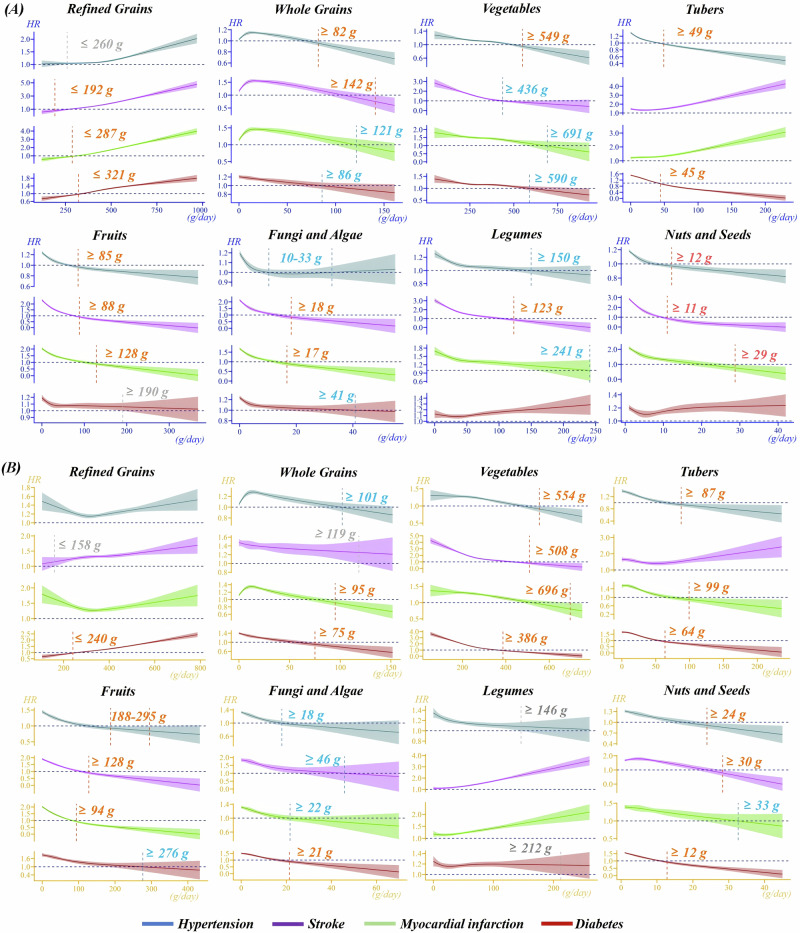
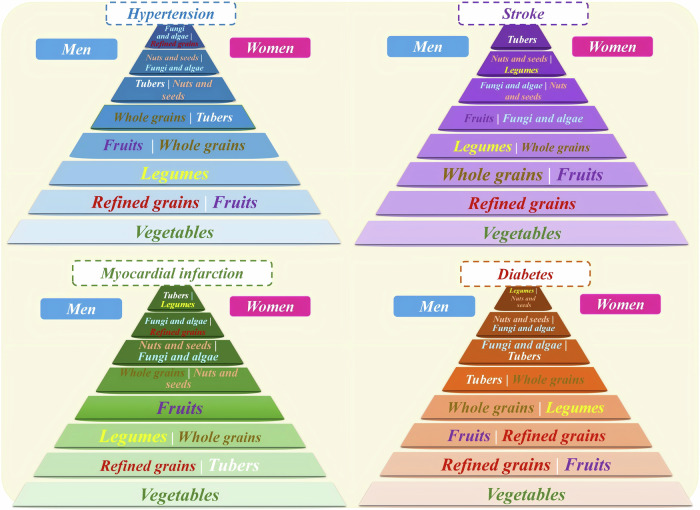
The present study examined optimal dietary patterns of eight plant-based foods for preventing chronic diseases, including hypertension, stroke, myocardial infarction, and diabetes, using data from the China Health and Nutrition Survey (CHNS). We applied generalized estimating equations to assess time-based changes and gender differences, using residual balancing weights to control time-varying confounders, and employed a restricted cubic spline model to explore dose-response relationships by gender. The findings suggested that a high intake of vegetables and whole grains, along with moderate amounts of fruits, fungi and algae, could help reduce the risk of developing these four chronic diseases simultaneously. Additionally, men could benefit from moderate refined grain consumption, while women should consider increasing their intake of nuts and seeds. Our results indicated that adopting a plant-based diet could provide non-linear protective effects against chronic diseases, with the magnitude of this protection varying by gender.
本研究利用中国健康与营养调查(CHNS)的数据,研究了八种植物性食物预防包括高血压、中风、心肌梗死和糖尿病在内的慢性疾病的最佳饮食模式。我们应用广义估计方程来评估基于时间的变化和性别差异,使用残差平衡权重来控制随时间变化的混杂因素,并采用受限立方样条模型按性别探索剂量反应关系。研究结果表明,大量摄入蔬菜和全谷物,同时适量摄入水果、菌类和藻类,有助于同时降低患这四种慢性疾病的风险。此外,男性适量食用精制谷物有益,而女性则应考虑增加坚果和种子的摄入量。我们的结果表明,采用植物性饮食可以对慢性疾病提供非线性保护作用,且这种保护作用的程度因性别而异。