Department of Global Public Health and Primary Care, University of Bergen, Bergen, Norway.
Department of Addiction Medicine, Haukeland University Hospital, Bergen, Norway.
Adv Nutr. 2022 Dec 22;13(6):2136-2148. doi: 10.1093/advances/nmac077.
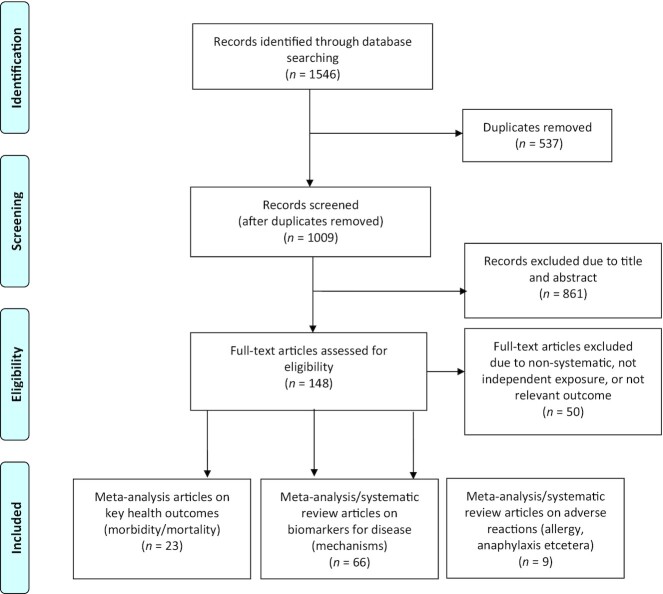
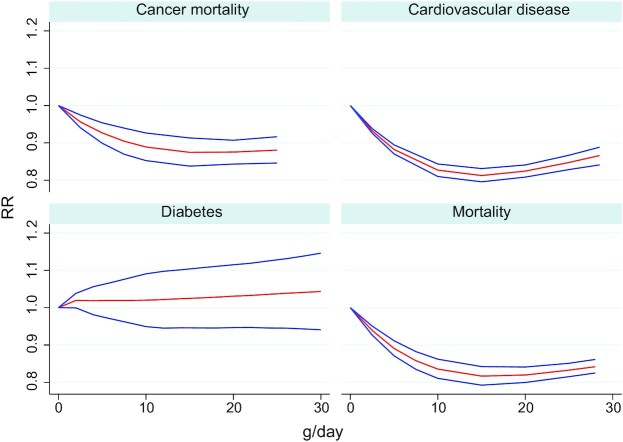
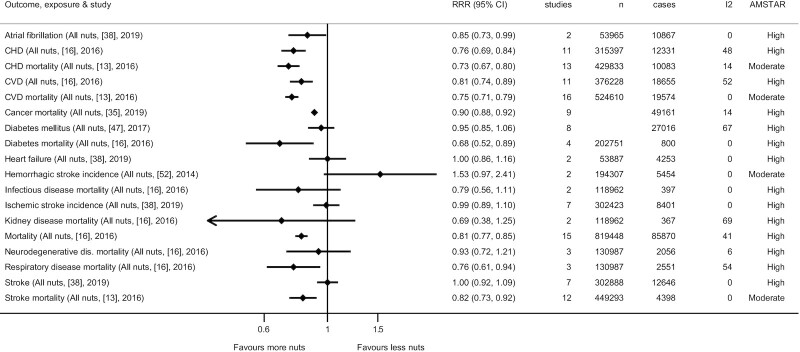
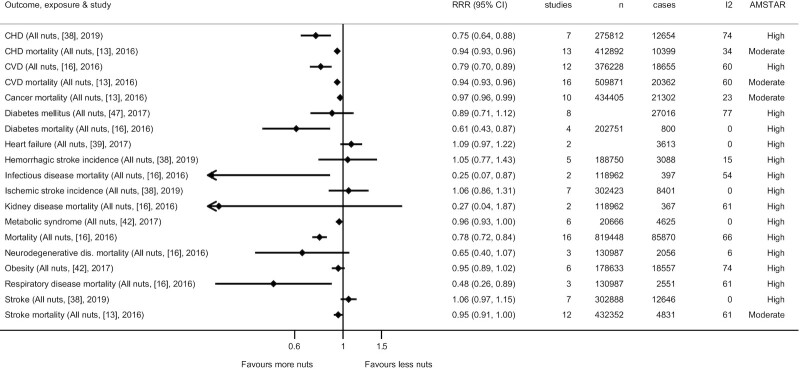
Consumption of nuts and seeds is associated with a range of health outcomes. Summarizing the best evidence on essential health outcomes from the consumption of nuts is essential to provide optimal recommendations. Our objective is to comprehensively assess health outcome associations related to the consumption of nuts and seeds, using a culinary definition including tree nuts and peanuts (registered in PROSPERO: CRD42021258300). Health outcomes of interest include cardiovascular disease, cancer, diabetes, obesity, respiratory disease, mortality, and their disease biomarkers. We present associations for high compared with low consumption, per serving, and dose-response relations. MEDLINE, Embase, Cochrane, and Epistemonikos were searched and screened for systematic reviews and meta-analyses. Evidence was extracted from 89 articles on the consumption of nuts and relevant health outcomes, including 23 articles with meta-analysis on disease and mortality, 66 articles on biomarkers for disease, and 9 articles on allergy/adverse outcomes. Intake of nuts was associated with reduced risk of cardiovascular diseases and related risk factors, with moderate quality of evidence. An intake of 28 g/d nuts compared with not eating nuts was associated with a 21% RR reduction of cardiovascular disease (including coronary heart disease incidence and mortality, atrial fibrillation, and stroke mortality), an 11% risk reduction of cancer deaths, and 22% reduction in all-cause mortality. Nut consumption was also inversely associated with mortality from respiratory diseases, infectious diseases, and diabetes; however, associations between nut consumption and diabetes incidence were mixed. Meta-analyses of trials on biomarkers for disease generally mirrored meta-analyses from observational studies on cardiovascular disease, cancers, and diabetes. Allergy and related adverse reactions to nuts were observed in 1-2% of adult populations, with substantial heterogeneity between studies. Overall, the current evidence supports dietary recommendations to consume a handful of nuts and seeds per day for people without allergies to these foods.
坚果和种子的消费与一系列健康结果有关。总结坚果消费对基本健康结果的最佳证据对于提供最佳建议至关重要。我们的目标是使用包括树坚果和花生(在 PROSPERO 中注册:CRD42021258300)的烹饪定义,全面评估与坚果和种子消费相关的健康结果关联。感兴趣的健康结果包括心血管疾病、癌症、糖尿病、肥胖、呼吸道疾病、死亡率及其疾病生物标志物。我们报告了高摄入量与低摄入量、每份摄入量和剂量反应关系的关联。我们检索了 MEDLINE、Embase、Cochrane 和 Epistemonikos,并对系统评价和荟萃分析进行了筛选。从 89 篇关于坚果消费和相关健康结果的文章中提取了证据,其中包括 23 篇关于疾病和死亡率的荟萃分析文章、66 篇关于疾病生物标志物的文章和 9 篇关于过敏/不良反应的文章。坚果的摄入量与心血管疾病和相关风险因素的风险降低有关,证据质量为中等。与不吃坚果相比,每天摄入 28 克坚果与心血管疾病(包括冠心病发病率和死亡率、心房颤动和中风死亡率)的 RR 降低 21%、癌症死亡风险降低 11%、全因死亡率降低 22%有关。坚果的摄入量也与呼吸道疾病、传染病和糖尿病的死亡率呈负相关;然而,坚果摄入量与糖尿病发病率之间的关联存在差异。关于疾病生物标志物的试验荟萃分析通常反映了关于心血管疾病、癌症和糖尿病的观察性研究的荟萃分析。在成年人中,1-2%观察到对坚果的过敏和相关不良反应,不同研究之间存在很大的异质性。总体而言,目前的证据支持对没有对这些食物过敏的人每天食用一把坚果和种子的饮食建议。