Raza Hafiz Ahmed, Ansari Shahab U, Javed Kamran, Hanif Muhammad, Mian Qaisar Saeed, Haider Usman, Pławiak Paweł, Maab Iffat
Artificial Intelligence in Medicine (AIM) Lab, GIK Institute of Engineering Sciences and Technology, Topi, 23640, Swabi, Pakistan.
National Centre of Artificial Intelligence (NCAI), Saudi Data and Artificial Intelligence Authority (SDAIA), Riyadh, Saudi Arabia.
Sci Rep. 2024 Dec 28;14(1):30925. doi: 10.1038/s41598-024-81563-z.
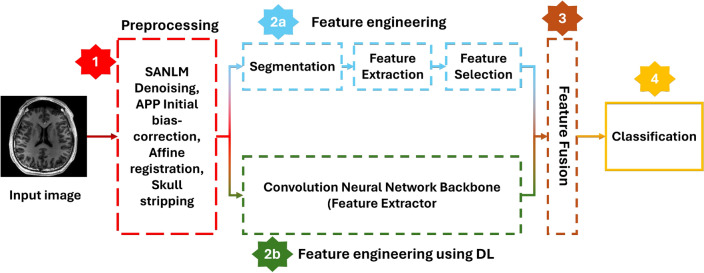
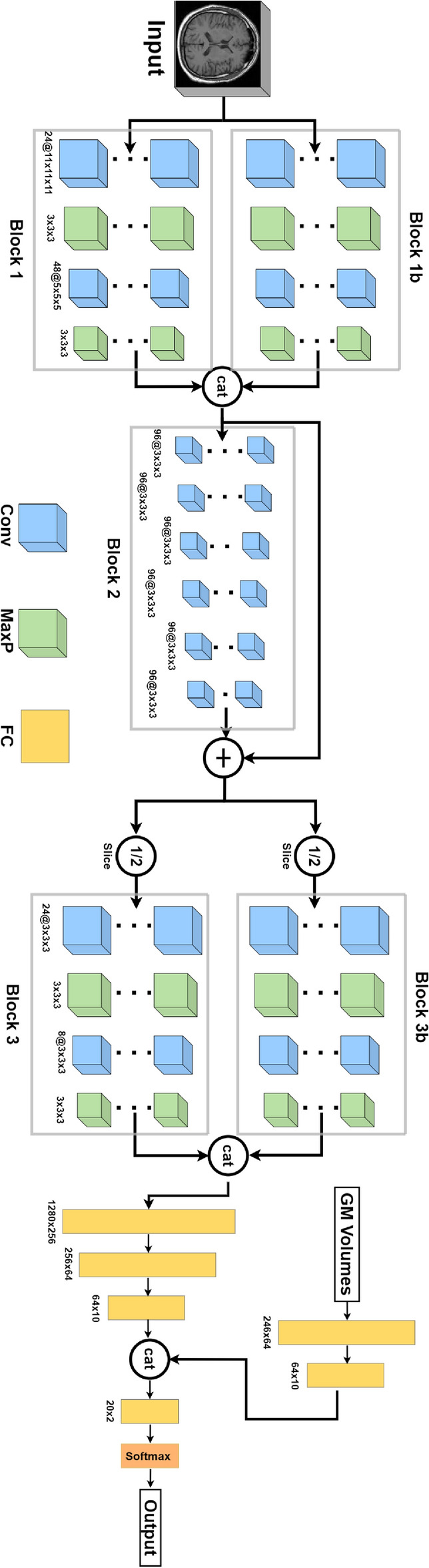
Alzheimer's disease (AD) is a neurodegenerative disorder. It causes progressive degeneration of the nervous system, affecting the cognitive ability of the human brain. Over the past two decades, neuroimaging data from Magnetic Resonance Imaging (MRI) scans has been increasingly used in the study of brain pathology related to the birth and growth of AD. Recent studies have employed machine learning to detect and classify AD. Deep learning models have also been increasingly utilized with varying degrees of success. This paper presents a novel hybrid approach for early detection and classification of AD using structural MRI (sMRI). The proposed model employs a unique combination of machine learning and deep learning approaches to optimize the precision and accuracy of the detection and classification of AD. The proposed approach surpassed multi-modal machine learning algorithms in accuracy, precision, and F-measure performance measures. Results confirm an outperformance compared to the state-of-the-art in AD versus CN and sMCI versus pMCI paradigms. Within the CN versus AD paradigm, the designed model achieves 91.84% accuracy on test data.
阿尔茨海默病(AD)是一种神经退行性疾病。它会导致神经系统进行性退化,影响人类大脑的认知能力。在过去二十年中,来自磁共振成像(MRI)扫描的神经影像数据越来越多地用于与AD发生和发展相关的脑病理学研究。最近的研究采用机器学习来检测和分类AD。深度学习模型也越来越多地被使用,并取得了不同程度的成功。本文提出了一种使用结构MRI(sMRI)对AD进行早期检测和分类的新型混合方法。所提出的模型采用机器学习和深度学习方法的独特组合,以优化AD检测和分类的精度和准确性。所提出的方法在准确性、精度和F值性能指标方面超过了多模态机器学习算法。结果证实,在AD与健康对照(CN)以及轻度认知障碍(sMCI)与轻度痴呆(pMCI)范式中,该方法优于现有技术。在CN与AD范式中,所设计的模型在测试数据上达到了91.84%的准确率。