Schoofs Kathleen, Ferro Dos Santos Maísa R, De Wilde Jilke, Roelandt Sofie, Van de Velde Sofie, Decruyenaere Philippe, Meuris Leander, Thas Olivier, Philippron Annouck, Depypere Lieven, Nafteux Philippe, Vanommeslaeghe Hanne, Van Daele Elke, Pattyn Piet, Vandesompele Jo, De Preter Katleen
Translational Oncogenomics and Bioinformatics Lab, Center for Medical Biotechnology, VIB-UGent & CRIG, Technologiepark-Zwijnaarde 75, 9052, Ghent, Belgium.
OncoRNALab, Cancer Research Institute Ghent (CRIG), Ghent, Belgium.
Sci Rep. 2024 Dec 28;14(1):31112. doi: 10.1038/s41598-024-82325-7.
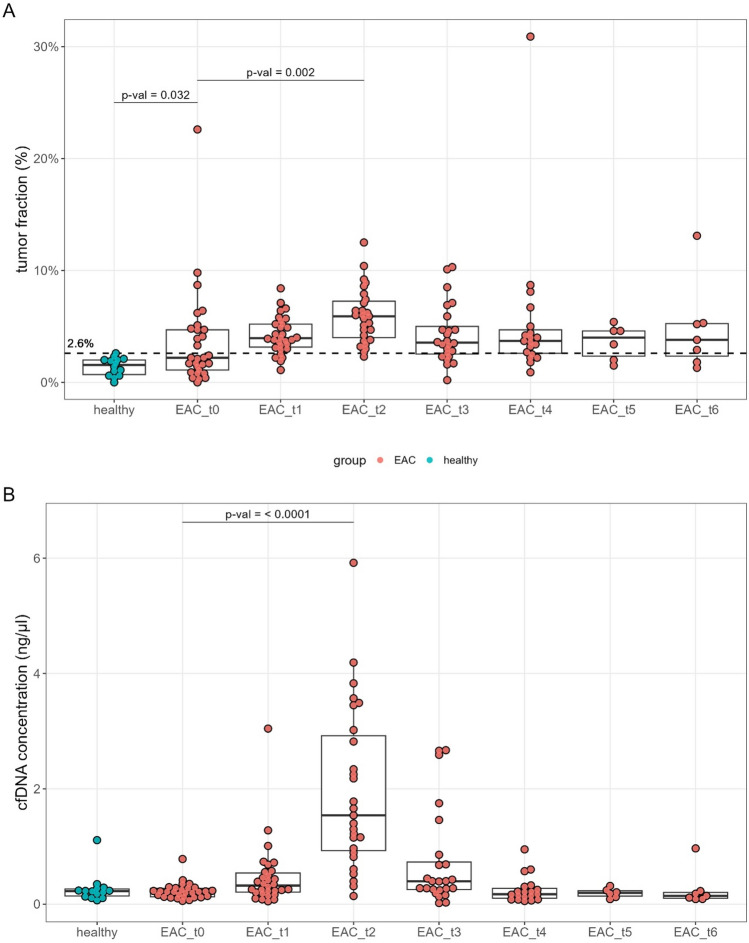
Esophageal adenocarcinoma (EAC) is an aggressive cancer characterized by a high risk of relapse post-surgery. Current follow-up methods (serum carcinoembryonic antigen detection and PET-CT) lack sensitivity and reliability, necessitating a novel approach. Analyzing cell-free DNA (cfDNA) from blood plasma emerges as a promising avenue. This study aims to evaluate the cost-effective and genome-wide cell-free reduced representation bisulfite sequencing (cfRRBS) method combined with computational deconvolution for effective disease monitoring in EAC patients. cfDNA methylation profiling with cfRRBS was performed on 162 blood plasma samples from 33 EAC cancer patients and 28 blood plasma samples from 20 healthy donors. The estimated tumor fraction for EAC patients at the time of diagnosis was significantly different from the healthy donor plasma samples (one-sided Wilcoxon rank-sum test: p-value = 0.032). Tumor fractions above 15% and focal gains/amplifications in MYC (chr8), KRAS (chr12), EGFR (chr7) and NOTCH2 (chr1) were observed in four samples of distinct patients at the time metastatic disease was detected. This study showed feasibility to estimate tumor fractions in blood plasma of EAC patients based on cfDNA methylation using cfRRBS and computational deconvolution. Nevertheless, in this study only cancer patients with evidence of metastatic disease show high tumor fractions and copy number alterations.
食管腺癌(EAC)是一种侵袭性癌症,其特征是术后复发风险高。目前的随访方法(血清癌胚抗原检测和PET-CT)缺乏敏感性和可靠性,因此需要一种新的方法。分析血浆中的游离DNA(cfDNA)成为一种有前景的途径。本研究旨在评估具有成本效益的全基因组游离DNA简化代表性亚硫酸氢盐测序(cfRRBS)方法与计算反卷积相结合,用于有效监测EAC患者的疾病。对33例EAC癌症患者的162份血浆样本和20例健康供体的28份血浆样本进行了cfRRBS的cfDNA甲基化分析。EAC患者诊断时的估计肿瘤分数与健康供体血浆样本有显著差异(单侧Wilcoxon秩和检验:p值 = 0.032)。在检测到转移性疾病时,在不同患者的四个样本中观察到肿瘤分数高于15%以及MYC(8号染色体)、KRAS(12号染色体)、EGFR(7号染色体)和NOTCH2(1号染色体)的局灶性扩增。本研究表明,使用cfRRBS和计算反卷积基于cfDNA甲基化估计EAC患者血浆中的肿瘤分数是可行的。然而,在本研究中,只有有转移性疾病证据的癌症患者显示出高肿瘤分数和拷贝数改变。