Lugano Doreen, Kutima Bernadette, Kimani Makobu, Sigilai Antipa, Gitonga John, Karani Angela, Akech Donald, Karia Boniface, Ziraba Abdhalah K, Maina Angela, Lambisia Arnold, Omuoyo Donwilliams, Mugo Daisy, Lucinde Ruth, Owuor Sharon, Konyino Gloria, Newman Joseph, Bailey Dalan, Nduati Eunice, Githinji George, Agoti Charles N, Bejon Philip, Scott J Anthony G, Agweyu Ambrose, Kagucia Wangeci, Warimwe George M, Sande Charles, Ochola-Oyier Lynette I, Nyagwange James
KEMRI-Wellcome Trust Research Programme, P.O. Box 230, Kilifi, Kenya.
African Population and Health Research Center, APHRC Campus, Manga Close, Kitisuru Nairobi, P.O. Box 10787, Nairobi, 00100, Kenya.
BMC Infect Dis. 2024 Dec 28;24(1):1474. doi: 10.1186/s12879-024-10367-3.
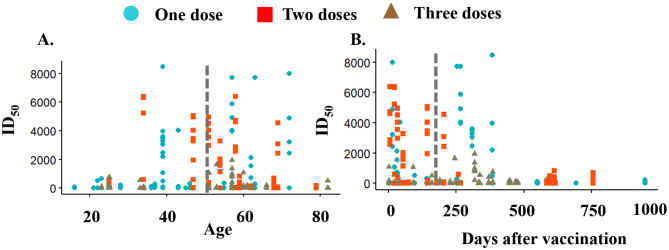
Increased immune evasion by emerging and highly mutated SARS-CoV-2 variants is a key challenge to the control of COVID-19. The majority of these mutations mainly target the spike protein, allowing the new variants to escape the immunity previously raised by vaccination and/or infection by earlier variants of SARS-CoV-2. In this study, we investigated the neutralizing capacity of antibodies against emerging variants of interest circulating between May 2023 and October 2024 using sera from representative samples of the Kenyan population. From our genomics data, we identified the most prevalent Kenyan and global variants and performed pseudoviruses neutralization assays with the most recent SARS-CoV-2 variants. Our data show that antibodies from individuals in the general population in Kenya were less effective against the recent prevalent SARS-CoV-2 omicron variants (i.e. EG.5.1, FY.4, BA.2.86, JN.1, JN.1.4, and KP.3.1.1) compared to the ancestral wildtype strain. Although there was increased neutralization following multiple doses of vaccine, antibodies from > 40% of the vaccinated individuals did not neutralize the omicron variants, suggesting that individuals were susceptible to infection by these variants.
新出现的高度变异的严重急性呼吸综合征冠状病毒2(SARS-CoV-2)变体增强的免疫逃逸能力是控制2019冠状病毒病(COVID-19)的一项关键挑战。这些突变大多主要针对刺突蛋白,使新变体能够逃避先前通过接种疫苗和/或感染早期SARS-CoV-2变体所产生的免疫力。在本研究中,我们使用肯尼亚人群代表性样本的血清,调查了针对2023年5月至2024年10月期间流行的新出现的感兴趣变体的抗体中和能力。根据我们的基因组学数据,我们确定了肯尼亚和全球最流行的变体,并对最新的SARS-CoV-2变体进行了假病毒中和试验。我们的数据表明,与原始野生型毒株相比,肯尼亚普通人群个体的抗体对近期流行的SARS-CoV-2奥密克戎变体(即EG.5.1、FY.4、BA.2.86、JN.1、JN.1.4和KP.3.1.1)的效力较低。尽管多剂疫苗接种后中和作用有所增强,但超过40%的接种个体的抗体无法中和奥密克戎变体,这表明个体易受这些变体的感染。