Moran Samantha A, Bishop Meg D, Watson Ryan J, Fish Jessica N
Department of Family Science, University of Maryland, College Park, Maryland, USA.
Department of Human Development & Family Sciences, University of Connecticut, Storrs, Connecticut, USA.
J Res Adolesc. 2025 Mar;35(1):e13052. doi: 10.1111/jora.13052.
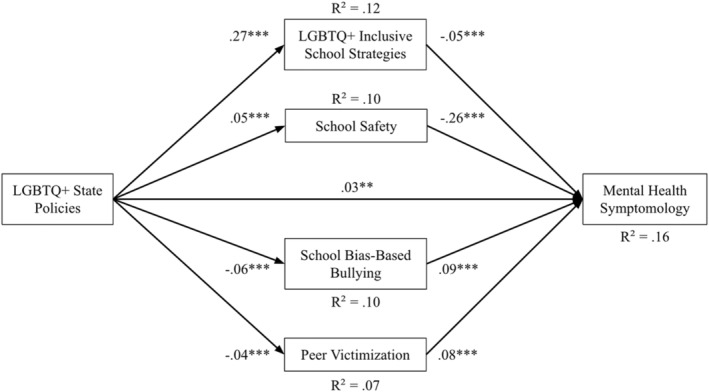
The link between state policies and LGBTQ+ youth mental health is well-established, yet less well-understood are the mechanisms that drive these associations. We used a sample from the LGBTQ+ National Teen Survey (n = 8368) collected in 2022 to examine whether and to what degree LGBTQ+ inclusive school strategies, student perceptions of school safety, and experiences with bias-based bullying and peer victimization explain the association between state LGBTQ+ youth-focused policies and LGBTQ+ youth mental health symptomology. We observed significant indirect effects between policy and LGBTQ+ youth mental health through all four constructs, suggesting that each of these more proximal school experiences was independently implicated in this association. Findings underscore how state policies shape LGBTQ+ youth mental health symptomology via more proximal contexts and emphasize the importance of policy implementation following enactment.
国家政策与LGBTQ+青年心理健康之间的联系已得到充分确立,但驱动这些关联的机制却鲜为人知。我们使用了2022年收集的LGBTQ+全国青少年调查样本(n = 8368),以检验LGBTQ+包容性学校策略、学生对学校安全的认知,以及基于偏见的欺凌和同伴受害经历是否以及在多大程度上解释了以LGBTQ+青年为重点的国家政策与LGBTQ+青年心理健康症状之间的关联。我们观察到,通过所有这四个结构,政策与LGBTQ+青年心理健康之间存在显著的间接影响,这表明这些更直接的学校经历中的每一个都独立地与这种关联有关。研究结果强调了国家政策如何通过更直接的背景塑造LGBTQ+青年的心理健康症状,并强调了政策颁布后实施的重要性。