Fathi Mehdi, Hosseinali Zahra, Molaei Tina, Hekmatfar Somayeh
Department of Dental Biomaterials, School of Dentistry, Ardabil University of Medical Sciences, Ardabil, Iran.
Depatment of Microbiology, School of Medicine, Ardabil University of Medical Sciences, Ardabil, Iran.
Dent Res J (Isfahan). 2024 Nov 21;21:58. doi: 10.4103/drj.drj_12_24. eCollection 2024.
Recurrent caries were attributed to the lack of antibacterial properties of the dental materials. Silver nanoparticles (AgNPs) and calcium fluoride nanoparticles (CaF2NPs) are broad-spectrum antibacterial agents. The object of the study was to investigate the antibacterial properties of composite-incorporated AgNPs and CaF2NPs on .
This experimental study forty-eight disks containing 0.5, 1, and 1.5% wt AgNPs s ( = 24) and 5, 10, and 15% wt CaF2NPs were prepared from flowable composite resin ( = 24). The third group consisted of 9 types of the combination of AgNPs and CaF2NPs ( = 72). A field emission scanning electron microscope with an energy-dispersive X-ray spectroscopy analysis system was used to test for the presence of nanoparticles in composite resins. The antibacterial efficacy of dental composite was evaluated by disk diffusion agar test. The minimum inhibitory concentration (MIC) and minimal bactericidal concentration were conducted. Data were analyzed using one-way ANOVA and multiple Tukey HSD (Honestly Significant Difference) tests. Significance level was set at 0.05.
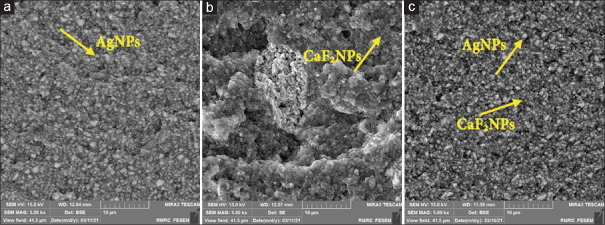
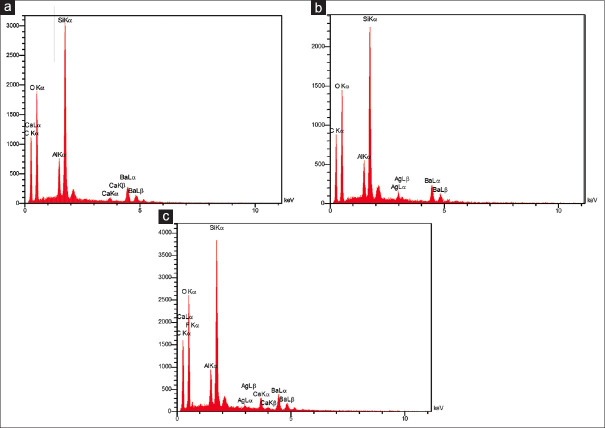
Nanoparticles added to composite produce bacterial inhibition zone. The greatest inhibition of bacterial growth was recorded in the third group which contained both nanoparticles ( < 0.05). MIC values decreased after adding CaF2 NPs to the AgNPs-containing composite. The results of the FE-SEM test indicate the presence of AgNPs and CaF2NPs in the dental composite resin sample. On the other hand, the formation of AgNPs and their elemental nature were proved using energy dispersive X-ray microanalysis EDX analysis. According to the results, composite resins containing 0.5% of AgNPs s and 15% of CaF2NPs exhibited a significantly lower antibacterial activity compared to the 1.5% and 1% of AgNPs s with 15% of CaF2NPs ( < 0.05).
Dental composite resins-containing CaF2NPs and AgNPs showed anti-bacterial activity against .
继发龋归因于牙科材料缺乏抗菌性能。银纳米颗粒(AgNPs)和氟化钙纳米颗粒(CaF2NPs)是广谱抗菌剂。本研究的目的是研究复合掺入AgNPs和CaF2NPs对……的抗菌性能。
本实验研究用可流动复合树脂制备了48个圆盘,其中含0.5%、1%和1.5%重量的AgNPs(n = 24)以及5%、10%和15%重量的CaF2NPs(n = 24)。第三组由9种AgNPs和CaF2NPs的组合构成(n = 72)。使用配备能量色散X射线光谱分析系统的场发射扫描电子显微镜检测复合树脂中纳米颗粒的存在情况。通过纸片扩散琼脂试验评估牙科复合材料的抗菌效果。进行了最低抑菌浓度(MIC)和最小杀菌浓度测定。数据采用单因素方差分析和多重Tukey HSD(真实显著差异)检验进行分析。显著性水平设定为0.05。
添加到复合材料中的纳米颗粒产生细菌抑制区。在同时含有两种纳米颗粒的第三组中记录到对细菌生长的最大抑制作用(P < 0.05)。向含AgNPs的复合材料中添加CaF2 NPs后,MIC值降低。FE - SEM测试结果表明牙科复合树脂样品中存在AgNPs和CaF2NPs。另一方面,使用能量色散X射线微量分析(EDX分析)证明了AgNPs的形成及其元素性质。根据结果,与含1.5%和1% AgNPs以及15% CaF2NPs相比,含0.5% AgNPs和15% CaF2NPs的复合树脂表现出显著更低的抗菌活性(P < 0.05)。
含CaF2NPs和AgNPs的牙科复合树脂对……显示出抗菌活性。