Zhou Yong, Li Yudong, Chen Hongzhuang, Shu Sicheng, Li Zhixin, Sun Honglei, Sun Yipeng, Liu Jinhua, Lu Lu, Pu Juan
National Key Laboratory of Veterinary Public Health and Safety, Key Laboratory for Prevention and Control of Avian Influenza and Other Major Poultry Diseases, Ministry of Agriculture and Rural Affairs, College of Veterinary Medicine, China Agricultural University, 2 Yuanmingyuan West Road, Haidian District, Beijing 100193, China.
Ningxia Hui Autonomous Region Animal Disease Prevention and Control Center, No. 411, Mancheng South Street, Jinfeng District, Yinchuan City, Ningxia Hui Autonomous Region, Yinchuan 750011, China.
Virus Evol. 2024 Dec 9;10(1):veae106. doi: 10.1093/ve/veae106. eCollection 2024.
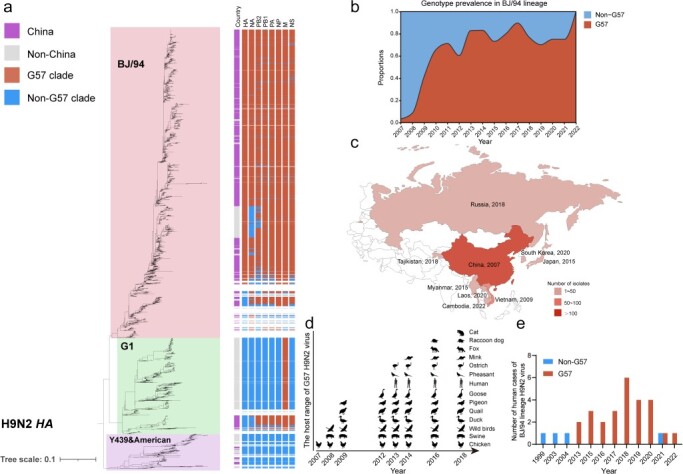
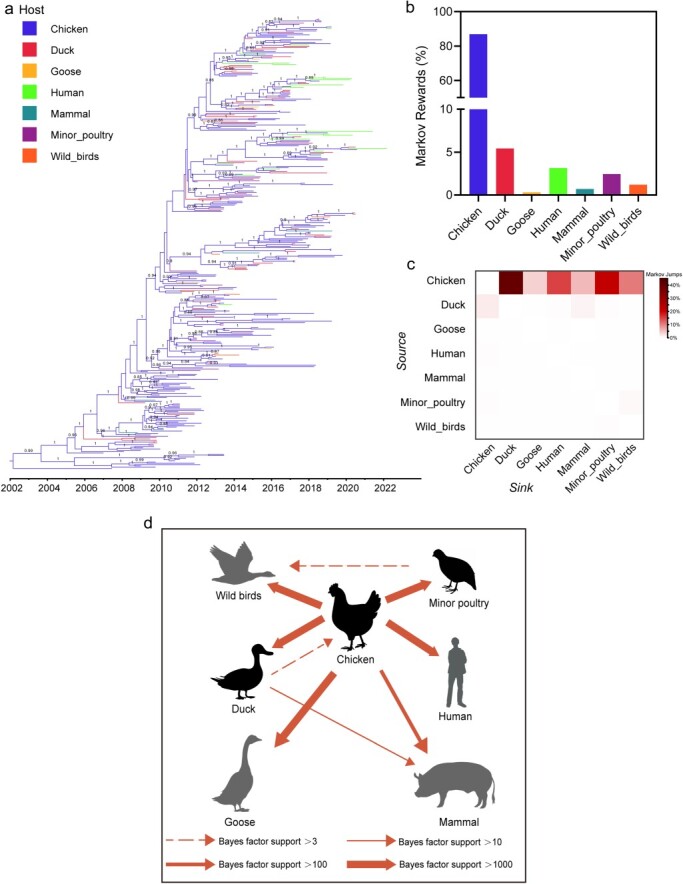
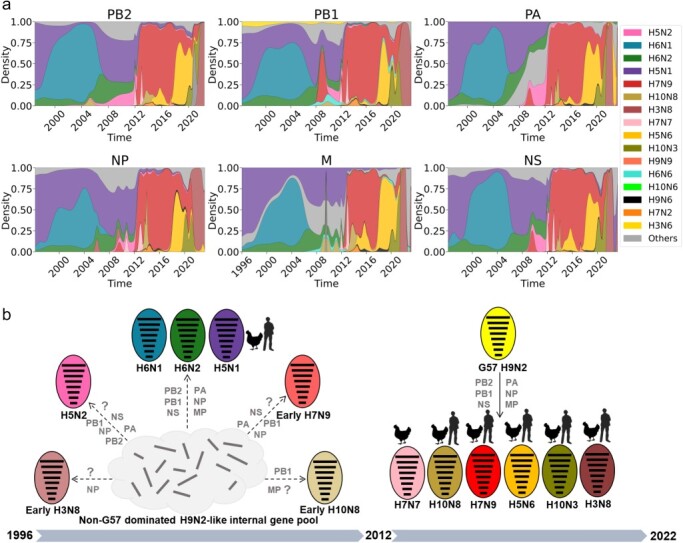
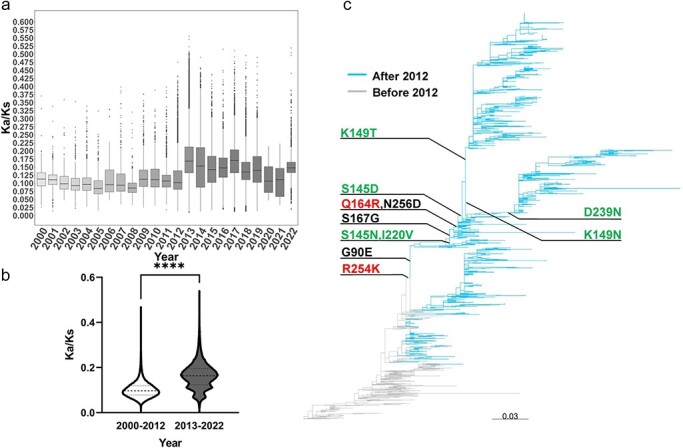
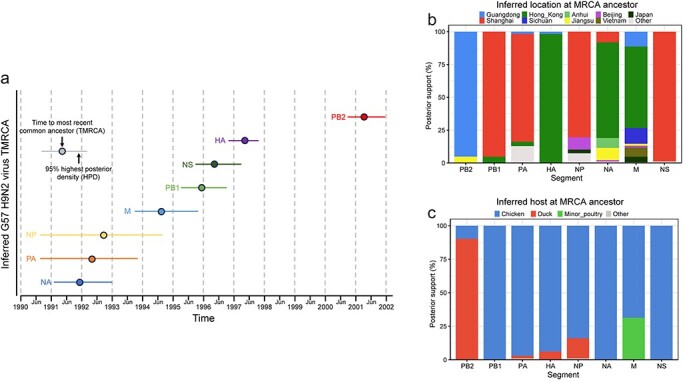
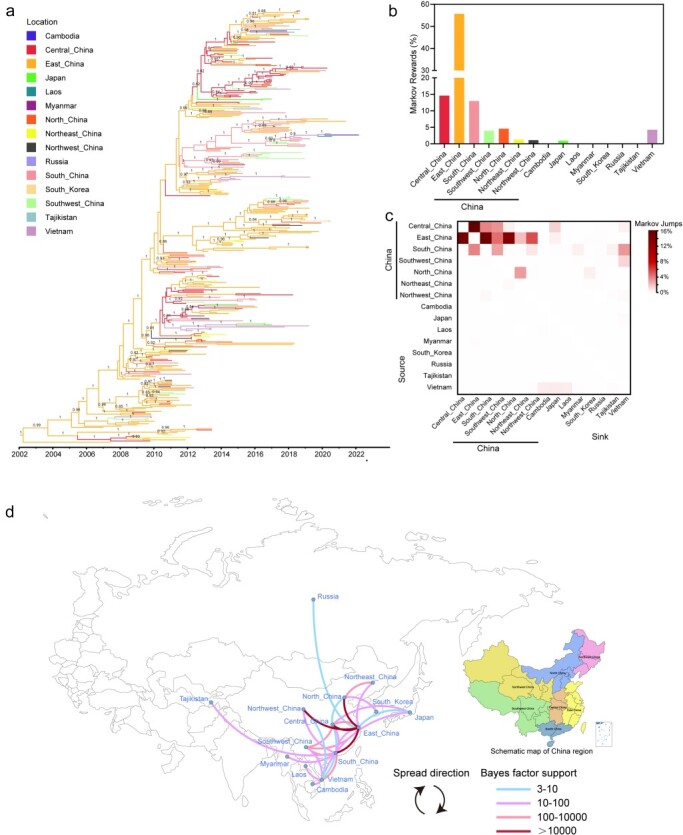
The H9N2 subtype of avian influenza viruses (AIVs) is widely prevalent in poultry and wild birds globally, with occasional transmission to humans. In comparison to other H9N2 lineages, the BJ/94 lineage has raised more public health concerns; however, its evolutionary dynamics and transmission patterns remain poorly understood. In this study, we demonstrate that over three decades (1994-2023), BJ/94 lineage has undergone substantial expansion in its geographical distribution, interspecies transmission, and viral reassortment with other AIV subtypes, increasing associated public health risks. These changes were primarily driven by the emergence of a dominant genotype G57. In the first decade, G57 emerged in East China and rapidly adapted to chickens and spread across China. Since 2013, the G57 genotype has expanded beyond China into eight other countries and reassorted with various AIV subtypes to form new zoonotic reassortants. Chickens have played a key role in the generation and circulation of the G57 viruses, with ducks and other poultry species likely assuming an increasingly importantly role. Over the past decade, G57 has been more frequently detected in wild birds, mammals, and humans. Additionally, Vietnam has emerged as a new hotspot for the international spread of G57. Our results suggest that the BJ/94 lineage H9N2 virus may continue to overcome geographical and species barriers, with potentially more severe consequences.
H9N2亚型禽流感病毒(AIV)在全球家禽和野鸟中广泛流行,偶尔会传播给人类。与其他H9N2谱系相比,BJ/94谱系引发了更多的公共卫生关注;然而,其进化动态和传播模式仍知之甚少。在本研究中,我们证明在三十年(1994 - 2023年)间,BJ/94谱系在地理分布、种间传播以及与其他AIV亚型的病毒重配方面经历了大幅扩张,增加了相关的公共卫生风险。这些变化主要由优势基因型G57的出现驱动。在第一个十年中,G57出现在中国东部,并迅速适应鸡群并在中国传播。自2013年以来,G57基因型已从中国扩展到其他八个国家,并与各种AIV亚型重配形成新的人畜共患重配病毒。鸡在G57病毒的产生和传播中发挥了关键作用,鸭子和其他家禽物种可能也发挥着越来越重要的作用。在过去十年中,G57在野鸟、哺乳动物和人类中被更频繁地检测到。此外,越南已成为G57国际传播的新热点。我们的结果表明,BJ/94谱系H9N2病毒可能会继续突破地理和物种障碍,可能产生更严重的后果。