Pyrina Maria, Vicedo-Cabrera Ana M, Büeler Dominik, Sivaraj Sidharth, Spirig Christoph, Domeisen Daniela I V
Institute for Atmospheric and Climate Science, ETH Zurich Zurich Switzerland.
Center for Climate Systems Modeling (C2SM) Zurich Switzerland.
Geohealth. 2024 Dec 25;9(1):e2024GH001199. doi: 10.1029/2024GH001199. eCollection 2025 Jan.
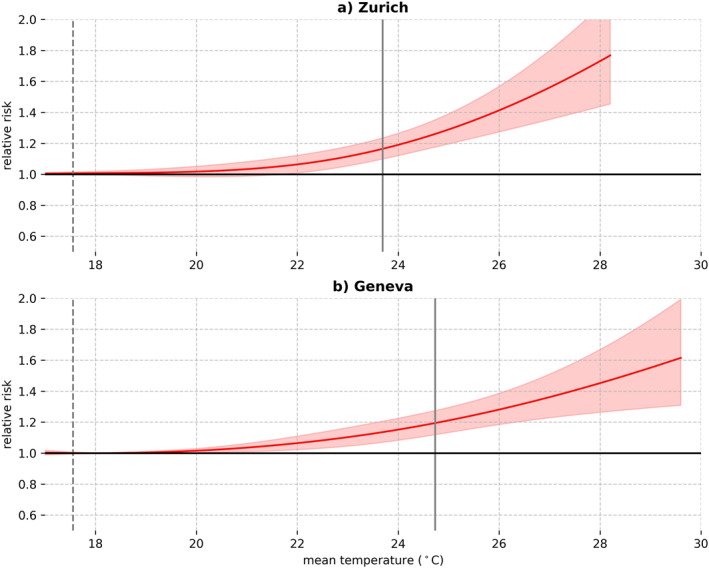
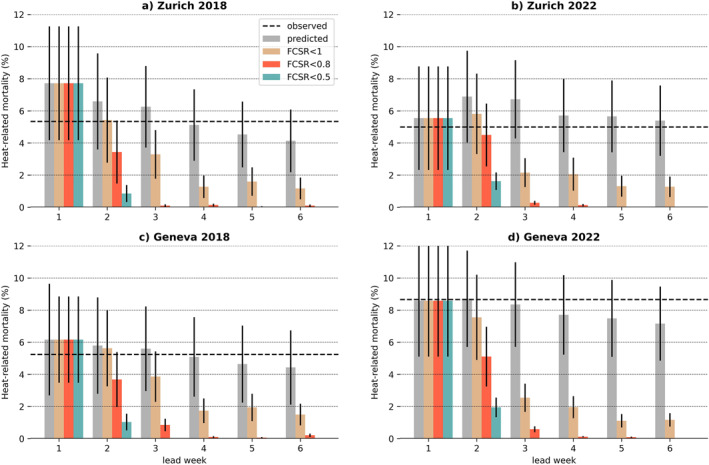
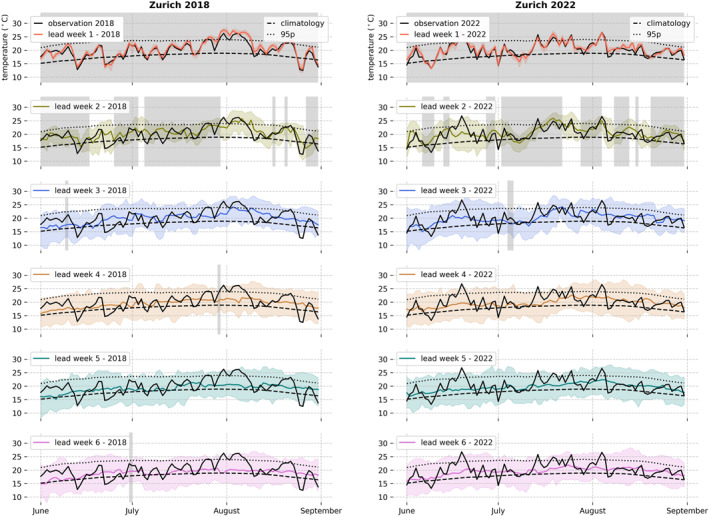
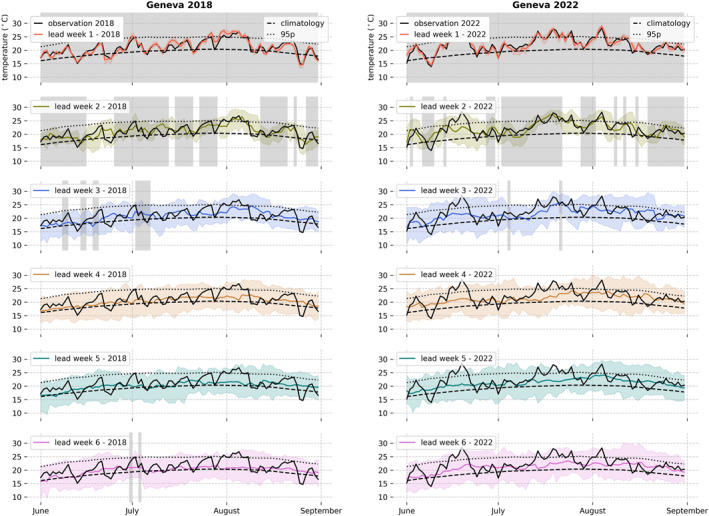
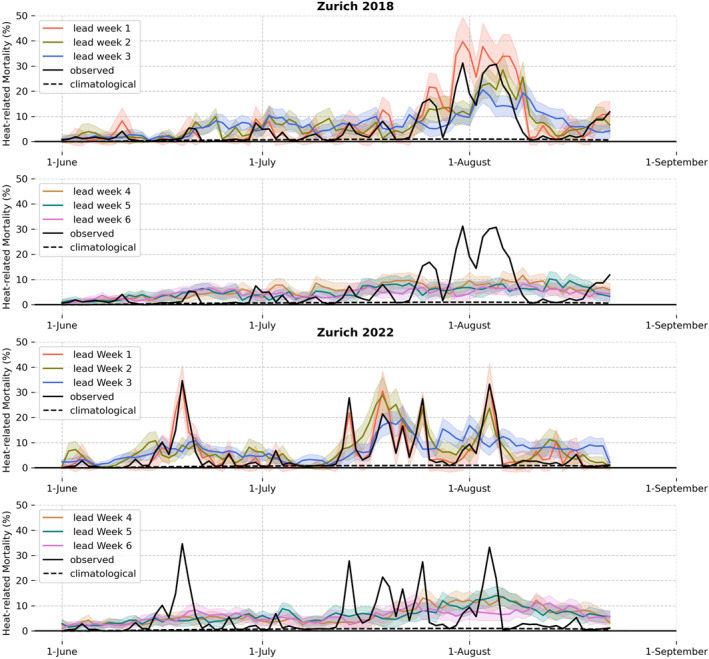
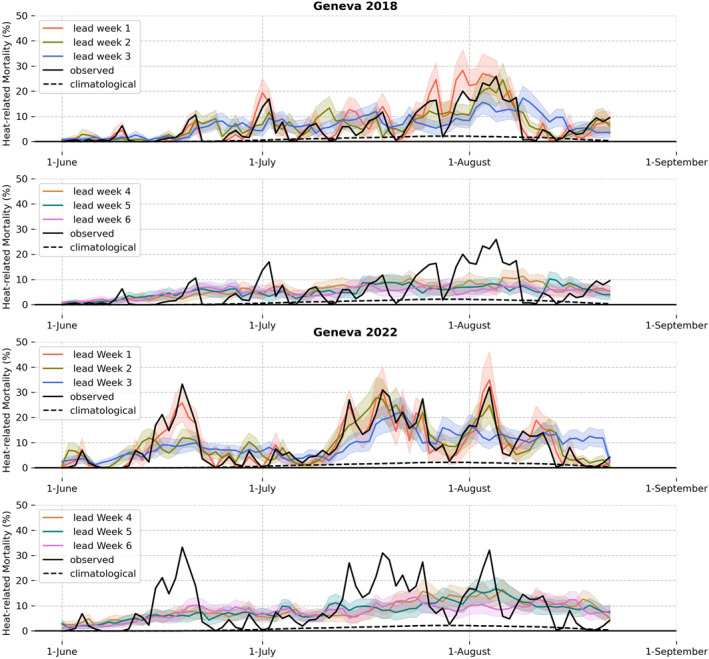
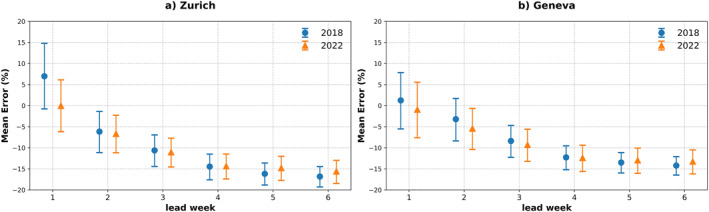
Heatwaves pose a range of severe impacts on human health, including an increase in premature mortality. The summers of 2018 and 2022 are two examples with record-breaking temperatures leading to thousands of heat-related excess deaths in Europe. Some of the extreme temperatures experienced during these summers were predictable several weeks in advance by subseasonal forecasts. Subseasonal forecasts provide weather predictions from 2 weeks to 2 months ahead, offering advance planning capabilities. Nevertheless, there is only limited assessment of the potential for heat-health warning systems at a regional level on subseasonal timescales. Here we combine methods of climate epidemiology and subseasonal forecasts to retrospectively predict the 2018 and 2022 heat-related mortality for the cantons of Zurich and Geneva in Switzerland. The temperature-mortality association for these cantons is estimated using observed daily temperature and mortality during summers between 1990 and 2017. The temperature-mortality association is subsequently combined with bias-corrected subseasonal forecasts at a spatial resolution of 2-km to predict the daily heat-related mortality counts of 2018 and 2022. The mortality predictions are compared against the daily heat-related mortality estimated based on observed temperature during these two summers. Heat-related mortality peaks occurring for a few days can be accurately predicted up to 2 weeks ahead, while longer periods of heat-related mortality lasting a few weeks can be anticipated 3 to even 4 weeks ahead. Our findings demonstrate that subseasonal forecasts are a valuable-but yet untapped-tool for potentially issuing warnings for the excess health burden observed during central European summers.
热浪对人类健康造成一系列严重影响,包括过早死亡率上升。2018年和2022年的夏季就是两个例子,创纪录的气温导致欧洲数千人因高温死亡。在这些夏季期间经历的一些极端气温在提前几周就可以通过次季节预测进行预报。次季节预测提供提前2周至2个月的天气预报,具备提前规划能力。然而,在次季节时间尺度上,对区域层面的热健康预警系统潜力的评估还很有限。在此,我们结合气候流行病学方法和次季节预测,回顾性地预测瑞士苏黎世和日内瓦州2018年和2022年与高温相关的死亡率。利用1990年至2017年夏季观测到的每日气温和死亡率来估算这些州的气温与死亡率之间的关联。随后将气温与死亡率之间的关联与经偏差校正的2公里空间分辨率的次季节预测相结合,以预测2018年和2022年每日与高温相关死亡人数。将死亡率预测结果与基于这两个夏季观测气温估算的每日与高温相关死亡率进行比较。持续数天的与高温相关的死亡高峰可提前2周准确预测,而持续数周的较长时间的与高温相关的死亡率可提前3至4周预测。我们的研究结果表明,次季节预测是一种有价值但尚未得到充分利用的工具,有可能对中欧夏季期间观察到的额外健康负担发出预警。