Eunice Lo Y T, Mitchell Dann M, Buzan Jonathan R, Zscheischler Jakob, Schneider Rochelle, Mistry Malcolm N, Kyselý Jan, Lavigne Éric, da Silva Susana Pereira, Royé Dominic, Urban Aleš, Armstrong Ben, Gasparrini Antonio, Vicedo-Cabrera Ana M
School of Geographical Sciences, University of Bristol, Bristol, UK.
Cabot Institute for the Environment, University of Bristol, Bristol, UK.
Int J Climatol. 2023 Jul 12;43(12):5553-68. doi: 10.1002/joc.8160.
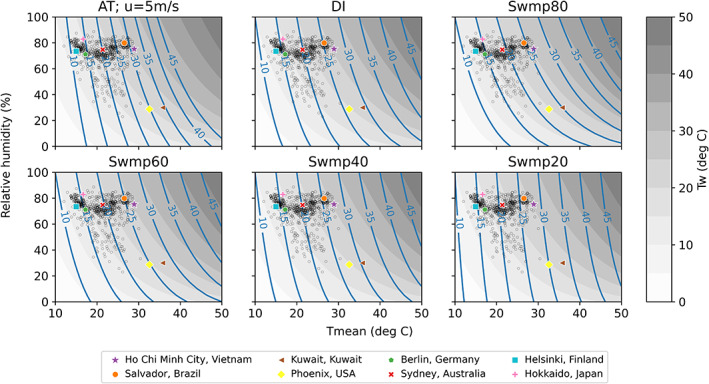
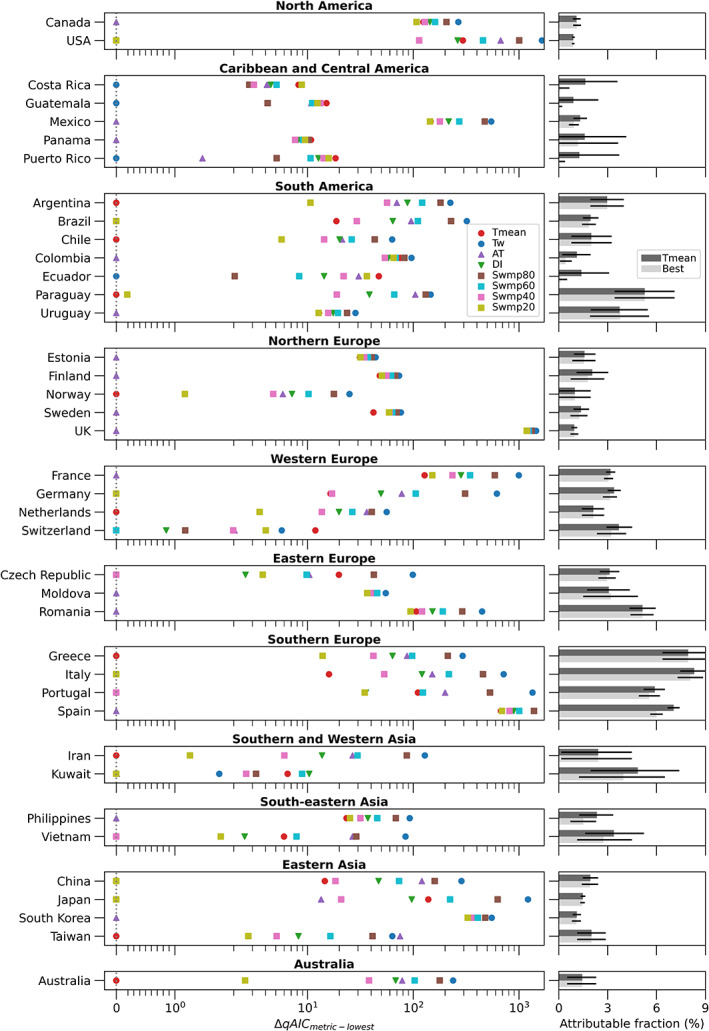
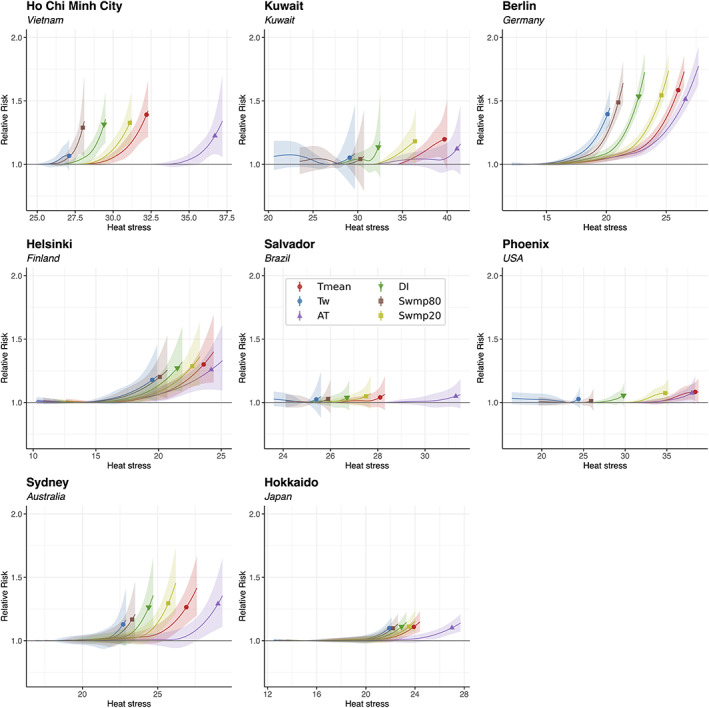
Combined heat and humidity is frequently described as the main driver of human heat-related mortality, more so than dry-bulb temperature alone. While based on physiological thinking, this assumption has not been robustly supported by epidemiological evidence. By performing the first systematic comparison of eight heat stress metrics (i.e., temperature combined with humidity and other climate variables) with warm-season mortality, in 604 locations over 39 countries, we find that the optimal metric for modelling mortality varies from country to country. Temperature metrics with no or little humidity modification associates best with mortality in ~40% of the studied countries. Apparent temperature (combined temperature, humidity and wind speed) dominates in another 40% of countries. There is no obvious climate grouping in these results. We recommend, where possible, that researchers use the optimal metric for each country. However, dry-bulb temperature performs similarly to humidity-based heat stress metrics in estimating heat-related mortality in present-day climate.
湿热通常被认为是与人类高温相关死亡率的主要驱动因素,比单纯的干球温度影响更大。虽然这一假设基于生理学原理,但尚未得到流行病学证据的有力支持。通过对39个国家604个地点的八个热应激指标(即温度与湿度及其他气候变量的组合)与暖季死亡率进行首次系统比较,我们发现用于模拟死亡率的最佳指标因国家而异。在约40%的研究国家中,未作或几乎未作湿度修正的温度指标与死亡率的关联最佳。体感温度(结合了温度、湿度和风速)在另外40%的国家中占主导地位。这些结果中没有明显的气候分组。我们建议,在可能的情况下,研究人员针对每个国家使用最佳指标。然而,在估算当前气候下与高温相关的死亡率时,干球温度与基于湿度的热应激指标表现相当。