Wang Yongqiang, Feng Xiaochen, Chai Yulin, Chen Kexuan, Yang Shilan, Li Wei, Mi Yuqing
School of Management, Shandong Second Medical University, Weifang, China.
School of Public Health, Shandong Second Medical University, Weifang, China.
Front Public Health. 2024 Dec 16;12:1513188. doi: 10.3389/fpubh.2024.1513188. eCollection 2024.
Improving system coordination is a pivotal strategy and a critical pathway for social governance. Chinese society is currently facing a significant challenge in aligning the allocation of health resources with economic development. Evaluating the level of coordinated development within the system can provide valuable insights to support the construction of a more coordinated China and foster high-quality development.
Based on a systematically constructed indicator framework, our study selected data from five eastern provinces of China to establish a ten-year panel dataset covering the period from 2011 to 2020. The comprehensive evaluation index and the relative development degree were employed to comprehensively evaluate the development level of the system. The coupling coordination degree model was applied to analyze the coupling coordination relationship and spatiotemporal evolution trend of the two systems. Additionally, the fixed effects model was used to identify the driving factors behind the coordinated development of the two systems.
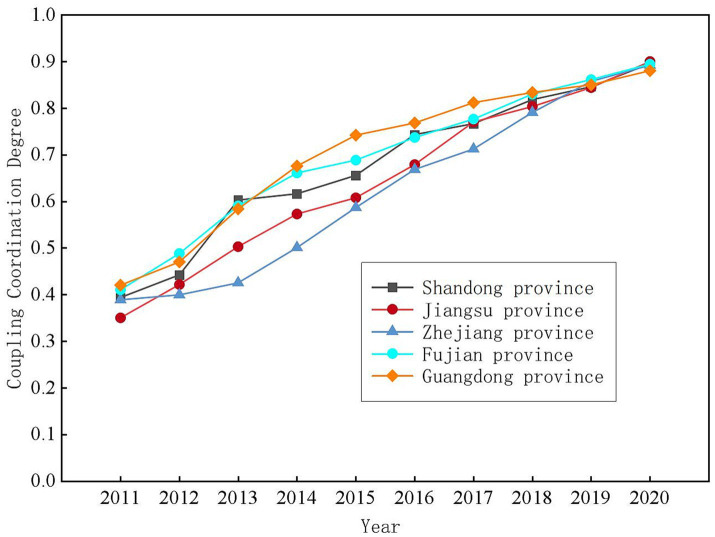
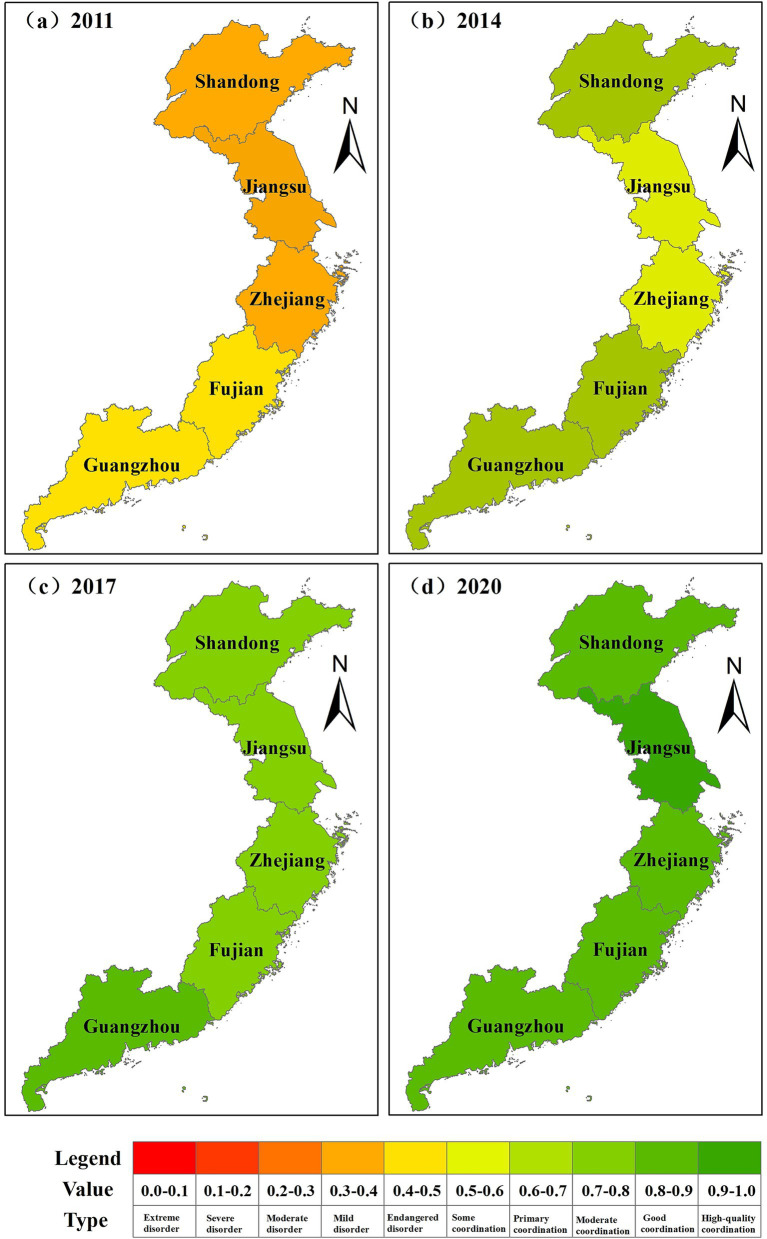
From 2011 to 2020, the comprehensive indices of health resource allocation and economic development in the five eastern provinces of China exhibited a consistent year-on-year increase, and the relative development degree experienced two critical values of 0.8 and 1.2, which changed from the lagging allocation of health resources to the lagging economic development. The system coordination index generally ranged between 0.35 and 0.90, with the coordination phase undergoing a transition from an antagonistic stage to a coordinated stage. The coordination type also gradually shifted from mild imbalance to good coordination. Furthermore, the levels of economic development, economic structure, technological investment, as well as the allocation of health human and material resources, all serve as critical drivers in enhancing the coordinated development of the system.
The coordinated development of eastern China's provinces produces substantial spillover effects, and the realization of a Healthy China initiative must strategically harness their radiative and demonstrative effects. Achieving a superior level of coordination requires urgent efforts to rectify the existing deficiencies in the distribution of grassroots healthcare resources. Furthermore, cultivating innovative drivers of economic growth and enhancing the capacity for economic support are critical to ensuring high-quality and sustainable development.
改善系统协调是社会治理的关键战略和重要途径。中国社会目前在使卫生资源分配与经济发展相匹配方面面临重大挑战。评估系统内的协调发展水平可为建设更加协调的中国和促进高质量发展提供有价值的见解。
基于系统构建的指标框架,我们的研究选取了中国东部五个省份的数据,建立了一个涵盖2011年至2020年的十年面板数据集。采用综合评价指数和相对发展度对系统的发展水平进行综合评价。运用耦合协调度模型分析两个系统的耦合协调关系及时空演变趋势。此外,使用固定效应模型来确定两个系统协调发展背后的驱动因素。
2011年至2020年,中国东部五个省份的卫生资源配置和经济发展综合指数呈逐年上升趋势,相对发展度经历了0.8和1.2两个临界值,从卫生资源配置滞后转变为经济发展滞后。系统协调指数一般在0.35至0.90之间,协调阶段从拮抗阶段向协调阶段转变。协调类型也逐渐从轻度失衡转变为良好协调。此外,经济发展水平、经济结构、技术投入以及卫生人力和物力资源配置,都是促进系统协调发展的关键驱动因素。
中国东部省份的协调发展产生了巨大的溢出效应,实现健康中国倡议必须从战略上利用其辐射和示范效应。要达到更高水平的协调,迫切需要努力纠正基层医疗资源分配中存在的不足。此外,培育经济增长的创新驱动力和增强经济支撑能力对于确保高质量和可持续发展至关重要。