Wang Feng, Zhou Hengzhu, Lv Chengcheng, Song Xiaokang
School of Management, Xuzhou Medical University, Xuzhou, China.
Front Public Health. 2025 Jun 25;13:1578827. doi: 10.3389/fpubh.2025.1578827. eCollection 2025.
Analyze the distribution equilibrium of older adult meal service facilities in mainland China and explore the factors influencing their distribution.
Use Python to obtain data on older adult meal service facilities, and analyze the equity of older adult meal services using descriptive statistics, the Lorenz curve, the Gini coefficient, and the Spatial Mismatch Index (SMI). A multiple linear regression model was applied to explore the relationships between older adult meal services and factors such as population, economy, infrastructure, geography, and policies.
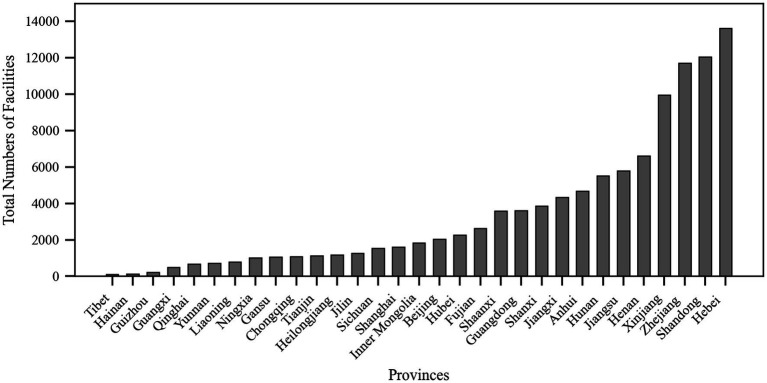
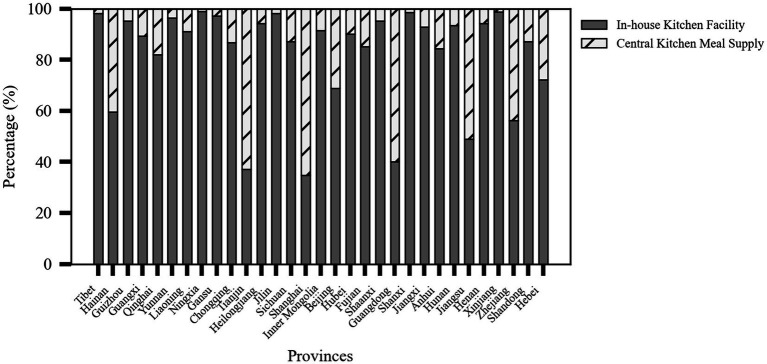
The vast majority (85.26%) of older adult meal service facilities in mainland China are located at the community or village level, with the number of rural facilities significantly higher than that in urban areas. Most of these facilities are self-operated, and those with in-house kitchens dominate. The distribution of older adult meal services across mainland China was uneven, with a Gini coefficient of 0.418, indicating a substantial disparity in the allocation of service resources. The Spatial Mismatch Index (SMI) varied significantly among provinces, reflecting a considerable mismatch between the current supply of older adult meal service facilities and the actual demand of the older adult population. Analysis of influencing factors reveals that the number and coverage level of older adult meal service facilities were significantly negatively correlated with the size of the older adult population, the older adult dependency ratio, and GDP.
The equity of older adult meal services still needs improvement. The planning and implementation of meal services should place greater emphasis on population demand to ensure that older adult individuals across the country can fairly access the older adult meal services they deserve. Future policy formulation should comprehensively consider factors such as demographic structure, economic development levels, and infrastructure conditions to optimize resource allocation, reduce regional disparities, and enhance service coverage and quality.
分析中国大陆老年助餐服务设施的分布均衡性,探讨影响其分布的因素。
运用Python获取老年助餐服务设施数据,采用描述性统计、洛伦兹曲线、基尼系数和空间错配指数(SMI)分析老年助餐服务的公平性。应用多元线性回归模型探究老年助餐服务与人口、经济、基础设施、地理和政策等因素之间的关系。
中国大陆绝大多数(85.26%)老年助餐服务设施位于社区或村级,农村设施数量显著高于城市地区。这些设施大多为自营,有内部厨房的占主导。中国大陆老年助餐服务分布不均衡,基尼系数为0.418,表明服务资源分配存在较大差距。空间错配指数(SMI)在各省之间差异显著,反映出当前老年助餐服务设施供给与老年人口实际需求之间存在较大错配。影响因素分析显示,老年助餐服务设施数量和覆盖水平与老年人口规模、老年抚养比和国内生产总值显著负相关。
老年助餐服务公平性仍需提升。助餐服务的规划与实施应更注重人口需求,确保全国老年人能够公平获得应有的老年助餐服务。未来政策制定应综合考虑人口结构、经济发展水平和基础设施条件等因素,优化资源配置,缩小区域差距,提高服务覆盖范围和质量。