Heise Verena, Offer Alison, Whiteley William, Mackay Clare E, Armitage Jane M, Parish Sarah
Clinical Trial Service Unit and Epidemiological Studies Unit, Nuffield Department of Population Health, University of Oxford, Oxford, UK.
Medical Research Council Population Health Research Unit, Nuffield Department of Population Health, University of Oxford, Oxford, UK.
Transl Psychiatry. 2024 Mar 12;14(1):143. doi: 10.1038/s41398-024-02848-5.
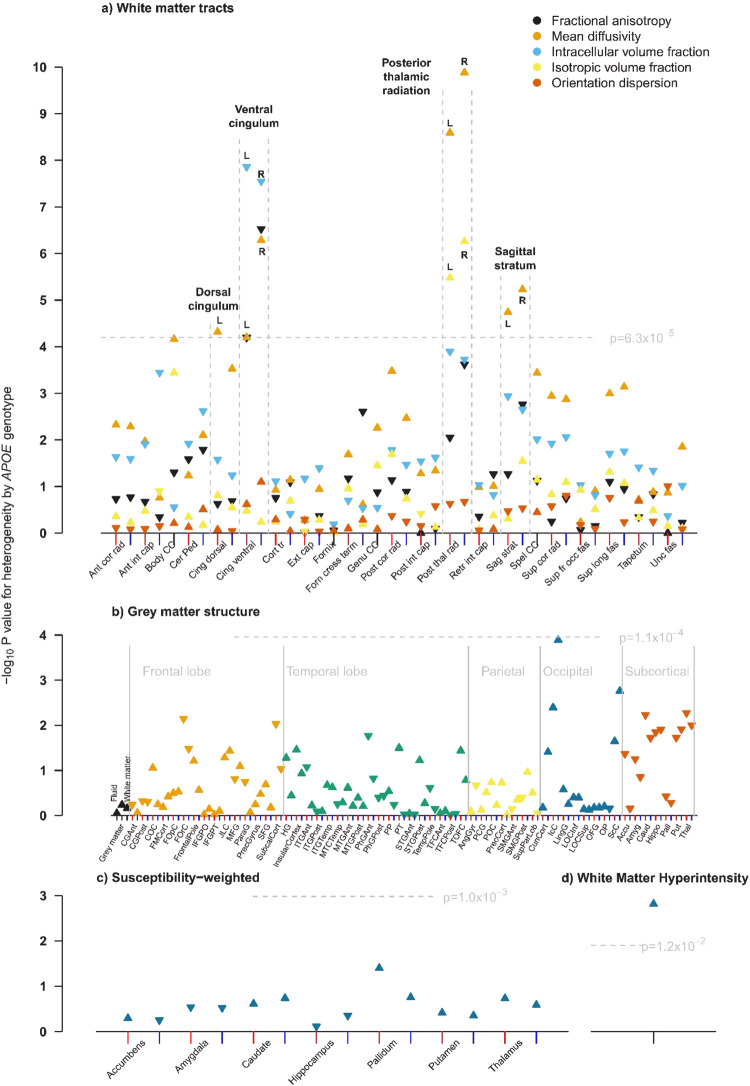
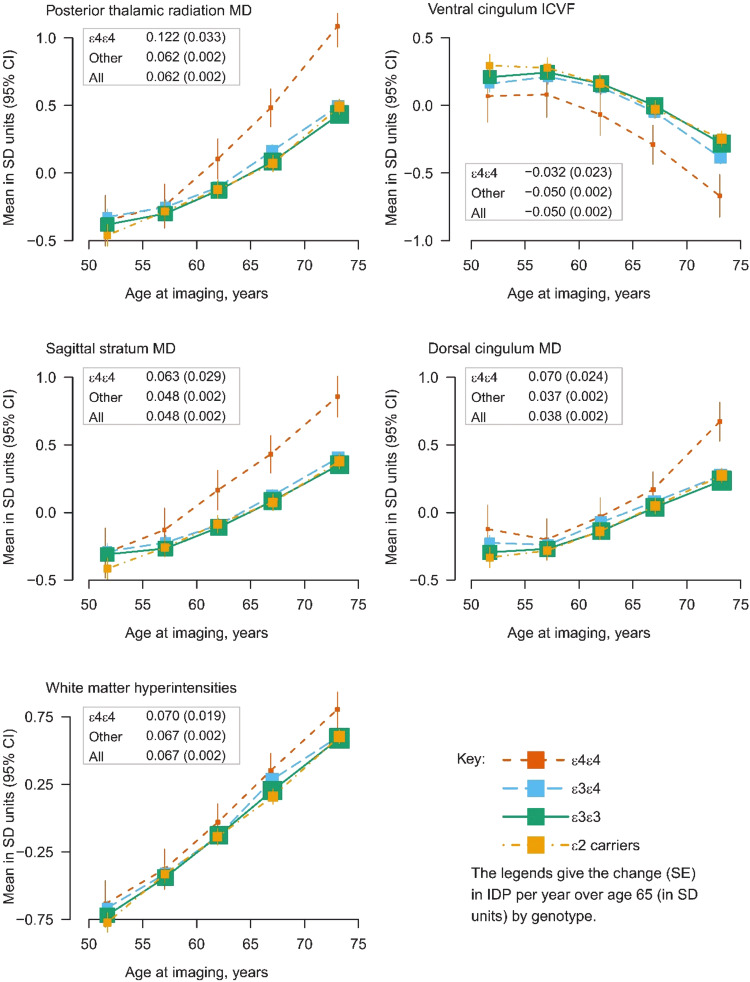
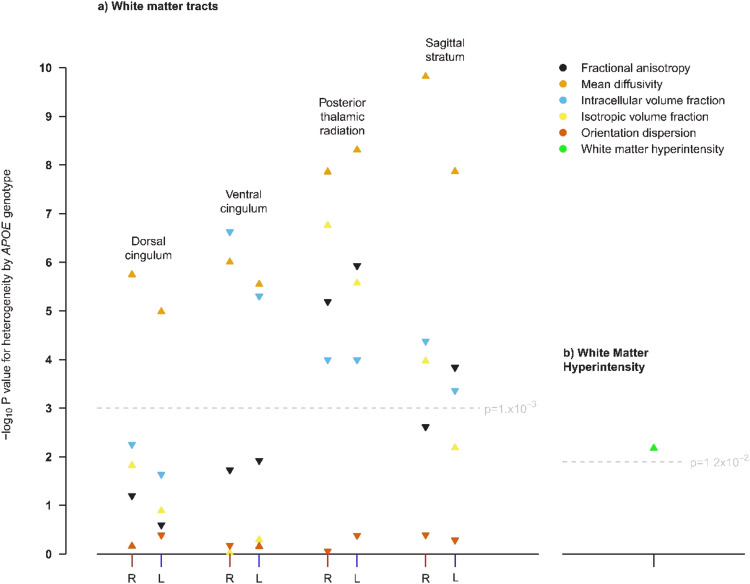
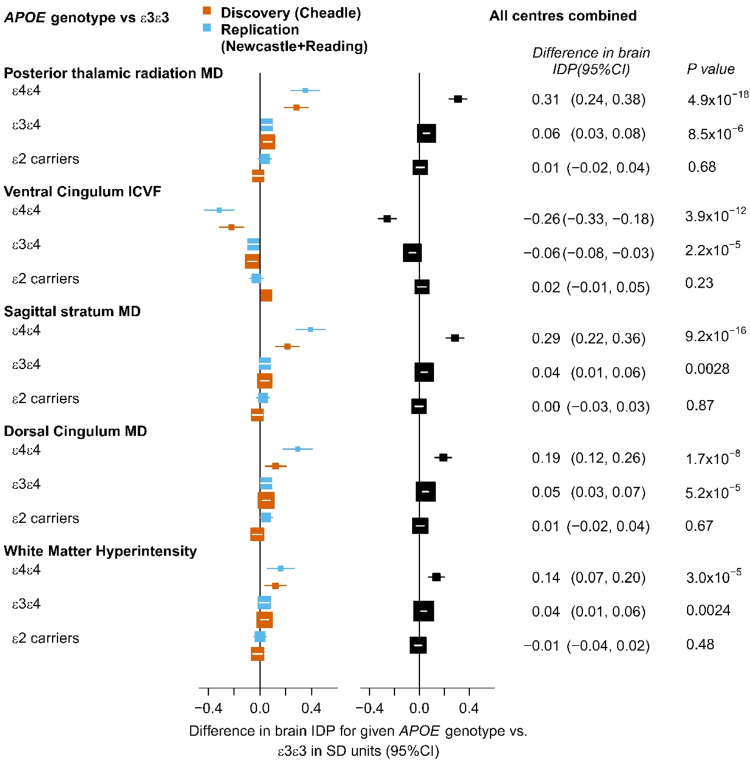
Alzheimer's disease (AD) risk is increased in carriers of the apolipoprotein E (APOE) ε4 allele and decreased in ε2 allele carriers compared with the ε3ε3 genotype. The aim of this study was to determine whether: the APOE genotype affects brain grey (GM) or white matter (WM) structure; and if differences exist, the age when they become apparent and whether there are differential effects by sex. We used cross-sectional magnetic resonance imaging data from ~43,000 (28,494 after pre-processing) white British cognitively healthy participants (7,446 APOE ε4 carriers) aged 45-80 years from the UK Biobank cohort and investigated image-derived phenotypes (IDPs). We observed no statistically significant effects of APOE genotype on GM structure volumes or median T2* in subcortical structures, a measure related to iron content. The volume of white matter hyperintensities differed significantly between APOE genotype groups with higher volumes in APOE ε4ε4 (effect size 0.14 standard deviations [SD]) and ε3ε4 carriers (effect size 0.04 SD) but no differences in ε2 carriers compared with ε3ε3 carriers. WM integrity measures in the dorsal (mean diffusivity [MD]) and ventral cingulum (MD and intracellular volume fraction), posterior thalamic radiation (MD and isotropic volume fraction) and sagittal stratum (MD) indicated lower integrity in APOE ε4ε4 carriers (effect sizes around 0.2-0.3 SD) and ε3ε4 (effect sizes around 0.05 SD) carriers but no differences in ε2 carriers compared with the APOE ε3ε3 genotype. Effects did not differ between men and women. APOE ε4 homozygotes had lower WM integrity specifically at older ages with a steeper decline of WM integrity from the age of 60 that corresponds to around 5 years greater "brain age". APOE genotype affects various white matters measures, which might be indicative of preclinical AD processes. This hypothesis can be assessed in future when clinical outcomes become available.
与ε3ε3基因型相比,载脂蛋白E(APOE)ε4等位基因携带者患阿尔茨海默病(AD)的风险增加,而ε2等位基因携带者的风险降低。本研究的目的是确定:APOE基因型是否影响脑灰质(GM)或白质(WM)结构;如果存在差异,差异在什么年龄变得明显,以及是否存在性别差异效应。我们使用了来自英国生物银行队列的约43000名(预处理后为28494名)45至80岁的英国白人认知健康参与者(7446名APOE ε4携带者)的横断面磁共振成像数据,并研究了图像衍生表型(IDPs)。我们观察到APOE基因型对GM结构体积或皮质下结构中的中位T2*(与铁含量相关的指标)没有统计学上的显著影响。APOE基因型组之间的白质高信号体积存在显著差异,APOE ε4ε4携带者(效应大小为0.14标准差[SD])和ε3ε4携带者(效应大小为0.04 SD)的白质高信号体积更大,但与ε3ε3携带者相比,ε2携带者没有差异。背侧(平均扩散率[MD])和腹侧扣带(MD和细胞内体积分数)、丘脑后辐射(MD和各向同性体积分数)以及矢状层(MD)的WM完整性测量表明,APOE ε4ε4携带者(效应大小约为0.2 - 0.3 SD)和ε3ε4携带者(效应大小约为0.05 SD)的WM完整性较低,但与APOE ε3ε3基因型相比,ε2携带者没有差异。男性和女性之间的效应没有差异。APOE ε4纯合子在老年时WM完整性较低,从60岁起WM完整性下降更为陡峭,这相当于“脑龄”增加约5岁。APOE基因型影响各种白质测量指标,这可能表明临床前AD过程。当未来获得临床结果时,可以对这一假设进行评估。