Jeong Jaeyong, Kim Seong Kwang, Suh Yoon-Je, Lee Jisung, Choi Joonyoung, Kim Joon Pyo, Kim Bong Ho, Park Juhyuk, Shim Joonsup, Rheem Nahyun, Lee Chan Jik, Jo Younjung, Geum Dae-Myeong, Park Seung-Young, Kim Jongmin, Kim Sanghyeon
School of Electrical Engineering, Korea Advanced Institute of Science and Technology (KAIST), Daejeon, Republic of Korea.
Center for Scientific Instrumentation, Korea Basic Science Institute (KBSI), Daejeon, Republic of Korea.
Nat Commun. 2024 Dec 30;15(1):10809. doi: 10.1038/s41467-024-55077-1.
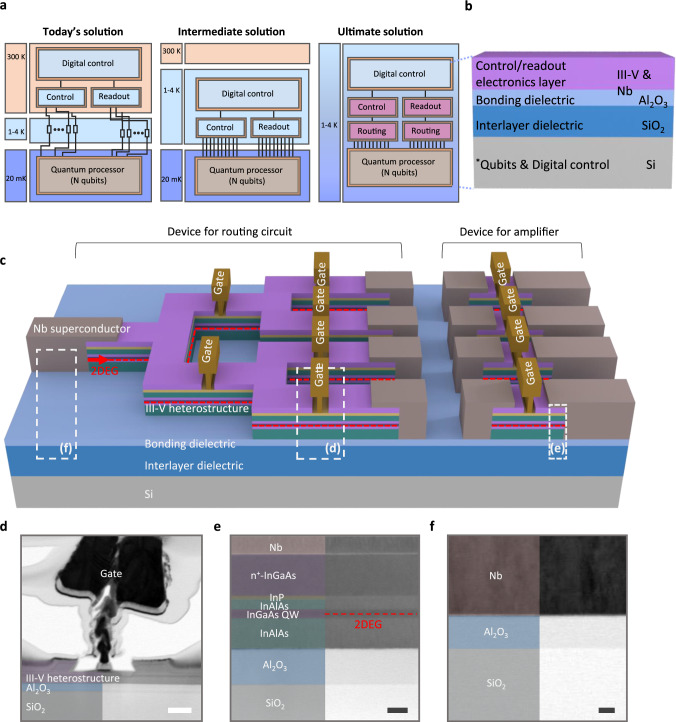
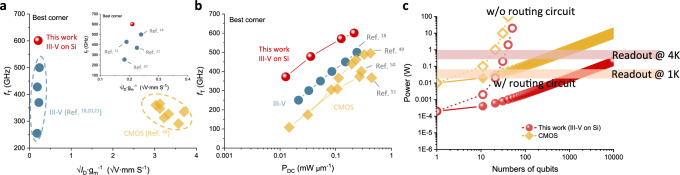
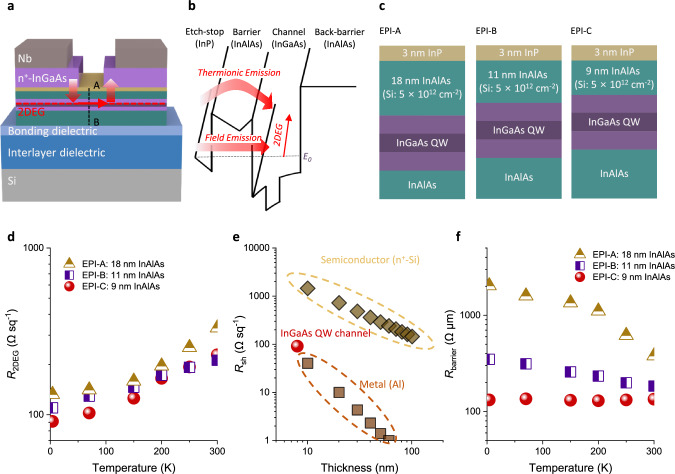
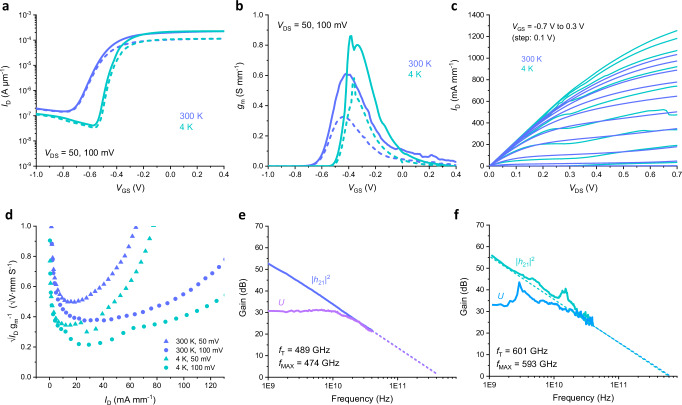
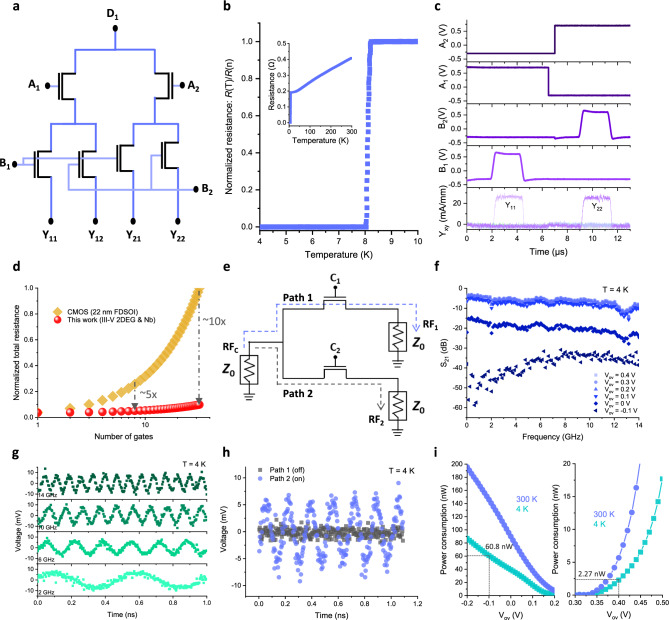
Quantum computers now encounter the significant challenge of scalability, similar to the issue that classical computing faced previously. Recent results in high-fidelity spin qubits manufactured with a Si CMOS technology, along with demonstrations that cryogenic CMOS-based control/readout electronics can be integrated into the same chip or die, opens up an opportunity to break out the challenges of qubit size, I/O, and integrability. However, the power consumption of cryogenic CMOS-based control/readout electronics cannot support thousands or millions of qubits. Here, we show that III-V two-dimensional electron gas and Nb superconductor-based cryogenic electronics can be integrated with Si and operate at extremely low power levels, enabling the control and readout for millions of qubits. Our devices offer a unity gain cutoff frequency of 601 GHz, a unity power gain cutoff frequency of 593 GHz, and a low noise indication factor of at 4 K using more than 10 times less power consumption than CMOS.
量子计算机目前面临着与经典计算之前所面临的问题类似的重大可扩展性挑战。近期采用硅互补金属氧化物半导体(Si CMOS)技术制造的高保真自旋量子比特的成果,以及基于低温CMOS的控制/读出电子器件可集成到同一芯片或管芯的演示,为突破量子比特尺寸、输入/输出和可集成性的挑战带来了机遇。然而,基于低温CMOS的控制/读出电子器件的功耗无法支持数千或数百万个量子比特。在此,我们展示了基于III-V族二维电子气和铌超导体的低温电子器件可与硅集成,并在极低功率水平下运行,从而实现对数百万个量子比特的控制和读出。我们的器件在4K温度下具有601 GHz的单位增益截止频率、593 GHz的单位功率增益截止频率以及低噪声指示因子,且功耗比CMOS低10倍以上。