Deligiannis Theodore, Barfi Mahsa, Schlattmann Brian, Kiyono Ken, Kelty-Stephen Damian G, Mangalam Madhur
Division of Biomechanics and Research Development, Department of Biomechanics, and Center for Research in Human Movement Variability, University of Nebraska at Omaha, Omaha, NE, 68182, USA.
Graduate School of Engineering Science, Osaka University, Osaka, 560-8531, Japan.
Sci Rep. 2024 Dec 30;14(1):31819. doi: 10.1038/s41598-024-83101-3.
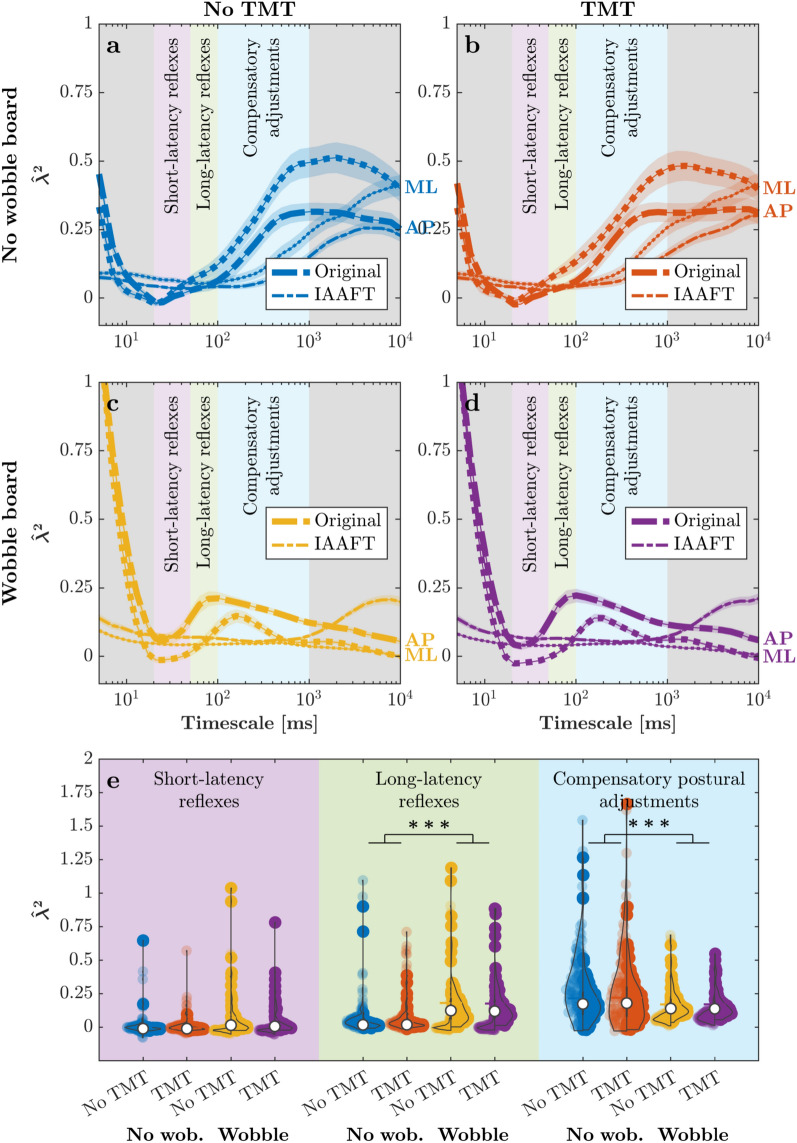
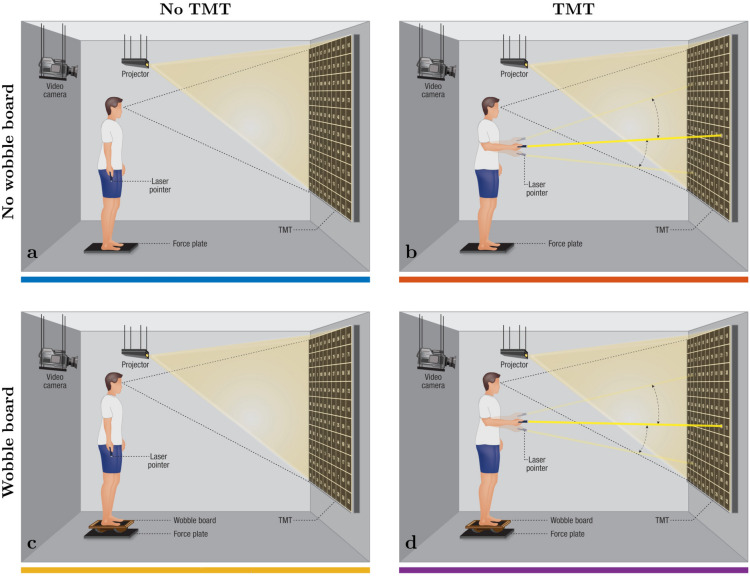
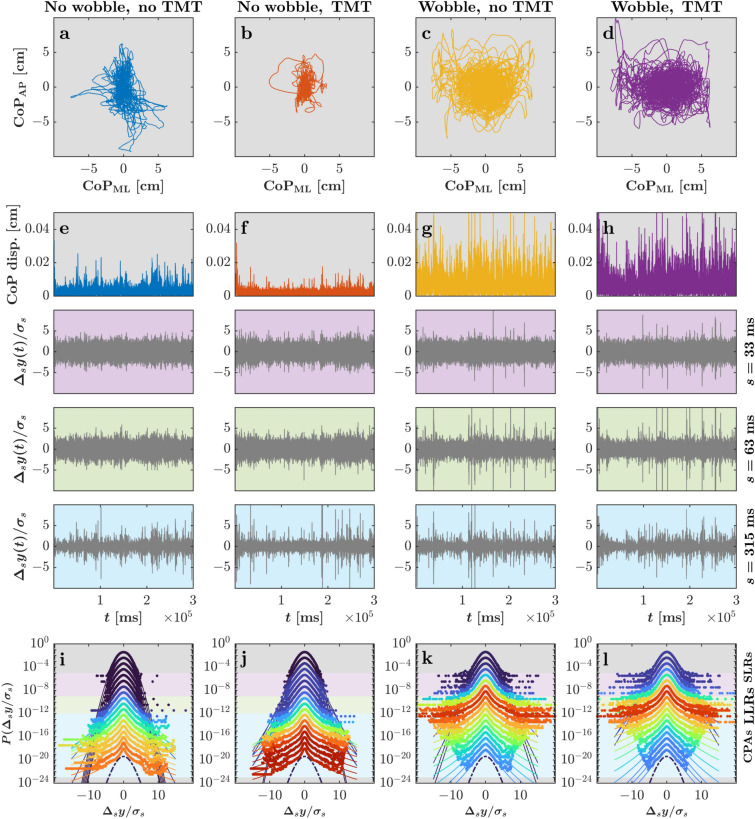
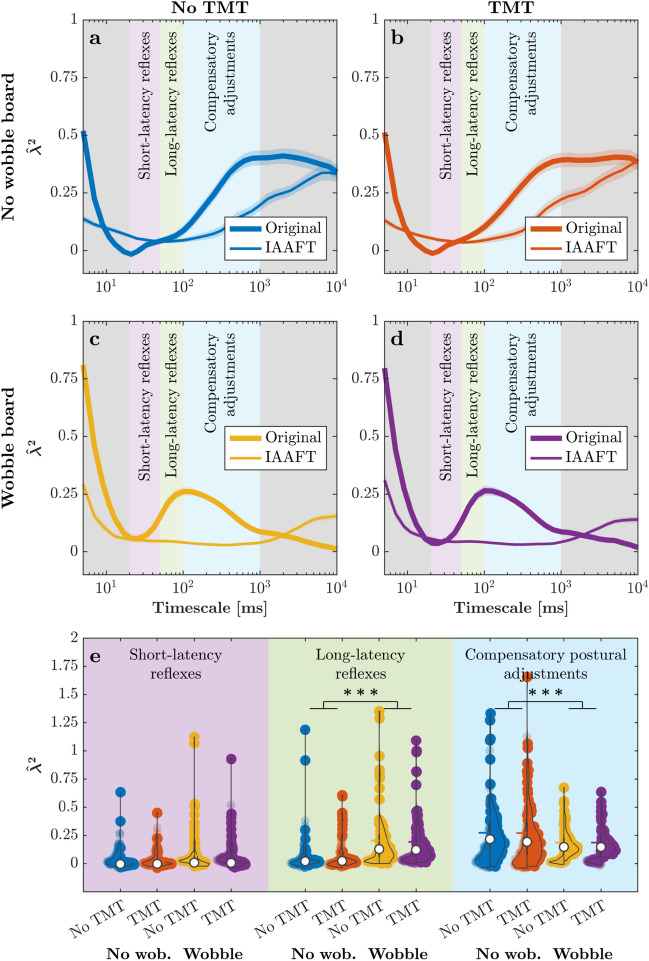
Long-latency reflexes (LLRs) are critical precursors to intricate postural coordination of muscular adaptations that sustain equilibrium following abrupt disturbances. Both disturbances and adaptive responses reflect excursions of postural control from quiescent Gaussian stability under a narrow bell curve, excursions beyond Gaussianity unfolding at many timescales. LLRs slow with age, accentuating the risk of falls and undermining dexterity, particularly in settings with concurrent additional tasks. We investigated whether the wobble board could cultivate the engagement of LLRs selectively in healthy young participants executing a suprapostural Trail Making Task (TMT). A concurrent additional-task demand constituted visual precision predominantly along the anteroposterior (AP) axis and mechanical instability mainly along the mediolateral (ML) axis. We scrutinized planar center-of-pressure (CoP) trajectories to quantify postural non-Gaussianity across various temporal scales. Wobble board increased engagement of LLRs and decreased engagement of compensatory postural adjustments (CPAs), indicated by the peak in non-Gaussianity of CoP planar displacements over LLR-specific timescales (50-100 ms) and non-Gaussianity of CoP planar displacements progressively diminishing over CPA-specific timescales ([Formula: see text] ms). Engagement with TMT did not show any noticeable influence on non-Gaussian postural sway patterns. Despite aligning the unstable axis of the wobble board with participants' ML axis, thus rendering posture more unstable along the ML axis, the wobble board increased engagement of LLRs significantly more along the AP axis and reduced engagement of CPAs significantly more along the ML axis. These findings offer initial mechanistic insights into how wobble boards may bolster balance and potentially reduce the occurrence of falls by catalyzing the engagement of LLRs selectively.
长潜伏期反射(LLRs)是复杂肌肉适应性姿势协调的关键先兆,这些适应性变化能在突然受到干扰后维持平衡。干扰和适应性反应都反映了姿势控制在狭窄钟形曲线下从静态高斯稳定性的偏离,这种超出高斯性的偏离在多个时间尺度上展开。LLRs会随着年龄增长而变慢,这加剧了跌倒风险并损害灵活性,尤其是在同时执行额外任务的情况下。我们研究了在执行超姿势连线测验任务(TMT)的健康年轻参与者中,摇摆板是否能选择性地促进LLRs的参与。同时存在的额外任务需求主要包括沿前后(AP)轴的视觉精度和主要沿内外侧(ML)轴的机械不稳定性。我们仔细研究了平面压力中心(CoP)轨迹,以量化不同时间尺度上的姿势非高斯性。摇摆板增加了LLRs的参与度,并减少了代偿性姿势调整(CPAs)的参与度,这表现为在LLR特定时间尺度(50 - 100毫秒)上CoP平面位移的非高斯性峰值,以及在CPA特定时间尺度([公式:见正文]毫秒)上CoP平面位移的非高斯性逐渐减小。参与TMT对非高斯姿势摇摆模式没有显示出任何明显影响。尽管将摇摆板的不稳定轴与参与者的ML轴对齐,从而使姿势在ML轴上更不稳定,但摇摆板在AP轴上显著增加LLRs参与度的幅度更大,在ML轴上显著减少CPAs参与度的幅度更大。这些发现为摇摆板如何通过选择性地促进LLRs的参与来增强平衡并潜在降低跌倒发生率提供了初步的机制性见解。