Molnar Andras, Paolacci Gabriele
Department of Psychology, University of Michigan, 530 Church Street, Ann Arbor, MI, 48109, USA.
Rotterdam School of Management, Erasmus University, Burgemeester Oudlaan 50, 3062 PA, Rotterdam, The Netherlands.
Sci Rep. 2024 Dec 30;14(1):31980. doi: 10.1038/s41598-024-83621-y.
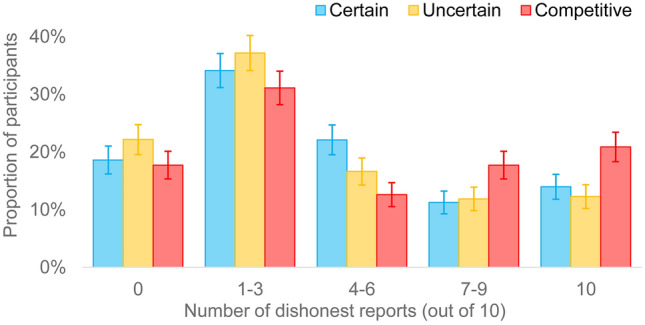
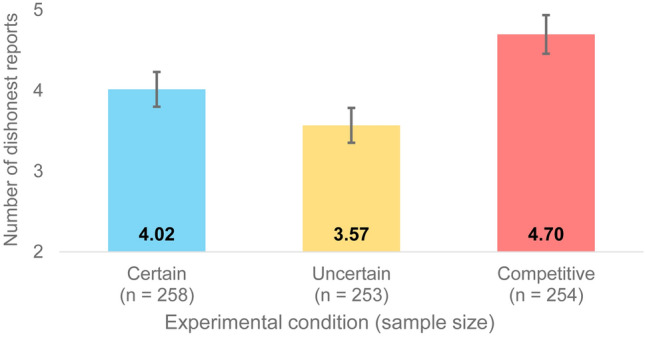
Does competition increase cheating? This question has been investigated by both psychologists and economists in the past and received conflicting answers. Notably, prior experimental work compared how people behaved under competitive and non-competitive tasks that were associated with different levels of uncertainty about the reward that people would receive. We aim to experimentally disentangle the effect of competition from the effects of uncertain rewards. We conducted an incentivized, pre-registered study featuring real-time interaction between participants (N = 765). We introduce an uncertain non-competitive incentive scheme along with the certain non-competitive scheme and the (uncertain) competitive scheme. We find that competition significantly increases the magnitude (but not the prevalence) of cheating relative to both non-competitive schemes, with the effect of competition being larger when the level of uncertainty is held constant across schemes.
竞争会增加作弊行为吗?过去,心理学家和经济学家都对这个问题进行了研究,但得到了相互矛盾的答案。值得注意的是,之前的实验工作比较了人们在与获得奖励的不同不确定性水平相关的竞争性和非竞争性任务中的行为表现。我们旨在通过实验区分竞争的影响与不确定奖励的影响。我们进行了一项有激励措施、预先注册的研究,参与者(N = 765)之间进行实时互动。我们引入了一种不确定的非竞争性激励方案以及确定的非竞争性方案和(不确定的)竞争性方案。我们发现,相对于两种非竞争性方案,竞争显著增加了作弊的程度(但不是发生率),并且当各方案的不确定性水平保持不变时,竞争的影响更大。