Zhang Xuejing, Zhao Ning, Zhang Hanqi, Fan Yiming, Jin Feng, Li Chunsheng, Sun Yan, Wang Jiaqi, Chen Ming, Hu Xiaofei
School of Environmental and Chemical Engineering, Jiangsu University of Science and Technology, Zhenjiang, 212003, People's Republic of China.
Engineering Research Center of Energy Storage Materials and Devices, Ministry of Education, School of Chemistry, Xi'an Jiaotong University, Xi'an, 710049, People's Republic of China.
Nanomicro Lett. 2024 Dec 30;17(1):99. doi: 10.1007/s40820-024-01607-x.
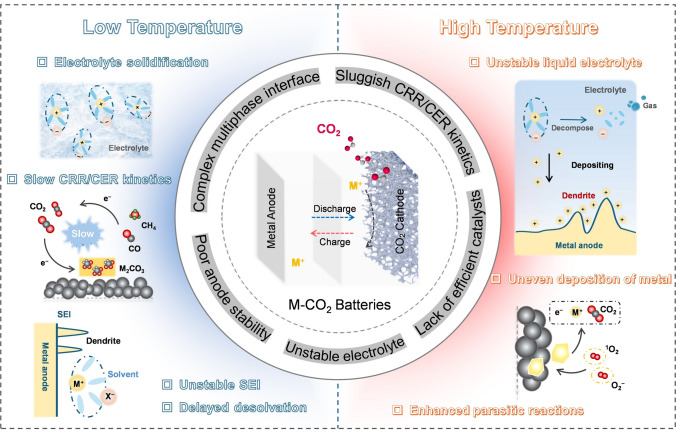
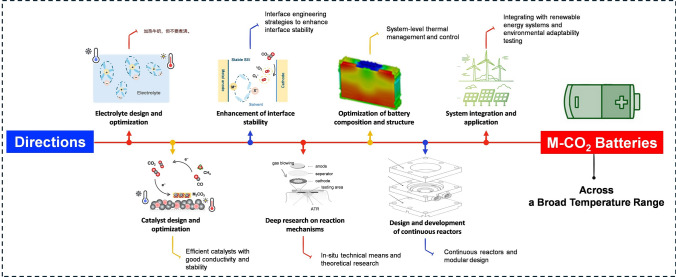
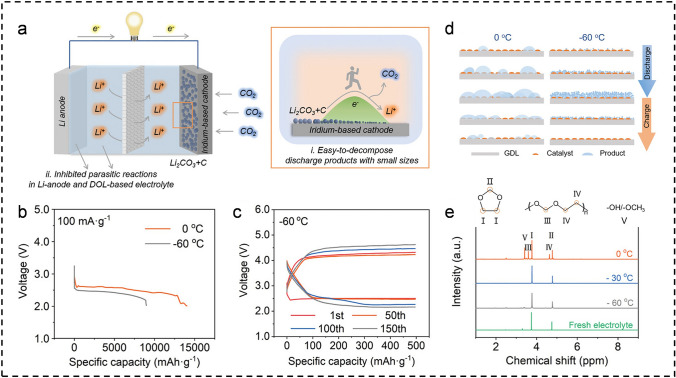
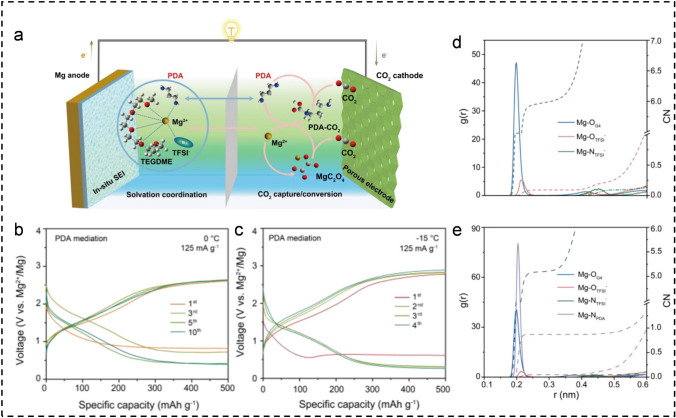
The metal-carbon dioxide batteries, emerging as high-energy-density energy storage devices, enable direct CO utilization, offering promising prospects for CO capture and utilization, energy conversion, and storage. However, the electrochemical performance of M-CO batteries faces significant challenges, particularly at extreme temperatures. Issues such as high overpotential, poor charge reversibility, and cycling capacity decay arise from complex reaction interfaces, sluggish oxidation kinetics, inefficient catalysts, dendrite growth, and unstable electrolytes. Despite significant advancements at room temperature, limited research has focused on the performance of M-CO batteries across a wide-temperature range. This review examines the effects of low and high temperatures on M-CO battery components and their reaction mechanism, as well as the advancements made in extending operational ranges from room temperature to extremely low and high temperatures. It discusses strategies to enhance electrochemical performance at extreme temperatures and outlines opportunities, challenges, and future directions for the development of M-CO batteries.
金属二氧化碳电池作为高能量密度储能装置正在兴起,能够直接利用二氧化碳,为二氧化碳的捕获与利用、能量转换及存储提供了广阔前景。然而,金属二氧化碳电池的电化学性能面临重大挑战,尤其是在极端温度下。诸如高过电位、电荷可逆性差以及循环容量衰减等问题,源于复杂的反应界面、缓慢的氧化动力学、低效的催化剂、枝晶生长以及不稳定的电解质。尽管在室温下已取得显著进展,但针对金属二氧化碳电池在宽温度范围内性能的研究仍较为有限。本综述考察了低温和高温对金属二氧化碳电池组件及其反应机理的影响,以及在将工作温度范围从室温扩展到极低和极高温度方面所取得的进展。它讨论了在极端温度下提高电化学性能的策略,并概述了金属二氧化碳电池发展的机遇、挑战及未来方向。