Lu Yue, Su Yi, Wang Nan, Li Dongyue, Zhang Huichao, Xu Hongyu
Department of Gastroenterology, The First Affiliated Hospital of Harbin Medical University, Harbin, Heilongjiang, China.
PLoS One. 2024 Dec 31;19(12):e0311495. doi: 10.1371/journal.pone.0311495. eCollection 2024.
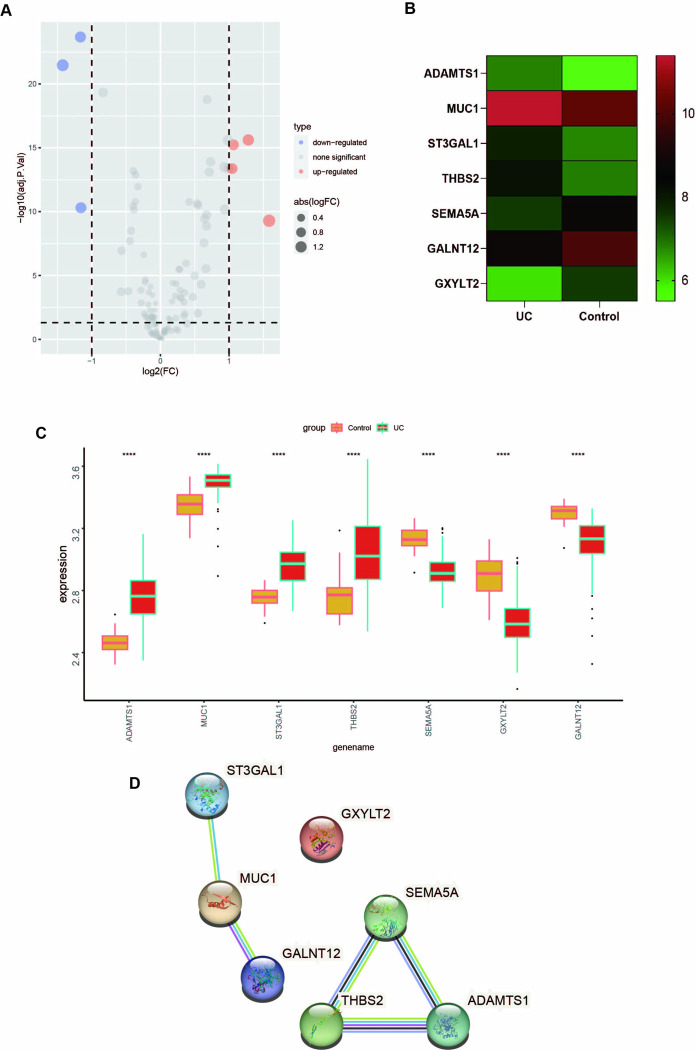
Ulcerative colitis (UC) is an immune-related inflammatory bowel disease, with its underlying mechanisms being a central area of clinical research. O-GlcNAcylation plays a critical role in regulating immunity progression and the occurrence of inflammatory diseases and tumors. Yet, the mechanism of O-GlcNAc-associated colitis remains to be elucidated. To this end, the transcriptional and clinical data of GSE75214 and GSE92415 from the GEO database was hereby examined, and genes MUC1, ADAMTS1, GXYLT2, and SEMA5A were found to be significantly related to O-GlcNAcylation using machine learning methods. Based on the four hub genes, two UC subtypes were built. Notably, subtype B might be prone to developing colitis-associated colorectal cancer (CAC). This study delved into the role of intestinal glycosylation changes, especially the O-GlcNAcylation, and forged a foundation for further research on the occurrence and development of UC. Overall, understanding the role of O-GlcNAcylation in UC could have significant implications for diagnosis and treatment, offering valuable insights into the disease's progression.
溃疡性结肠炎(UC)是一种免疫相关的炎症性肠病,其潜在机制是临床研究的核心领域。O-连接的N-乙酰葡糖胺糖基化(O-GlcNAcylation)在调节免疫进程以及炎症性疾病和肿瘤的发生中起关键作用。然而,O-GlcNAc相关结肠炎的机制仍有待阐明。为此,本研究检查了来自基因表达综合数据库(GEO数据库)的GSE75214和GSE92415的转录和临床数据,并使用机器学习方法发现MUC1、ADAMTS1、GXYLT2和SEMA5A基因与O-GlcNAcylation显著相关。基于这四个枢纽基因,构建了两种UC亚型。值得注意的是,B亚型可能更容易发展为结肠炎相关结直肠癌(CAC)。本研究深入探讨了肠道糖基化变化的作用,尤其是O-GlcNAcylation,为进一步研究UC的发生和发展奠定了基础。总体而言,了解O-GlcNAcylation在UC中的作用可能对诊断和治疗具有重要意义,为该疾病的进展提供有价值的见解。