Su Wanying, Liu Heping, Han Tiantian, Wang Yunyun, An Yi, Lin Yan
Department of Hospital Infection Control, Tongji Hospital, School of Medicine, Tongji University, Shanghai, 200065, China.
BMC Public Health. 2024 Dec 31;24(1):3621. doi: 10.1186/s12889-024-21179-0.
The burden of cardiovascular disease (CVD) is severe worldwide. Although many studies have investigated the association of particulate pollution with CVD, the effect of finer particulate pollution components on CVD remains unclear. This study aimed to explore the effect of five PM components ([Formula: see text], sulfate; [Formula: see text], nitrate; [Formula: see text], ammonium; OM, organic matter; BC, carbon black) on CVD admission in Shanghai City, identify the susceptible population, and provide clues for the prevention and control of particulate pollution.
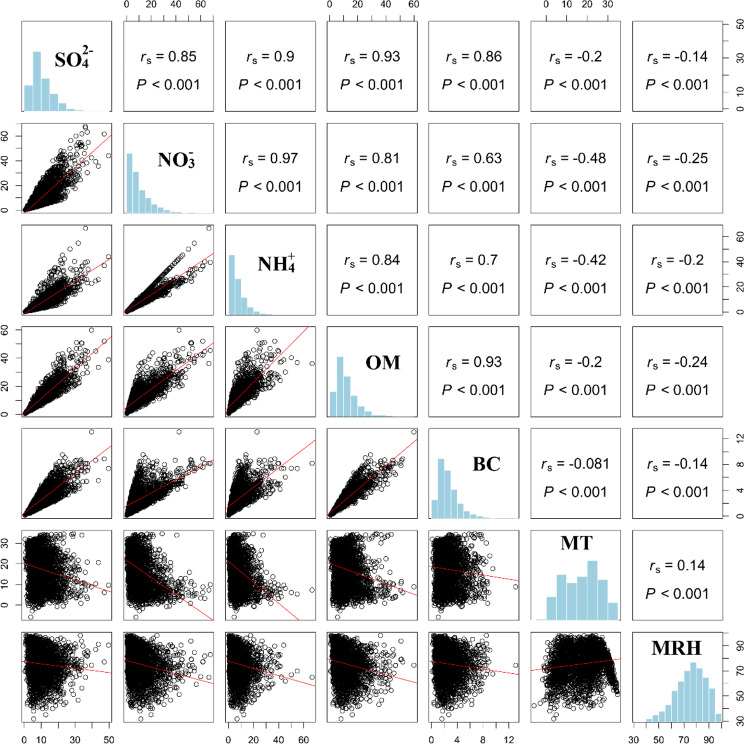
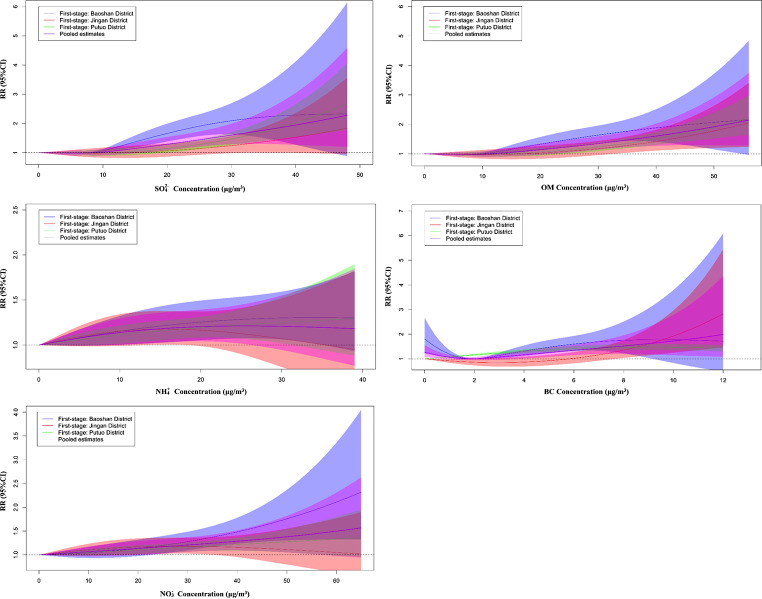
Daily PM components data during 2013-2019 in three districts of Shanghai were obtained from Tracking Air Pollution in China. We obtained CVD daily admissions data from relevant departments of Tongji Hospital, including basic information (sex, age, time of admissions, ICD code of root cause of admissions, etc.). First, generalized additive model (GAM) and distributed lag non-linear (DLNM) model were used to evaluate the individual effects of PM components on CVD admission in three districts of Shanghai. Then, the three regions were pooled for analysis using either a random-effects model or a fixed-effects model.
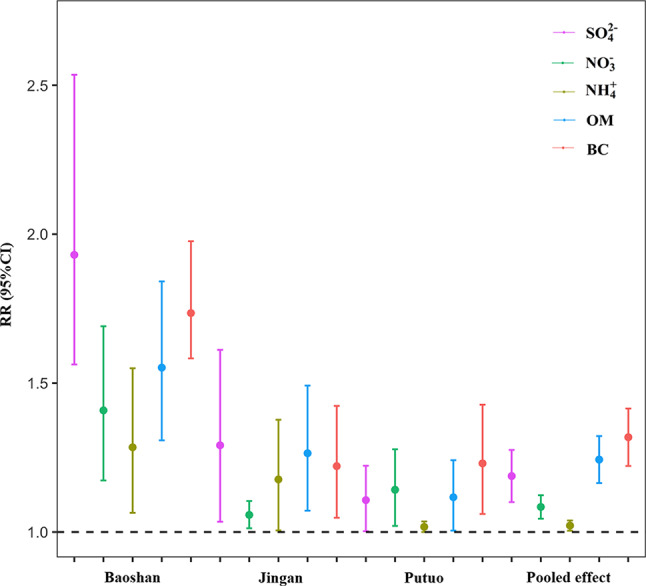
Overall, all five PM components had significant effects on CVD admission risk. BC and OM were strongly associated with daily CVD admissions, with increasing interquartile range of the concentrations, the maximum values of cumulative RR (95% CI) were 1.318 (95%CI: 1.222-1.415) and 1.243 (95%CI: 1.164-1.322), respectively. The elderly (≥ 65 years old) was more sensitive to the four PM components than the young population. [Formula: see text] and BC were strongest associated with CVD admissions in the elderly than in younger people, with increasing interquartile range of the concentrations, the maximum cumulative RR (95% CI) was 1.567 (95% CI: 1.116-2.019) and 1.534 (95% CI: 1.104-1.963), respectively.
This study found that five PM components were significant risk factors for CVD admissions and specific CVD diseases in Shanghai City. The elderly were susceptible to [Formula: see text],[Formula: see text], OM, and BC.
心血管疾病(CVD)在全球范围内负担沉重。尽管许多研究调查了颗粒物污染与心血管疾病的关联,但更细颗粒物污染成分对心血管疾病的影响仍不明确。本研究旨在探讨五种颗粒物成分([公式:见正文],硫酸盐;[公式:见正文],硝酸盐;[公式:见正文],铵;OM,有机物;BC,炭黑)对上海市心血管疾病入院率的影响,确定易感人群,并为颗粒物污染的预防和控制提供线索。
从《中国空气污染追踪》获取上海市三个区2013 - 2019年的每日颗粒物成分数据。我们从同济大学附属同济医院相关部门获取心血管疾病每日入院数据,包括基本信息(性别、年龄、入院时间、入院根本原因的国际疾病分类代码等)。首先,使用广义相加模型(GAM)和分布滞后非线性(DLNM)模型评估颗粒物成分对上海市三个区心血管疾病入院率的个体影响。然后,使用随机效应模型或固定效应模型对这三个区域进行合并分析。
总体而言,所有五种颗粒物成分对心血管疾病入院风险均有显著影响。BC和OM与每日心血管疾病入院密切相关,浓度四分位数间距增加时,累积相对危险度(RR)(95%可信区间)的最大值分别为1.318(95%CI:1.222 - 1.415)和1.243(95%CI:1.164 - 1.322)。老年人(≥65岁)对四种颗粒物成分比年轻人更敏感。[公式:见正文]和BC与老年人心血管疾病入院的关联比年轻人更强,浓度四分位数间距增加时,最大累积RR(95%可信区间)分别为1.567(95%CI:1.116 - 2.019)和1.534(95%CI:1.104 - 1.963)。
本研究发现,五种颗粒物成分是上海市心血管疾病入院及特定心血管疾病的重要危险因素。老年人对[公式:见正文]、[公式:见正文]、OM和BC易感。