Hajiyev Murad, Ibrahim Ahmed Farid, Alotaibi Mohammed B, Fahmi Mohanad, Patil Shirish, Al-Aqeel Noof, Abdelgawad Khaled
Petroleum Engineering Department, King Fahd University of Petroleum & Minerals, Dhahran 31261,Saudi Arabia.
Center for Integrative Petroleum Research, King Fahd University of Petroleum & Minerals, Dhahran 31261,Saudi Arabia.
ACS Omega. 2024 Dec 10;9(51):50642-50649. doi: 10.1021/acsomega.4c08548. eCollection 2024 Dec 24.
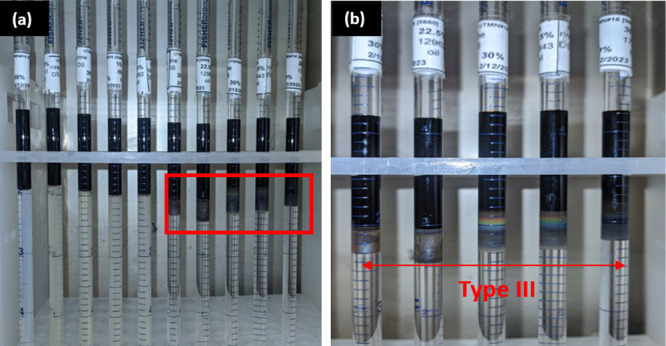
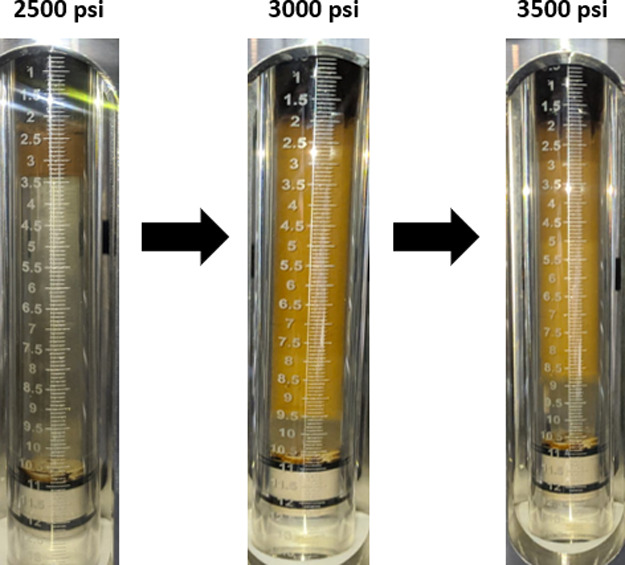
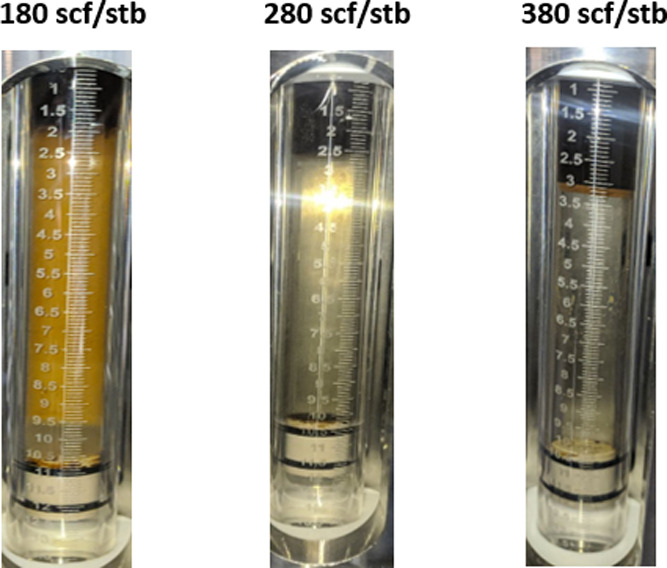
Surfactant chemical-enhanced oil recovery plays a crucial role in achieving ultralow interfacial tension between remaining crude oil and injected water, thereby enhancing oil recovery rates. This study aims to investigate the impact of pressure and gas/oil ratios (GORs) on surfactant flooding for enhanced oil recovery, focusing on high-pressure and high-temperature (HPHT) conditions. High-temperature salinity screening was employed to identify optimal surfactant formulations for Type III microemulsions. HPHT phase behavior tests were conducted to examine water and oil solubilization under pressure, with a particular focus on how GOR affects these parameters. The research utilized a unique approach to analyzing GOR variations at different pressure levels in a crude oil sample through salinity screening experiments and HPHT phase behavior tests using methane-containing live oil. With increasing pressure, while maintaining a lower GOR, the water solubilization ratio in the microemulsion increased dramatically, whereas the solubilization ratio of oil decreased. Furthermore, both oil and water solubilization ratios decreased at higher GOR and pressure compared to dead oil results. The optimum salinity was found to be equal to 17,283 ppm at a GOR of 180 scf/stb and decreased to 14,403 ppm at a GOR of 280 scf/stb, validating that the optimum salinity decreases with increasing GOR value. The tendency of microemulsion generation also decreased with increasing GOR from 180 to 280 and 380 scf/stb. Additionally, the minimum bubble point pressure required to solubilize the total amount of gas in the oil increased from 2500 psi at a GOR of 280 scf/stb to 3000 psi at a GOR of 380 scf/stb. The microemulsion was not observed at any pressure level and at any salinity at a higher GOR (380 scf/stb). This study provides valuable insights into the petroleum industry, offering potential improvements in reservoir management, forecasting accuracy, and recovery efficiency. The research's innovative approach to analyzing GOR variations and its impact on surfactant flooding under HPHT conditions contributes to the field's knowledge and could lead to more effective and efficient oil recovery strategies.
表面活性剂化学强化采油在实现剩余原油与注入水之间的超低界面张力从而提高采收率方面起着至关重要的作用。本研究旨在调查压力和气油比(GOR)对用于提高采收率的表面活性剂驱油的影响,重点关注高温高压(HPHT)条件。采用高温盐度筛选来确定III型微乳液的最佳表面活性剂配方。进行了高温高压相行为测试,以研究压力下的水和油增溶情况,特别关注气油比对这些参数的影响。该研究采用了一种独特的方法,通过盐度筛选实验和使用含甲烷的活油进行的高温高压相行为测试,分析原油样品在不同压力水平下的气油比变化。随着压力升高,在保持较低气油比的情况下,微乳液中的水增溶比急剧增加,而油增溶比下降。此外,与脱气原油结果相比,在高气油比和压力下,油和水的增溶比均下降。发现在气油比为180标准立方英尺/桶时,最佳盐度等于17283 ppm,在气油比为280标准立方英尺/桶时降至14403 ppm,这证实最佳盐度随着气油比的增加而降低。随着气油比从180增加到280和380标准立方英尺/桶,微乳液生成的趋势也降低。此外,使油中气体总量增溶所需的最低泡点压力从气油比为280标准立方英尺/桶时的2500 psi增加到气油比为380标准立方英尺/桶时的3000 psi。在高气油比(380标准立方英尺/桶)下,在任何压力水平和任何盐度下均未观察到微乳液。本研究为石油行业提供了有价值的见解,在油藏管理、预测准确性和采收效率方面提供了潜在的改进。该研究分析气油比变化及其在高温高压条件下对表面活性剂驱油影响的创新方法有助于该领域的知识积累,并可能导致更有效和高效的采油策略。