Abelman Rachel O, Wu Bogang, Barnes Haley, Medford Arielle, Norden Bryanna, Putur Annika, Bitman Elena, Thant Win, Liu Ting, Weipert Caroline, Fell Geoffrey, Spring Laura M, Wander Seth A, Moy Beverly, Vidula Neelima, Isakoff Steven J, Varkaris Andreas, Juric Dejan, Corcoran Ryan B, Ellisen Leif W, Bardia Aditya
Massachusetts General Hospital, Harvard Medical School, Boston, Massachusetts.
Guardant Health, Inc., Palo Alto, California.
Clin Cancer Res. 2025 May 15;31(10):1966-1974. doi: 10.1158/1078-0432.CCR-24-2771.
Antibody-drug conjugates (ADC) harboring topoisomerase I (TOP1) inhibitor payloads have improved survival for patients with metastatic breast cancer. However, knowledge of ADC resistance mechanisms and potential impact on the sequential use of ADCs is limited. In this study, we report the incidence and characterization of TOP1 mutations arising in the setting of ADC resistance in metastatic breast cancer.
Patients with metastatic breast cancer treated with ADCs with available posttreatment plasma-based genotyping were included. TOP1 mutation incidence, mutant allele frequency, and functional characterization were assessed, and incidence was compared with that in patients with metastatic breast cancer not receiving ADC treatment and in The Cancer Genome Atlas.
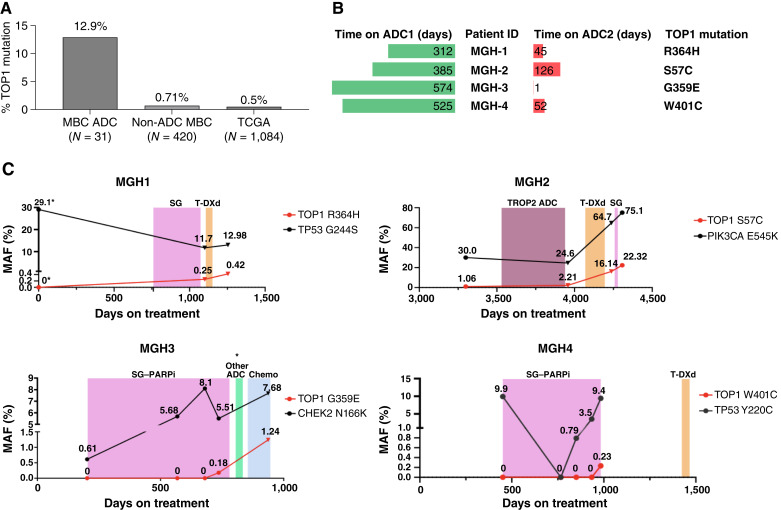
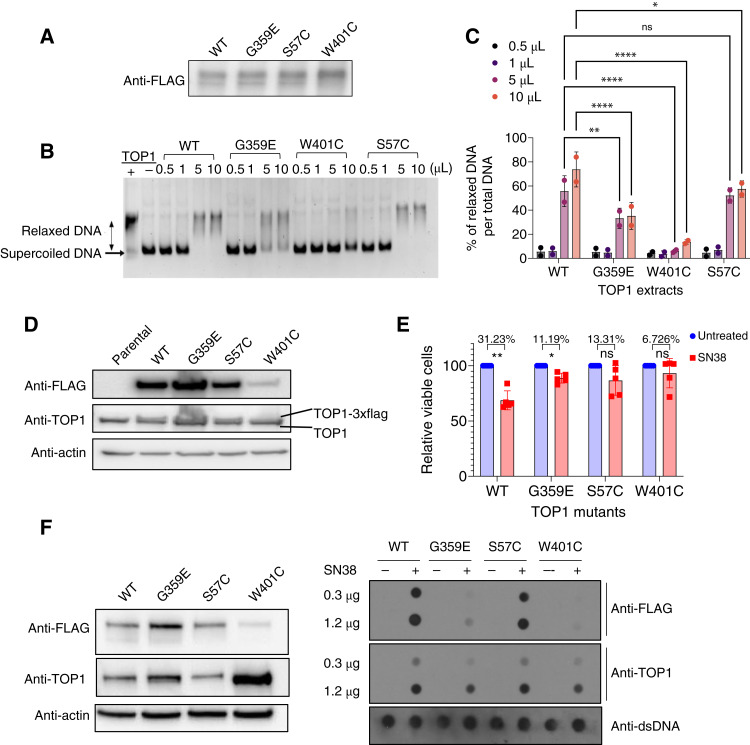
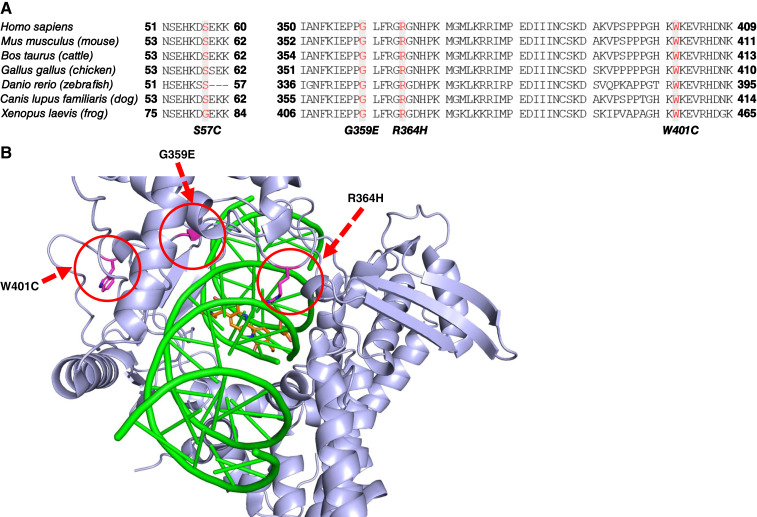
Plasma-based genotyping identified distinct TOP1 mutations (S57C, R364H, W401C, and G359E) in 12.9% of patients (4/31) at the time of disease progression on ADC, compared with 0.7% (3/420) in non-ADC-treated patients with metastatic breast cancer and 0.5% in The Cancer Genome Atlas. The appearance of mutations was associated with clinical cross-resistance, as median duration on the first ADC was 455 versus 52 days for the second ADC. The functional characterization of three novel TOP1-mutant proteins demonstrated that all exhibited reduced enzymatic activity, attenuated covalent DNA binding, and resistance to TOP1 inhibitor ADC payloads SN38 and deruxtecan.
We describe the recurrent emergence of functionally altered, resistance-associated TOP1 mutations in vivo under selective pressure from ADCs and the potential impact on mediating cross-resistance to sequential ADCs. TOP1 mutation may represent a biomarker of resistance in this setting, and additional work is needed to optimize biomarkers and ADC payload design to improve outcomes for the sequential use of ADCs. See related commentary by Gwin and Hurvitz, p. 1824.
携带拓扑异构酶I(TOP1)抑制剂有效载荷的抗体药物偶联物(ADC)可提高转移性乳腺癌患者的生存率。然而,关于ADC耐药机制及其对ADC序贯使用潜在影响的了解有限。在本研究中,我们报告了转移性乳腺癌ADC耐药情况下出现的TOP1突变的发生率及特征。
纳入接受ADC治疗且有可用的基于治疗后血浆基因分型的转移性乳腺癌患者。评估TOP1突变发生率、突变等位基因频率和功能特征,并将发生率与未接受ADC治疗的转移性乳腺癌患者以及癌症基因组图谱中的患者进行比较。
基于血浆的基因分型在12.9%(4/31)的患者疾病进展时,即在接受ADC治疗时,鉴定出不同的TOP1突变(S57C、R364H、W401C和G359E),而在未接受ADC治疗的转移性乳腺癌患者中这一比例为0.7%(3/420),在癌症基因组图谱中为0.5%。突变的出现与临床交叉耐药相关,因为第一个ADC的中位使用持续时间为455天,而第二个ADC为52天。三种新型TOP1突变蛋白的功能特征表明,它们均表现出酶活性降低、共价DNA结合减弱以及对TOP1抑制剂ADC有效载荷SN38和德卢替康的耐药性。
我们描述了在ADC的选择性压力下,体内功能改变、与耐药相关的TOP1突变反复出现,以及对介导对序贯ADC交叉耐药的潜在影响。TOP1突变可能代表这种情况下的耐药生物标志物,需要开展更多工作来优化生物标志物和ADC有效载荷设计,以改善ADC序贯使用的疗效。见Gwin和Hurvitz的相关评论,第1824页。