Fathi Kazerooni Anahita, Kraya Adam, Rathi Komal S, Kim Meen Chul, Vossough Arastoo, Khalili Nastaran, Familiar Ariana M, Gandhi Deep, Khalili Neda, Kesherwani Varun, Haldar Debanjan, Anderson Hannah, Jin Run, Mahtabfar Aria, Bagheri Sina, Guo Yiran, Li Qi, Huang Xiaoyan, Zhu Yuankun, Sickler Alex, Lueder Matthew R, Phul Saksham, Koptyra Mateusz, Storm Phillip B, Ware Jeffrey B, Song Yuanquan, Davatzikos Christos, Foster Jessica B, Mueller Sabine, Fisher Michael J, Resnick Adam C, Nabavizadeh Ali
Center for Data-Driven Discovery in Biomedicine (D3b), The Children's Hospital of Philadelphia, Philadelphia, PA, USA.
AI2D Center for AI and Data Science for Integrated Diagnostics, University of Pennsylvania, Philadelphia, PA, USA.
Nat Commun. 2025 Jan 2;16(1):340. doi: 10.1038/s41467-024-55659-z.
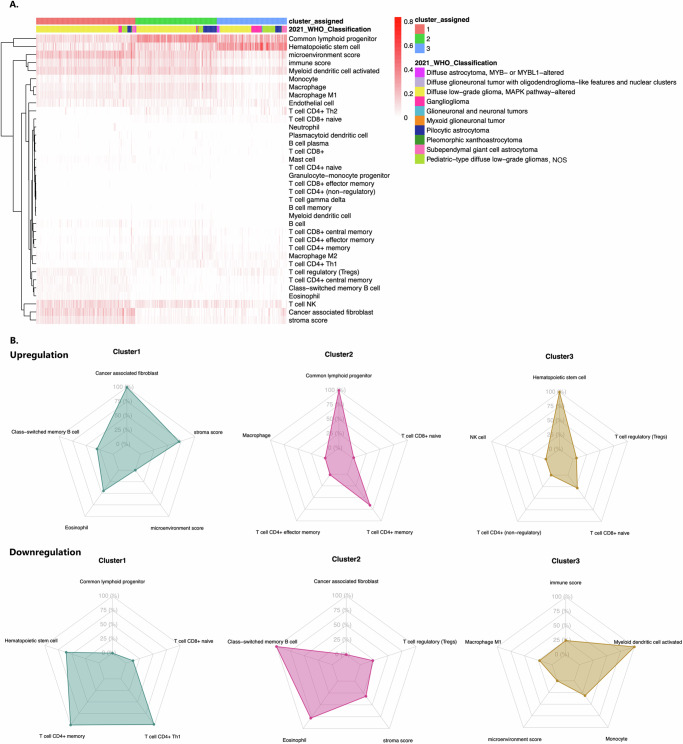
Pediatric low-grade gliomas (pLGGs) exhibit heterogeneous prognoses and variable responses to treatment, leading to tumor progression and adverse outcomes in cases where complete resection is unachievable. Early prediction of treatment responsiveness and suitability for immunotherapy has the potential to improve clinical management and outcomes. Here, we present a radiogenomic analysis of pLGGs, integrating MRI and RNA sequencing data. We identify three immunologically distinct clusters, with one group characterized by increased immune activity and poorer prognosis, indicating potential benefit from immunotherapies. We develop a radiomic signature that predicts these immune profiles with over 80% accuracy. Furthermore, our clinicoradiomic model predicts progression-free survival and correlates with treatment response. We also identify genetic variants and transcriptomic pathways associated with progression risk, highlighting links to tumor growth and immune response. This radiogenomic study in pLGGs provides a framework for the identification of high-risk patients who may benefit from targeted therapies.
小儿低级别胶质瘤(pLGGs)预后各异,对治疗的反应也不尽相同,在无法实现完全切除的情况下会导致肿瘤进展和不良后果。早期预测治疗反应性和免疫治疗的适用性有可能改善临床管理和治疗结果。在此,我们展示了一项对pLGGs的放射基因组分析,整合了MRI和RNA测序数据。我们确定了三个免疫特征不同的簇,其中一组的特点是免疫活性增加且预后较差,提示免疫治疗可能有益。我们开发了一种放射组学特征,其预测这些免疫特征的准确率超过80%。此外,我们的临床放射组学模型可预测无进展生存期并与治疗反应相关。我们还确定了与进展风险相关的基因变异和转录组途径,突出了与肿瘤生长和免疫反应的联系。这项针对pLGGs的放射基因组研究为识别可能从靶向治疗中获益的高危患者提供了一个框架。