Zhang Qianyun, Zhu Qidong, Xiao Yunqi, Yu Qinghua, Shi Shourong
College of Veterinary Medicine, Nanjing Agricultural University, Nanjing, China.
Jiangsu Institute of Poultry Sciences, Yangzhou, China.
J Anim Sci Biotechnol. 2025 Jan 3;16(1):2. doi: 10.1186/s40104-024-01132-2.
Salmonella enterica serovar Enteritidis (S. Enteritidis) is a global foodborne pathogen that poses a significant threat to human health, with poultry being the primary reservoir host. Therefore, addressing S. Enteritidis infections in poultry is crucial to protect human health and the poultry industry. In this study, we investigated the effect of co-housing Arbor Acres (AA) chickens, a commercial breed susceptible to S. Enteritidis, with Tibetan chickens, a local breed resistant to S. Enteritidis infection, on the resistance of the latter to the pathogen.
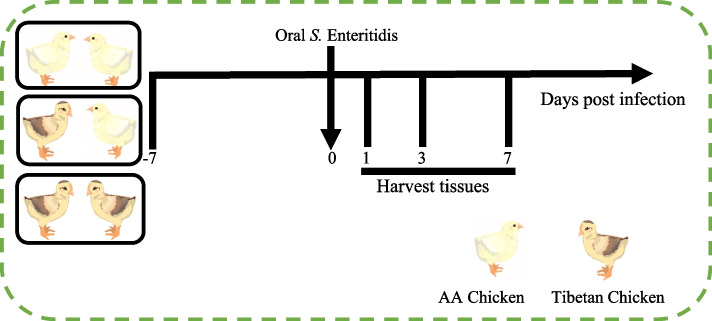
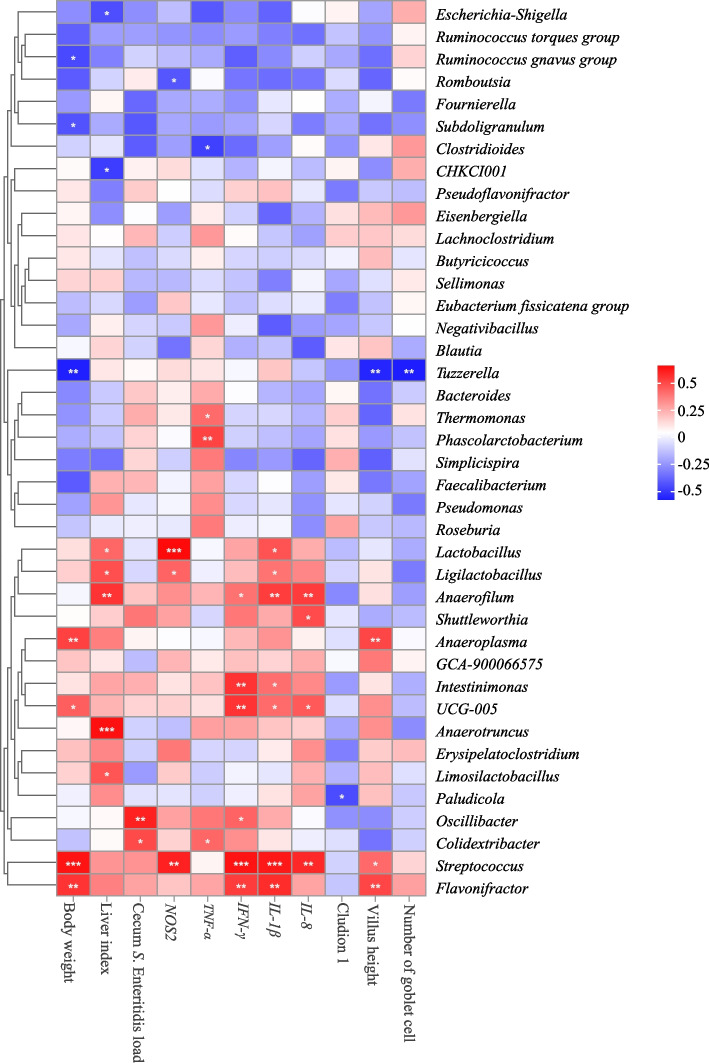
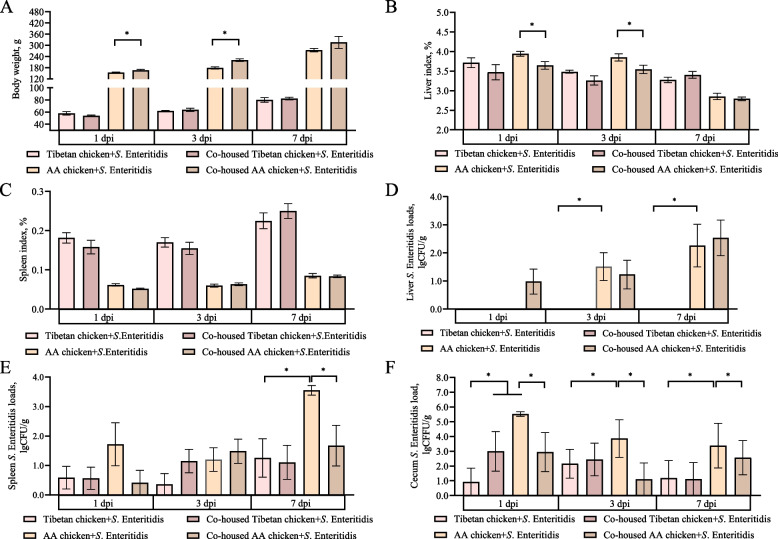
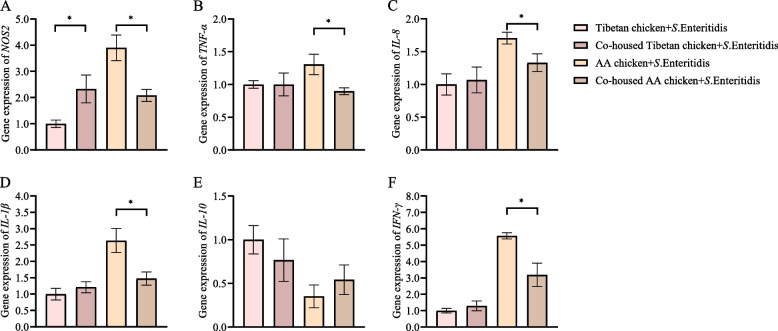
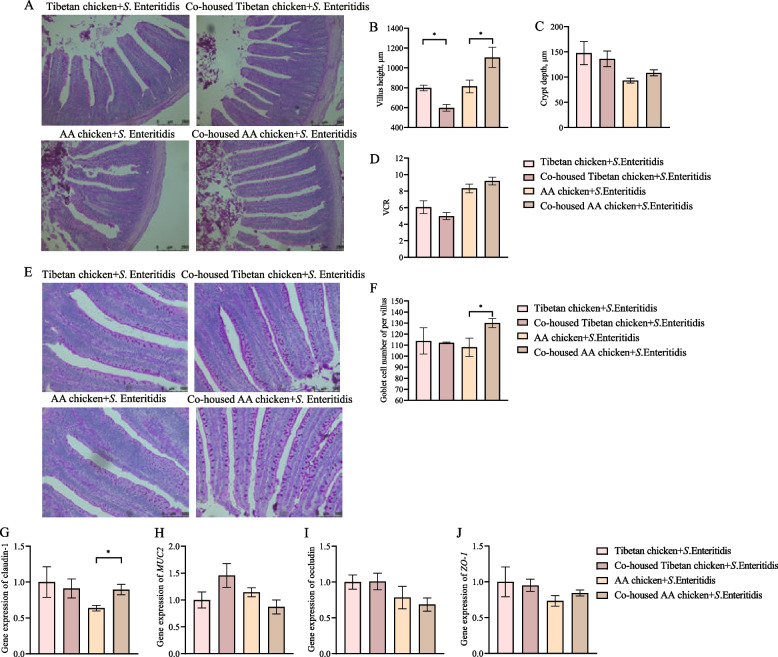
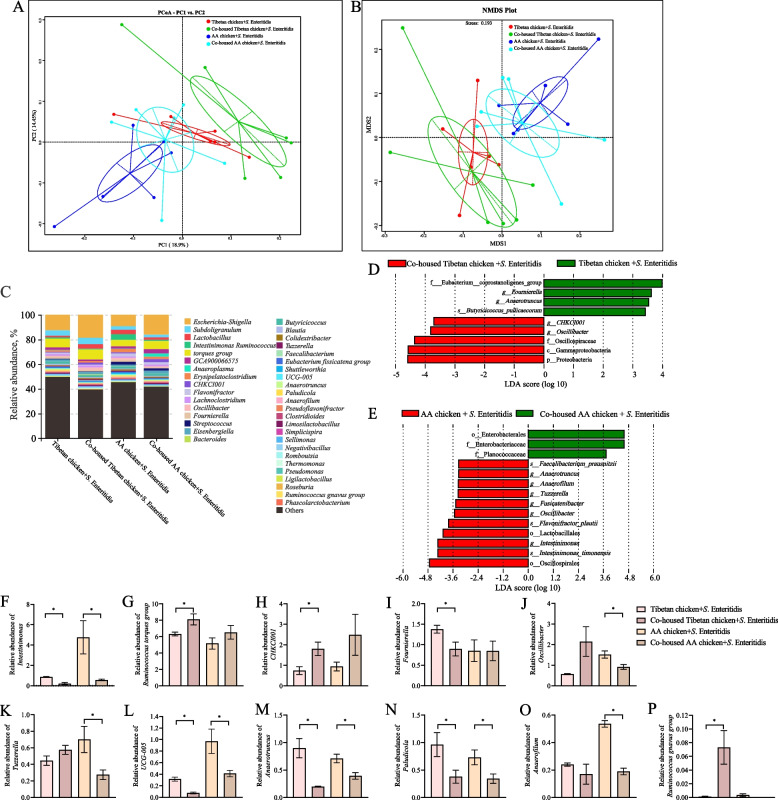
Ninety-six 1-day-old Tibetan chickens and 96 1-day-old AA chickens were divided into a Tibetan chicken housed alone group (n = 48), an AA chicken housed alone group (n = 48), and a co-housed group (48 birds from each breed for 2 cages). All birds were provided the same diet, and the experimental period lasted 14 d. At d 7, all chickens were infected with S. Enteritidis, and samples were collected at 1-, 3-, and 7-day-post-infection. We found that the body weight of AA chickens significantly increased when co-housed with Tibetan chickens at 1- and 3-day-post-infection (P < 0.05). In addition, the cecal S. Enteritidis load in AA chickens was significantly reduced at 1-, 3-, and 7-day-post-infection (P < 0.05). Furthermore, the inflammatory response in AA chickens decreased, as evidenced by the decreased expression of pro-inflammatory cytokines NOS2, TNF-α, IL-8, IL-1β, and IFN-γ in their cecal tonsils (P < 0.05). Co-housing with Tibetan chickens significantly increased the height of villi and number of goblet cells (P < 0.05), as well as the expression of claudin-1 (P < 0.05), a tight junction protein, in the jejunum of AA chickens. Further analysis revealed that co-housing altered the gut microbiota composition in AA chickens; specifically, the relative abundances of harmful microbes, such as Intestinimonas, Oscillibacter, Tuzzerella, Anaerotruncus, Paludicola, and Anaerofilum were reduced (P < 0.05).
Our findings indicate that co-housing with Tibetan chickens enhanced the resistance of AA chickens to S. Enteritidis infection without compromising the resistance of Tibetan chickens. This study provides a novel approach for Salmonella control in practical poultry production.
肠炎沙门氏菌肠炎亚种(肠炎沙门氏菌)是一种全球范围内的食源性病原体,对人类健康构成重大威胁,家禽是其主要储存宿主。因此,解决家禽中的肠炎沙门氏菌感染对于保护人类健康和家禽产业至关重要。在本研究中,我们调查了将易感染肠炎沙门氏菌的商业品种艾维茵(AA)鸡与对肠炎沙门氏菌感染具有抗性的地方品种藏鸡混养,对藏鸡抵抗该病原体能力的影响。
将96只1日龄藏鸡和96只1日龄AA鸡分为单独饲养的藏鸡组(n = 48)、单独饲养的AA鸡组(n = 48)和混养组(每个品种48只,分2个笼子)。所有鸡都提供相同的饲料,实验期持续14天。在第7天,所有鸡均感染肠炎沙门氏菌,并在感染后1天、3天和7天采集样本。我们发现,在感染后1天和3天,与藏鸡混养的AA鸡体重显著增加(P < 0.05)。此外,在感染后1天、3天和7天,AA鸡盲肠中的肠炎沙门氏菌载量显著降低(P < 0.05)。此外,AA鸡的炎症反应减弱,其盲肠扁桃体中促炎细胞因子NOS2、TNF-α、IL-8、IL-1β和IFN-γ的表达降低证明了这一点(P < 0.05)。与藏鸡混养显著增加了AA鸡空肠绒毛高度和杯状细胞数量(P < 0.05),以及紧密连接蛋白claudin-1的表达(P < 0.05)。进一步分析表明,混养改变了AA鸡的肠道微生物群组成;具体而言,有害微生物如肠单胞菌属、颤杆菌属、土氏菌属、厌氧短杆菌属、沼泽杆菌属和厌氧丝菌属的相对丰度降低(P < 0.05)。
我们的研究结果表明,与藏鸡混养可增强AA鸡对肠炎沙门氏菌感染的抵抗力,而不会损害藏鸡的抵抗力。本研究为实际家禽生产中控制沙门氏菌提供了一种新方法。