Marek L, Wiki J, Mandic S, Spence J C, Smith M, García Bengoechea E, Coppell K J, Kingham S, Hobbs M
GeoHealth Laboratory University of Canterbury Christchurch New Zealand.
School of Earth and Environment University of Canterbury Christchurch New Zealand.
Geohealth. 2025 Jan 2;9(1):e2024GH001101. doi: 10.1029/2024GH001101. eCollection 2025 Jan.
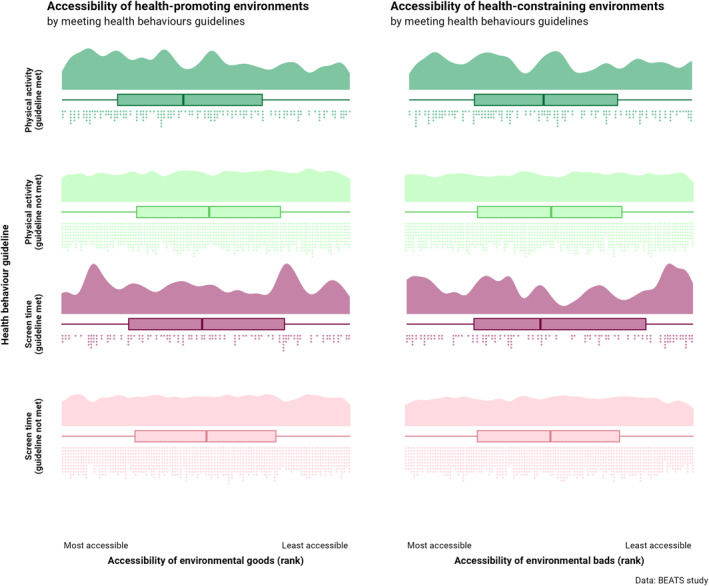
The built and natural environment can facilitate (un)healthy behaviors in adolescence. However, most previous studies have focused on examining associations between singular aspects of the environment. This study examined the association between the mixture of health-promoting and health-constraining environmental features in a Healthy Location Index (HLI) and physical activity and screen time among adolescents. This cross-sectional study used data from the Built Environment and Active Transport to School (BEATS) Research Program based in Dunedin, New Zealand. Data from 1,162 adolescents with complete demographic, health behavior and spatial records were included in the analysis. The environment was defined using the HLI based on access to health-promoting (e.g., greenspace, blue space, physical activity facility) and health-constraining (e.g., fast-food outlets) features and their mixture. Quantile g-computation and multilevel mixed effects models, with adolescents nested within schools, examined associations between the environment and the two health behaviors. A positive association existed between meeting physical activity guidelines and access to health-promoting environments (OR = 1.23 [95% CI 1.03; 1.47]), particularly blue space. In addition, the mixture of health-promoting and health-constraining environments was also important (ψ = 1.18 [1.01; 1.37]). However, there was limited evidence of an association between the environment and screen time. We provide evidence of a relationship between health-promoting environments, the mix of health-promoting and health-constraining environments, and physical activity among adolescents. The findings support the hypothesis that the environment has the potential to positively influence healthy behaviors of youth, particularly when it comes to physical activity.
建成环境和自然环境会促进(或不利于)青少年的健康行为。然而,以往大多数研究都集中在考察环境单一因素之间的关联。本研究考察了健康场所指数(HLI)中促进健康和限制健康的环境特征组合与青少年身体活动及屏幕使用时间之间的关联。这项横断面研究使用了来自新西兰达尼丁的“建成环境与步行上下学”(BEATS)研究项目的数据。分析纳入了1162名青少年的数据,这些数据包含完整的人口统计学信息、健康行为和空间记录。环境是根据HLI来定义的,该指数基于促进健康的特征(如绿地、蓝色空间、体育活动设施)、限制健康的特征(如快餐店)及其组合。分位数g计算和多水平混合效应模型(青少年嵌套于学校内)考察了环境与这两种健康行为之间的关联。达到身体活动指南要求与获得促进健康的环境之间存在正相关(比值比= 1.23 [95%置信区间1.03;1.47]),尤其是蓝色空间。此外,促进健康和限制健康的环境组合也很重要(ψ=1.18 [1.01;1.37])。然而,环境与屏幕使用时间之间的关联证据有限。我们提供了促进健康的环境、促进健康和限制健康的环境组合与青少年身体活动之间存在关系的证据。这些发现支持了这样一种假设,即环境有可能对青少年的健康行为产生积极影响,尤其是在身体活动方面。