• 文献检索
  • 文档翻译
  • 深度研究
  • 学术资讯
  • Suppr Zotero 插件Zotero 插件
  • 邀请有礼
  • 套餐&价格
  • 历史记录
应用&插件
Suppr Zotero 插件Zotero 插件浏览器插件Mac 客户端Windows 客户端微信小程序
定价
高级版会员购买积分包购买API积分包
服务
文献检索文档翻译深度研究API 文档MCP 服务
关于我们
关于 Suppr公司介绍联系我们用户协议隐私条款
关注我们

Suppr 超能文献

核心技术专利:CN118964589B侵权必究
粤ICP备2023148730 号-1Suppr @ 2026

文献检索

告别复杂PubMed语法,用中文像聊天一样搜索,搜遍4000万医学文献。AI智能推荐,让科研检索更轻松。

立即免费搜索

文件翻译

保留排版,准确专业,支持PDF/Word/PPT等文件格式,支持 12+语言互译。

免费翻译文档

深度研究

AI帮你快速写综述,25分钟生成高质量综述,智能提取关键信息,辅助科研写作。

立即免费体验

建成环境与步行或骑行上学(BEATS)研究:一项横断面研究的方案

Built Environment and Active Transport to School (BEATS) Study: protocol for a cross-sectional study.

作者信息

Mandic Sandra, Williams John, Moore Antoni, Hopkins Debbie, Flaherty Charlotte, Wilson Gordon, García Bengoechea Enrique, Spence John C

机构信息

Active Living Laboratory, School of Physical Education, Sport and Exercise Sciences, University of Otago, Dunedin, New Zealand.

Department of Marketing, University of Otago, Dunedin, New Zealand.

出版信息

BMJ Open. 2016 May 24;6(5):e011196. doi: 10.1136/bmjopen-2016-011196.

DOI:10.1136/bmjopen-2016-011196
PMID:27221127
原文链接:https://pmc.ncbi.nlm.nih.gov/articles/PMC4885465/
Abstract

INTRODUCTION

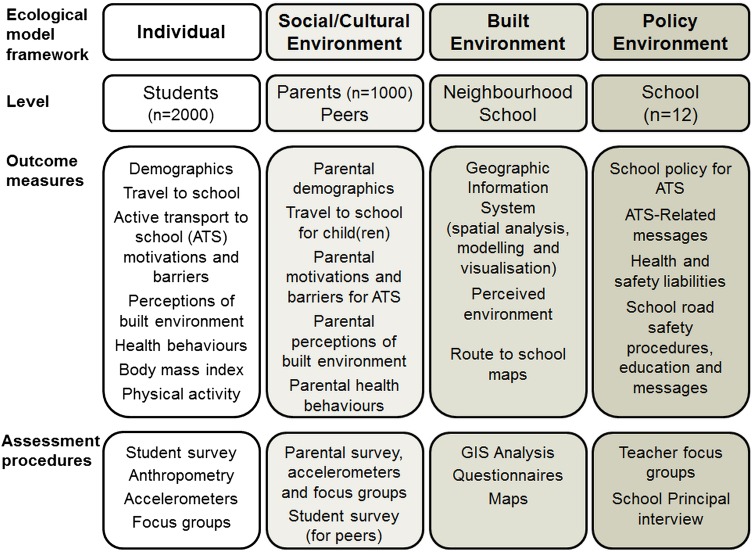
Active transport to school (ATS) is a convenient way to increase physical activity and undertake an environmentally sustainable travel practice. The Built Environment and Active Transport to School (BEATS) Study examines ATS in adolescents in Dunedin, New Zealand, using ecological models for active transport that account for individual, social, environmental and policy factors. The study objectives are to: (1) understand the reasons behind adolescents and their parents' choice of transport mode to school; (2) examine the interaction between the transport choices, built environment, physical activity and weight status in adolescents; and (3) identify policies that promote or hinder ATS in adolescents.

METHODS AND ANALYSIS

The study will use a mixed-method approach incorporating both quantitative (surveys, anthropometry, accelerometers, Geographic Information System (GIS) analysis, mapping) and qualitative methods (focus groups, interviews) to gather data from students, parents, teachers and school principals. The core data will include accelerometer-measured physical activity, anthropometry, GIS measures of the built environment and the use of maps indicating route to school (students)/work (parents) and perceived safe/unsafe areas along the route. To provide comprehensive data for understanding how to change the infrastructure to support ATS, the study will also examine complementary variables such as individual, family and social factors, including student and parental perceptions of walking and cycling to school, parental perceptions of different modes of transport to school, perceptions of the neighbourhood environment, route to school (students)/work (parents), perceptions of driving, use of information communication technology, reasons for choosing a particular school and student and parental physical activity habits, screen time and weight status. The study has achieved a 100% school recruitment rate (12 secondary schools).

ETHICS AND DISSEMINATION

The study has been approved by the University of Otago Ethics Committee. The results will be actively disseminated through reports and presentations to stakeholders, symposiums and scientific publications.

摘要

引言

主动步行或骑行上学是增加身体活动量并践行环境可持续出行方式的便捷途径。“建筑环境与主动步行或骑行上学”(BEATS)研究采用主动出行的生态模型,该模型考虑了个体、社会、环境和政策因素,对新西兰达尼丁市青少年的主动步行或骑行上学情况进行研究。研究目标如下:(1)了解青少年及其父母选择上学交通方式的背后原因;(2)研究青少年的交通选择、建筑环境、身体活动和体重状况之间的相互作用;(3)确定促进或阻碍青少年主动步行或骑行上学的政策。

方法与分析

本研究将采用混合方法,包括定量方法(调查、人体测量、加速度计、地理信息系统(GIS)分析、绘图)和定性方法(焦点小组讨论、访谈),以收集来自学生、家长、教师和学校校长的数据。核心数据将包括加速度计测量的身体活动量、人体测量数据、建筑环境的GIS测量数据,以及标明上学路线(学生)/上班路线(家长)和沿途感知到的安全/不安全区域的地图使用情况。为了提供全面的数据以了解如何改变基础设施来支持主动步行或骑行上学,本研究还将考察补充变量,如个体、家庭和社会因素,包括学生和家长对步行或骑行上学的看法、家长对不同上学交通方式的看法、对邻里环境的看法、上学路线(学生)/上班路线(家长)、对驾车的看法、信息通信技术的使用情况、选择特定学校的原因以及学生和家长的身体活动习惯、屏幕使用时间和体重状况。本研究已实现100%的学校招募率(12所中学)。

伦理与传播

本研究已获得奥塔哥大学伦理委员会的批准。研究结果将通过向利益相关者的报告和展示、研讨会以及科学出版物等方式积极传播。
https://cdn.ncbi.nlm.nih.gov/pmc/blobs/92a6/4885465/146b02dcdf3a/bmjopen2016011196f01.jpg

相似文献

1
Built Environment and Active Transport to School (BEATS) Study: protocol for a cross-sectional study.建成环境与步行或骑行上学(BEATS)研究:一项横断面研究的方案
BMJ Open. 2016 May 24;6(5):e011196. doi: 10.1136/bmjopen-2016-011196.
2
Built environment changes and active transport to school among adolescents: BEATS Natural Experiment Study protocol.建筑环境变化与青少年的主动上学交通方式:BEATS 自然实验研究方案。
BMJ Open. 2020 Mar 25;10(3):e034899. doi: 10.1136/bmjopen-2019-034899.
3
Physical and spatial assessment of school neighbourhood built environments for active transport to school in adolescents from Dunedin (New Zealand).达尼丁(新西兰)青少年通过积极交通方式上学的学校邻里建成环境的物理和空间评估。
Health Place. 2019 Jan;55:1-8. doi: 10.1016/j.healthplace.2018.10.003. Epub 2018 Nov 13.
4
Active Transport to School and School Neighbourhood Built Environment across Urbanisation Settings in Otago, New Zealand.奥塔哥,新西兰,城市化环境下主动上学与学校邻里建成环境。
Int J Environ Res Public Health. 2020 Dec 3;17(23):9013. doi: 10.3390/ijerph17239013.
5
Personal, social and environmental correlates of active transport to school among adolescents in Otago, New Zealand.新西兰奥塔哥地区青少年主动步行或骑车上学的个人、社会及环境影响因素
J Sci Med Sport. 2015 Jul;18(4):432-7. doi: 10.1016/j.jsams.2014.06.012. Epub 2014 Jun 27.
6
Neighbourhoods for Active Kids: study protocol for a cross-sectional examination of neighbourhood features and children's physical activity, active travel, independent mobility and body size.活跃儿童的社区环境:一项关于社区特征与儿童身体活动、主动出行、独立移动能力及体型的横断面研究方案
BMJ Open. 2016 Aug 16;6(8):e013377. doi: 10.1136/bmjopen-2016-013377.
7
Children's route choice during active transportation to school: difference between shortest and actual route.儿童在主动步行或骑车上学途中的路线选择:最短路线与实际路线的差异
Int J Behav Nutr Phys Act. 2016 Apr 12;13:48. doi: 10.1186/s12966-016-0373-y.
8
Environmental and socio-demographic associates of children's active transport to school: a cross-sectional investigation from the URBAN Study.儿童步行或骑行上学的环境及社会人口学相关因素:来自城市研究的横断面调查
Int J Behav Nutr Phys Act. 2014 Jun 2;11:70. doi: 10.1186/1479-5868-11-70.
9
Do Not Forget About Public Transportation: Analysis of the Association of Active Transportation to School Among Washington, DC Area Children With Parental Perceived Built Environment Measures.不要忘记公共交通:分析华盛顿特区地区儿童与父母感知的建成环境措施之间积极上学交通方式的关联。
J Phys Act Health. 2018 Jul 1;15(7):474-482. doi: 10.1123/jpah.2017-0266. Epub 2018 Mar 23.
10
Children's GPS-determined versus self-reported transport in leisure time and associations with parental perceptions of the neighborhood environment.儿童休闲时间通过全球定位系统确定的与自我报告的出行方式及其与父母对邻里环境认知的关联。
Int J Health Geogr. 2016 May 5;15(1):16. doi: 10.1186/s12942-016-0045-9.

引用本文的文献

1
Access to Healthy Built and Natural Environments and Physical Activity and Screen Time in New Zealand Adolescents: A Geospatial Cross-Sectional Study.新西兰青少年获得健康的建筑和自然环境、体育活动及屏幕使用时间:一项地理空间横断面研究。
Geohealth. 2025 Jan 2;9(1):e2024GH001101. doi: 10.1029/2024GH001101. eCollection 2025 Jan.
2
Adolescents' perceptions of food outlets in the school neighbourhood and their unhealthy snacking behaviour on the way to and from school.青少年对学校附近食品店的看法及其在上下学途中的不健康零食行为。
Public Health Nutr. 2024 Oct 7;27(1):e198. doi: 10.1017/S1368980024001782.
3
Effectiveness of an Ecological Model-Based Active Transport Education Program on Physical and Mental Health in High School Students (MOV-ES Project): Study Protocol for a Randomized Controlled Trial.

本文引用的文献

1
International variation in neighborhood walkability, transit, and recreation environments using geographic information systems: the IPEN adult study.利用地理信息系统研究邻里适宜步行性、公共交通及休闲环境的国际差异:国际成人环境与儿童健康研究(IPEN)成人研究
Int J Health Geogr. 2014 Oct 25;13:43. doi: 10.1186/1476-072X-13-43.
2
Personal, social and environmental correlates of active transport to school among adolescents in Otago, New Zealand.新西兰奥塔哥地区青少年主动步行或骑车上学的个人、社会及环境影响因素
J Sci Med Sport. 2015 Jul;18(4):432-7. doi: 10.1016/j.jsams.2014.06.012. Epub 2014 Jun 27.
3
Are we driving our kids to unhealthy habits? Results of the active healthy kids Canada 2013 report card on physical activity for children and youth.
基于生态模型的主动运输教育项目对高中生身心健康的影响(MOV-ES项目):一项随机对照试验的研究方案
Healthcare (Basel). 2024 Jun 25;12(13):1259. doi: 10.3390/healthcare12131259.
4
Physical activity, screen time and dietary behaviours in New Zealand adolescents prior to and following the onset of the COVID-19 pandemic.新西兰青少年在 COVID-19 大流行前后的身体活动、屏幕时间和饮食行为。
BMC Public Health. 2024 Jan 16;24(1):188. doi: 10.1186/s12889-024-17688-7.
5
Dietary Pattern Indicators among Healthy and Unhealthy Weight Adolescents Residing in Different Contexts across the Otago Region, New Zealand.新西兰奥塔哥地区不同环境下健康和体重不健康青少年的饮食模式指标
Children (Basel). 2023 Aug 24;10(9):1445. doi: 10.3390/children10091445.
6
School Bag-Related Factors and Their Implications for Walking and Cycling to School among New Zealand Adolescents.书包相关因素及其对新西兰青少年步行和骑车上学的影响。
Int J Environ Res Public Health. 2021 Dec 13;18(24):13125. doi: 10.3390/ijerph182413125.
7
The Impact of Organised Sport, Physical Education and Active Commuting on Physical Activity in a Sample of New Zealand Adolescent Females.组织化体育运动、体育教育和积极通勤对新西兰青少年女性身体活动的影响。
Int J Environ Res Public Health. 2021 Jul 30;18(15):8077. doi: 10.3390/ijerph18158077.
8
Sociodemographic and Built Environment Associates of Travel to School by Car among New Zealand Adolescents: Meta-Analysis.新西兰青少年驾车上学的社会人口学和建成环境相关因素:荟萃分析。
Int J Environ Res Public Health. 2020 Dec 7;17(23):9138. doi: 10.3390/ijerph17239138.
9
Active Transport to School and School Neighbourhood Built Environment across Urbanisation Settings in Otago, New Zealand.奥塔哥,新西兰,城市化环境下主动上学与学校邻里建成环境。
Int J Environ Res Public Health. 2020 Dec 3;17(23):9013. doi: 10.3390/ijerph17239013.
10
Taking the bus? Barriers and facilitators for adolescent use of public buses to school.乘坐公交车?青少年乘坐公共汽车上学的障碍与促进因素。
Travel Behav Soc. 2021 Jan;22:48-58. doi: 10.1016/j.tbs.2020.08.006. Epub 2020 Aug 28.
我们正在把孩子推向不健康的习惯吗?《2013年加拿大儿童与青少年身体活动状况报告卡》的结果
Int J Environ Res Public Health. 2014 Jun 5;11(6):6009-20. doi: 10.3390/ijerph110606009.
4
Understanding parental support of child physical activity behavior.了解父母对孩子身体活动行为的支持。
Am J Health Behav. 2013 Jul;37(4):469-77. doi: 10.5993/AJHB.37.4.5.
5
Individual, social and physical environmental correlates of 'never' and 'always' cycling to school among 10 to 12 year old children living within a 3.0 km distance from school.居住在距学校 3.0 公里范围内的 10 至 12 岁儿童中,“从不”和“总是”骑自行车上学的个体、社会和物理环境相关因素。
Int J Behav Nutr Phys Act. 2012 Dec 10;9:142. doi: 10.1186/1479-5868-9-142.
6
Six-year trend in active commuting to school in Spanish adolescents. The AVENA and AFINOS Studies.西班牙青少年积极上学交通方式的六年趋势。AVENA 和 AFINOS 研究。
Int J Behav Med. 2013 Dec;20(4):529-37. doi: 10.1007/s12529-012-9267-9.
7
Advancing science and policy through a coordinated international study of physical activity and built environments: IPEN adult methods.通过协调国际体力活动和建成环境研究来推进科学和政策发展:IPEN 成人方法。
J Phys Act Health. 2013 May;10(4):581-601. doi: 10.1123/jpah.10.4.581. Epub 2012 Sep 11.
8
Can a single question provide an accurate measure of physical activity?一个问题能否提供准确的身体活动测量?
Br J Sports Med. 2013 Jan;47(1):44-8. doi: 10.1136/bjsports-2011-090899. Epub 2012 Apr 20.
9
Neighborhood built environment and transport and leisure physical activity: findings using objective exposure and outcome measures in New Zealand.社区建成环境与交通和休闲体力活动:新西兰使用客观暴露和结果测量的发现。
Environ Health Perspect. 2012 Jul;120(7):971-7. doi: 10.1289/ehp.1104584. Epub 2012 Mar 28.
10
A Methodology for Conducting Integrative Mixed Methods Research and Data Analyses.一种进行整合性混合方法研究与数据分析的方法。
J Mix Methods Res. 2010 Sep 20;4(4):342-360. doi: 10.1177/1558689810382916.