Xingyu Xiong, Dandan Zhang, Shouzhen Cheng
The First Affiliated Hospital of Sun Yat-Sen University, Guangdong, 510080, China.
School of Nursing, Sun Yat-sen University, Guangdong, 510080, China.
BMC Pulm Med. 2025 Jan 3;25(1):4. doi: 10.1186/s12890-024-03461-4.
The aim of this systematic review and meta-analysis was to explore the effects of different pulmonary rehabilitation on respiratory function in mechanically ventilated patients and to determine the optimal type of intervention.
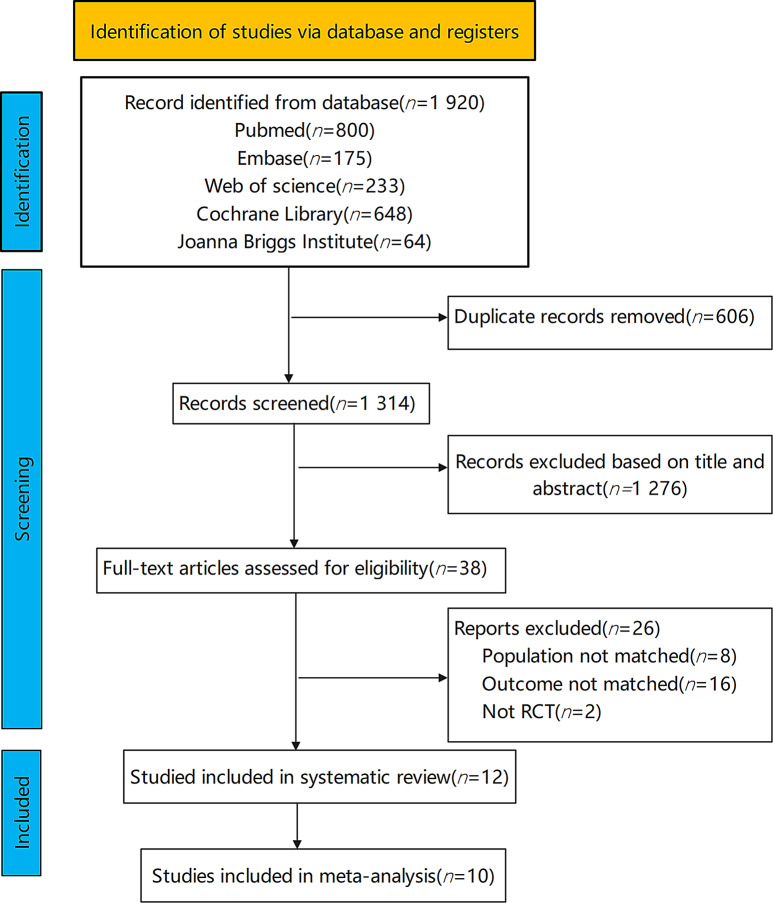
A comprehensive search was conducted using PubMed, Embase, Web of Science, Joanna Briggs Institute(JBI), and the Cochrane Library from their inception until September 16th, 2024. The search targeted randomized controlled trials (RCTs) comparing pulmonary rehabilitation or usual care, for improving respiratory function in mechanically ventilated patients. We performed a meta-analysis utilizing Endnote X9 and R 4.3.1.
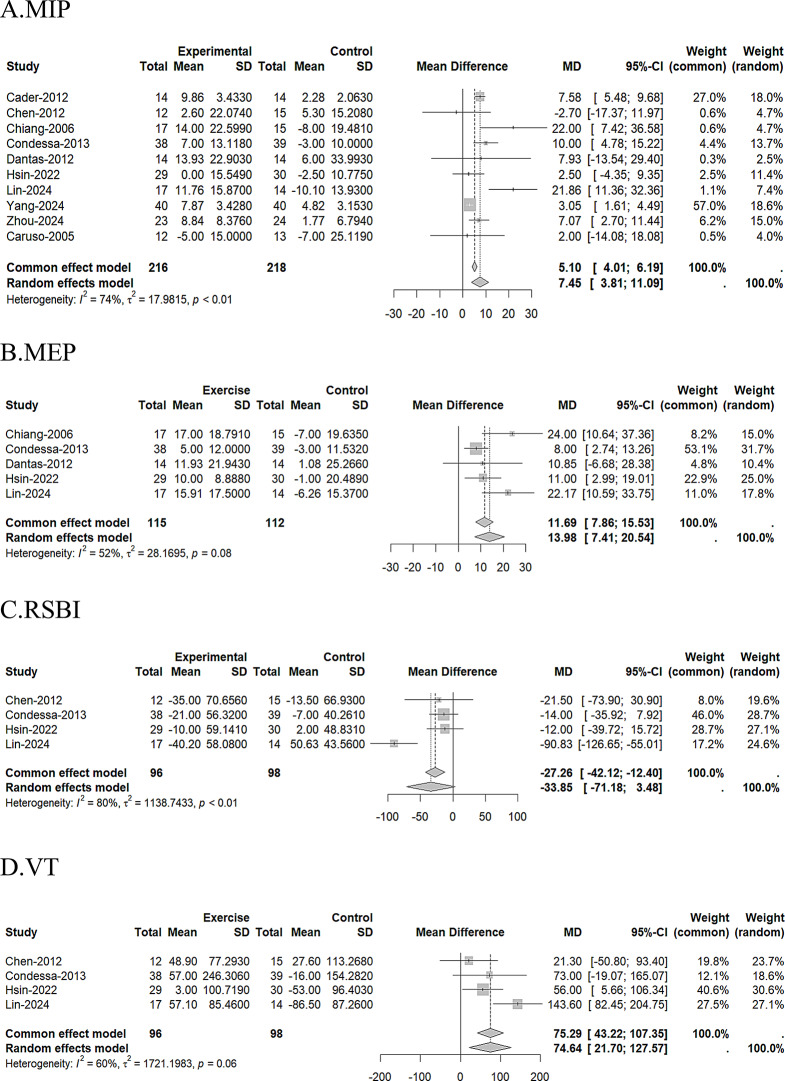
Twelve articles were included for systematic review and ten articles were analyzed in the meta-analysis.The primary outcomes such as Maximum inspiratory pressure(MIP)[n = 10 studies, sample size 216 (intervention) vs. 218 (control), MD = 7.45, 95% CI: 3.81 to 11.09], Maximum expiratory pressure(MEP)[n = 5 studies, sample size 115 (intervention) vs. 112 (control), MD = 13.98, 95% CI:7.41 to 20.54], Rapid shallow breathing index(RSBI)[n = 4 studies, sample size 96 (intervention) vs. 98 (control), MD = -33.85, 95% CI:-71.18 to 3.48] and Tidal volume(VT)[n = 4 studies, sample size 96 (intervention) vs. 98 (control), MD = 74.64, 95% CI:21.7 to 127.57] shows that MIP, MEP and VT significantly improved after the pulmonary rehabilitation.The random-effects models were employed because of the modest degree of heterogeneity present.
Pulmonary rehabilitation showed mixed effects on significantly improved the MIP, MEP, VT and DT. Pulmonary rehabilitation by inspiratory muscle training could administer the best therapeutic effect, followed by neuromuscular electrical stimulation.
Not applicable.
本系统评价和荟萃分析旨在探讨不同的肺康复对机械通气患者呼吸功能的影响,并确定最佳干预类型。
使用PubMed、Embase、Web of Science、乔安娜·布里格斯研究所(JBI)和考科蓝图书馆进行全面检索,检索时间从各数据库建库至2024年9月16日。检索目标为比较肺康复与常规护理以改善机械通气患者呼吸功能的随机对照试验(RCT)。我们使用Endnote X9和R 4.3.1进行荟萃分析。
纳入12篇文章进行系统评价,10篇文章纳入荟萃分析。主要结局指标如最大吸气压(MIP)[n = 10项研究,样本量216(干预组)对218(对照组),MD = 7.45,95%CI:3.81至11.09]、最大呼气压(MEP)[n = 5项研究,样本量115(干预组)对112(对照组),MD = 13.98,95%CI:7.41至20.54]、快速浅呼吸指数(RSBI)[n = 4项研究,样本量96(干预组)对98(对照组),MD = -33.85,95%CI:-71.18至3.48]和潮气量(VT)[n = 4项研究,样本量96(干预组)对98(对照组),MD = 74.64,95%CI:21.7至127.57]显示,肺康复后MIP、MEP和VT显著改善。由于存在中等程度的异质性,采用随机效应模型。
肺康复对显著改善MIP、MEP、VT和DT显示出混合效应。吸气肌训练的肺康复可产生最佳治疗效果,其次是神经肌肉电刺激。
不适用。