Bidgoli Mohammad Arbabpour, Behmanesh Arian, Khademi Navid, Thansirichaisree Phromphat, Zheng Zuduo, Tehrani Sara Saberi Moghadam, Mazloum Sajjad, Kongsilp Sirisilp
School of Civil Engineering, College of Engineering, University of Tehran, Tehran, Iran.
Thammasat School of Engineering, Faculty of Engineering, Thammasat University Rangsit, Klong Luang, Pathumthani, Thailand.
Sci Rep. 2025 Jan 4;15(1):761. doi: 10.1038/s41598-024-81271-8.
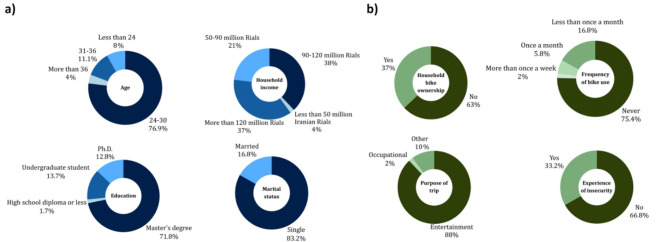
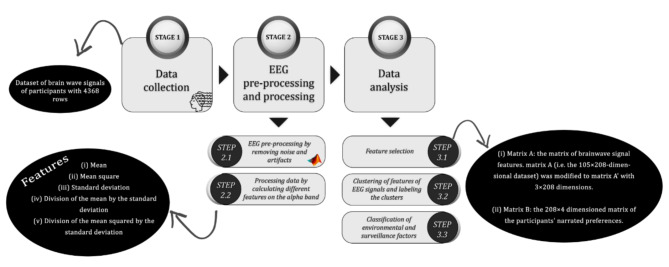
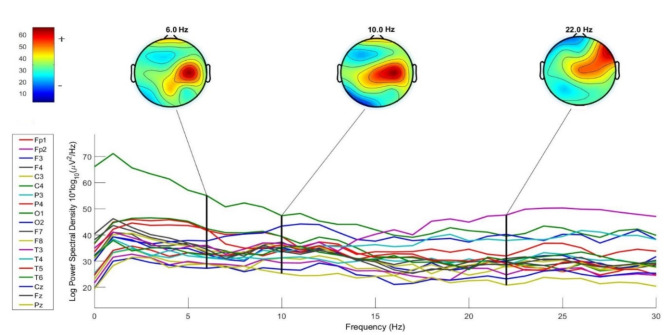
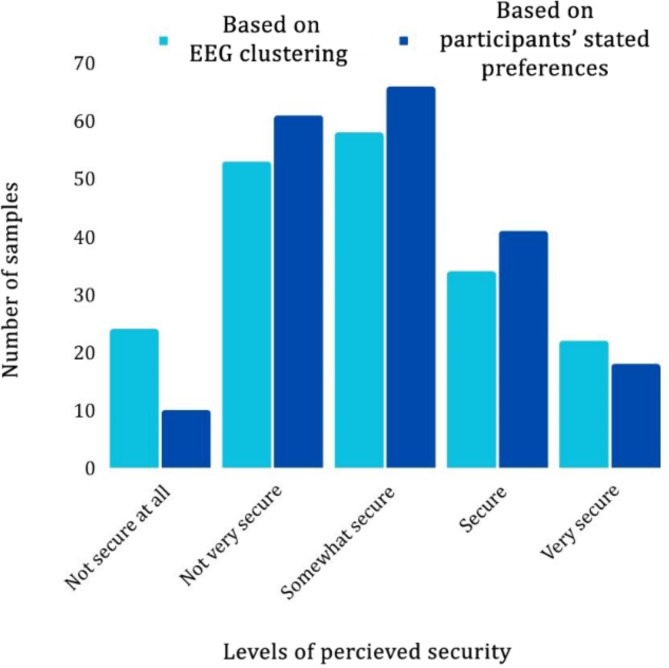
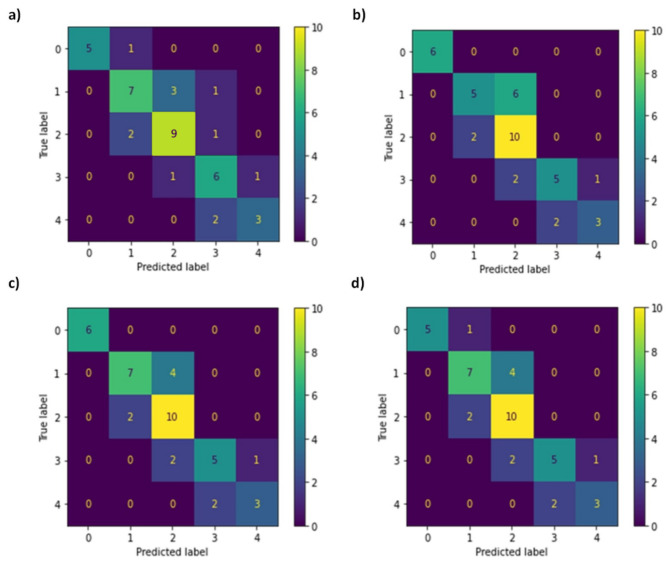
Active transportation, such as cycling, improves mobility and general health. However, statistics reveal that in low- and middle-income countries, male and female cycling participation rates differ significantly. Existing literature highlights that women's willingness to use bicycles is significantly influenced by their perception of security. This study employs virtual reality (VR) cycling simulation and electroencephalography (EEG) analysis to investigate factors influencing female cyclists' perceptions of security in Tehran. A total of 52 female participants took part in four scenarios within a VR bicycle simulator, which simulates various environmental settings. In this experiment, participants' brainwave signals are gathered through an EEG device, and a questionnaire with their stated preferences is filled out. The Gaussian mixture approach is used to cluster brainwave patterns based on security perception from EEG data. Subsequently, four supervised machine learning methods, random forest, support vector machine, logistic regression, and multilayer perceptron, are utilized to classify influential factors on security perception using clustered EEG data. Consequently, the support vector machine model, with an F1 score of 0.74, appears to be the most effective technique for the classification of environmental and surveillance factors. Furthermore, the SelectKBest algorithm determines that factors such as the presence of obstacles like kiosks, cycling routes passing through tunnels and underpasses, the level of incivility in the urban cycling environment, and the presence of informal surveillance have the biggest impact on female cyclists' security perception.
积极的交通方式,如骑自行车,可改善出行能力和总体健康状况。然而,统计数据显示,在低收入和中等收入国家,男性和女性的骑行参与率存在显著差异。现有文献强调,女性使用自行车的意愿受其安全感认知的显著影响。本研究采用虚拟现实(VR)骑行模拟和脑电图(EEG)分析,以调查影响德黑兰女性骑行者安全感认知的因素。共有52名女性参与者在VR自行车模拟器中参与了四种场景,该模拟器模拟了各种环境设置。在本实验中,通过EEG设备收集参与者的脑电波信号,并填写一份关于其既定偏好的问卷。高斯混合方法用于根据EEG数据中的安全感认知对脑电波模式进行聚类。随后,利用随机森林、支持向量机、逻辑回归和多层感知器这四种监督机器学习方法,使用聚类后的EEG数据对安全感认知的影响因素进行分类。因此,F1分数为0.74的支持向量机模型似乎是用于环境和监控因素分类的最有效技术。此外,SelectKBest算法确定,诸如售货亭等障碍物的存在、穿过隧道和地下通道的骑行路线、城市骑行环境中的不文明程度以及非正式监控的存在等因素,对女性骑行者的安全感认知影响最大。