Long Dongling, Li Min, Ma Lingchao, Huang Jiewen, Lv Chao, Chen Yiwen, Cheng Zile, Liu Chang, Huang Huitao, Guo Xiaokui, Yang Chao, Zhu Yongzhang
Zhuhai Center for Disease Control and Prevention, Zhuhai, China.
School of Global Health, Chinese Center for Tropical Diseases Research, Shanghai Jiao Tong University School of Medicine, Shanghai, China.
Commun Biol. 2025 Jan 4;8(1):9. doi: 10.1038/s42003-024-07426-5.
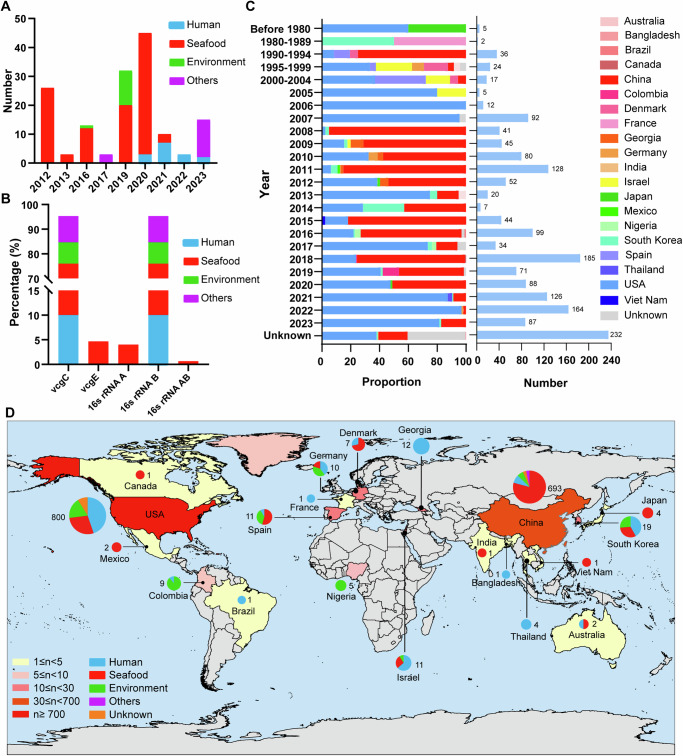
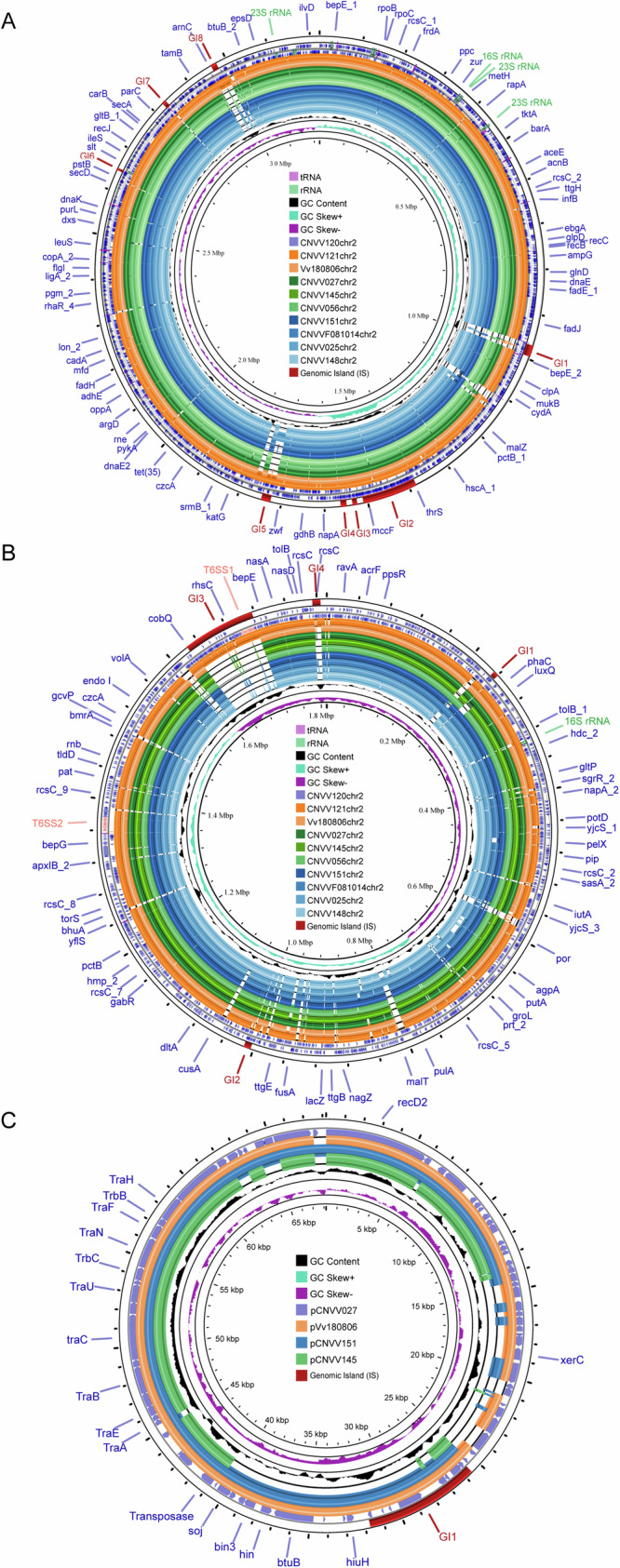
Vibrio vulnificus is a significant zoonotic pathogen that causes severe vibriosis in humans and fish. The lack of a national annual surveillance program in China has hindered understanding of its epidemiological characteristics and genetic diversity. This study characterized 150 V. vulnificus isolates collected from diverse sources in China during 2012-2023, including seafood, aquaculture water, migratory birds, marine animals, and clinical patients. Most seafood-derived isolates and all 15 clinical isolates harbored the virulence-related gene vcgC and 16S rRNA type B. The isolates exhibited diverse virulence factors (VFs), including flagella, outer membrane components, RTX toxins, and multiple secretion systems. Genes associated with the Type III secretion system were identified in migratory bird isolates, while a unique Type VI secretion system (T6SS1) were identified exclusively within a specific phylogenetic sub-lineage. T6SS1-positive strains demonstrated an increased number of genomic islands (GIs) and VFs compared to T6SS1-negative strains. Enrichment of genes related to secretion systems and biofilm formation likely facilitated the expansion of the T6SS1-positive population. The novel association between T6SS1 and a specific sub-lineage underscores potential ecological and adaptive advantages. These findings provide new insights into the ecological and evolutionary dynamics of V. vulnificus.
创伤弧菌是一种重要的人畜共患病原体,可导致人类和鱼类严重的弧菌病。中国缺乏全国性的年度监测计划,这阻碍了对其流行病学特征和遗传多样性的了解。本研究对2012年至2023年期间从中国不同来源收集的150株创伤弧菌分离株进行了特征分析,这些来源包括海鲜、水产养殖用水、候鸟、海洋动物和临床患者。大多数源自海鲜的分离株以及所有15株临床分离株都携带与毒力相关的基因vcgC和16S rRNA B型。这些分离株表现出多种毒力因子(VFs),包括鞭毛、外膜成分、RTX毒素和多种分泌系统。在候鸟分离株中鉴定出与III型分泌系统相关的基因,而独特的VI型分泌系统(T6SS1)仅在特定的系统发育亚谱系中被鉴定出来。与T6SS1阴性菌株相比,T6SS1阳性菌株的基因组岛(GIs)和VFs数量增加。与分泌系统和生物膜形成相关的基因富集可能促进了T6SS1阳性群体的扩张。T6SS1与特定亚谱系之间的新关联突出了潜在的生态和适应性优势。这些发现为创伤弧菌的生态和进化动态提供了新的见解。