Huang Si-Yue, Zeng Qing-Sheng, Shi Xin-Fu, He Yun-Ting, Fang Yue-Yi, Lai Ying-Si
Department of Medical Statistics, School of Public Health, Sun Yat-sen University, Guangzhou, Guangdong, People's Republic of China.
Xinhui District Center for Disease Control and Prevention, Jiangmen, Guangdong, People's Republic of China.
Infect Dis Poverty. 2025 Jan 6;14(1):1. doi: 10.1186/s40249-024-01271-8.
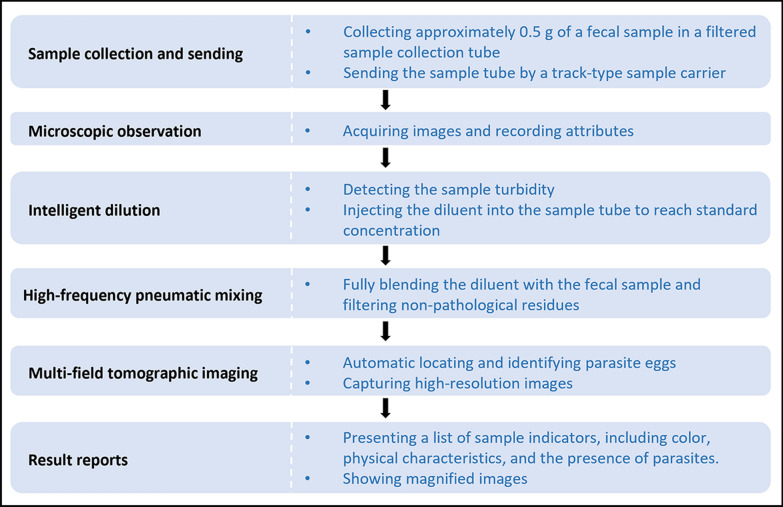
Clonorchiasis is an important foodborne parasitic disease in China caused by Clonorchis sinensis. Accurate and rapid diagnosis of this disease is vital for treatment and control. Traditional fecal examination methods, such as the Kato-Katz (KK) method, are labor-intensive, time-consuming, and have limited acceptance. The FA280, an advanced automated fecal analyzer, increases efficiency while significantly reducing labor load. This study aims to evaluate its performance, applicability, and scalability in clonorchiasis diagnosis to explore its potential application in the future.
A mixed-methods study integrating both quantitative and qualitative approaches was conducted. The quantitative component consisted of a cross-sectional survey in Xinhui District, Guangdong, China, to evaluate the diagnostic performance of the FA280. The positive rate and agreement between the FA280 and the KK method were evaluated using McNemar's test. Additionally, Pearson's Chi-square test was used to analyze the consistency of positive results between the two methods across various eggs per gram (EPG) groups under different cut-off values. The qualitative component included semi-structured individual interviews with medical staff and institutional administrators to examine the FA280's applicability and potential for broader adoption, with thematic analysis of the data.
In the quantitative study of 1000 participants, both the FA280 and KK methods detected clonorchiasis with a positive rate of 10.0%, achieving 96.8% agreement and showing no significant difference (P > 0.999). The kappa value was 0.82 (95% confidence interval: 0.76-0.88), indicating a strong agreement between the methods. The agreement rate for positive results between the two methods was significantly higher in the high infection intensity group compared to the low infection intensity group (P < 0.05). The qualitative study, which involved interviews with three medical staff and two administrators revealed that the FA280 outperformed the KK method in testing procedures, detection results, and user acceptance. The benefits, challenges, and suggestions of FA280 promotion were also emphasized.
This study demonstrated the FA280's application value in clonorchiasis diagnosis by assessing its detection performance, applicability, and scalability. These findings contribute to the future prevention and control of the disease.
华支睾吸虫病是由中华分支睾吸虫引起的一种在中国重要的食源性寄生虫病。准确、快速地诊断该病对于治疗和防控至关重要。传统的粪便检查方法,如加藤厚涂片法(KK法), labor-intensive,耗时且接受度有限。先进的自动粪便分析仪FA280提高了效率,同时显著减轻了劳动强度。本研究旨在评估其在华支睾吸虫病诊断中的性能、适用性和可扩展性,以探索其未来的潜在应用。
进行了一项整合定量和定性方法的混合方法研究。定量部分包括在中国广东省新会区进行的横断面调查,以评估FA280的诊断性能。使用McNemar检验评估FA280与KK法之间的阳性率和一致性。此外,使用Pearson卡方检验分析两种方法在不同截断值下各克虫卵数(EPG)组之间阳性结果的一致性。定性部分包括对医务人员和机构管理人员进行半结构化个人访谈,以检查FA280的适用性和更广泛采用的潜力,并对数据进行主题分析。
在对1000名参与者的定量研究中,FA280和KK法检测华支睾吸虫病的阳性率均为10.0%,一致性达到96.8%,差异无统计学意义(P>0.999)。kappa值为0.82(95%置信区间:0.76-0.88),表明两种方法之间有很强的一致性。高感染强度组中两种方法阳性结果的一致率明显高于低感染强度组(P<0.05)。定性研究涉及对三名医务人员和两名管理人员的访谈,结果显示FA280在检测程序、检测结果和用户接受度方面优于KK法。还强调了FA280推广的益处、挑战和建议。
本研究通过评估FA280的检测性能、适用性和可扩展性,证明了其在华支睾吸虫病诊断中的应用价值。这些发现有助于该病未来的预防和控制。