Tang Haiming, Wen Li, Shi Lihong, Cheng Kaikai, Sun Geng, Sun Mei, Li Weiyan
Hunan Soil and Fertilizer Institute, Changsha, 410125, China.
Sci Rep. 2025 Jan 5;15(1):852. doi: 10.1038/s41598-025-85289-4.
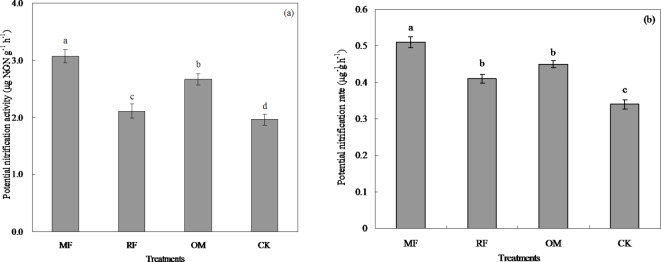
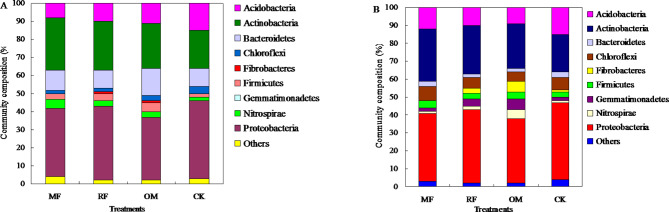
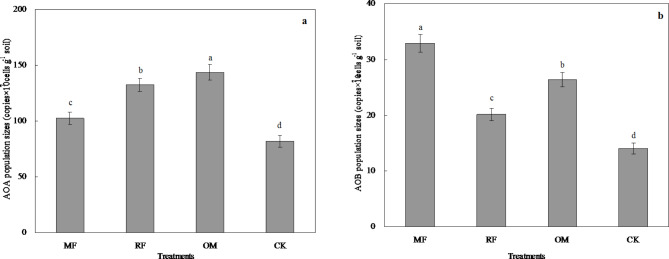
Ammonia oxidation plays a vital role in regulating soil nitrogen (N) cycle in agricultural soil, which is significantly influenced by different fertilizer regimes. However, there is still need to further investigate the effects of different fertilizer managements on rhizosphere soil ammonia-oxidizing archaea (AOA) and bacteria (AOB) community in the double-cropping rice field. Therefore, the effects of different long-term (37 years) fertilizer managements on rhizosphere soil potential nitrification activity (PNA), AOA and AOB community structure, and its relationship under the double-cropping rice system in southern of China were studied in the present paper. The field experiment included without fertilizer input as a control (CK), inorganic fertilizer (MF), rice straw and inorganic fertilizer (RF), 30% organic manure and 70% inorganic fertilizer (OM). This result indicated that rhizosphere soil organic carbon (SOC) (SOC), total N and ammonium N (NH-N) contents in paddy field with RF and OM treatments were increased. Rhizosphere soil PNA, potential nitrification rate (PNR) and abundance of AOB in paddy field with MF treatment were increased, and abundance of AOA in paddy field with RF and OM treatments were increased, respectively. The result also showed that rhizosphere soil diversity index of AOA and AOB with RF and OM treatments were enhanced, compared with CK treatment. Rhizosphere soil AOB and AOA community composition was dominated by Proteobacteria, Actinobacteria and Acidobacteria with all fertilizer treatments. There had significantly positively correlation between the abundance of AOA and SOC, total N, and NH-N contents. However, there had significantly negatively correlation between soil pH and abundance of AOA, soil PNA, PNR. As a result, long-term application of rice straw and organic manure was benefit for increasing community structure of rhizosphere soil ammonia oxidizer under the double-cropping rice system in southern of China.
氨氧化在调控农业土壤氮循环中起着至关重要的作用,这受到不同施肥制度的显著影响。然而,仍需进一步研究不同施肥管理对双季稻田根际土壤氨氧化古菌(AOA)和细菌(AOB)群落的影响。因此,本文研究了中国南方双季稻系统下不同长期(37年)施肥管理对根际土壤潜在硝化活性(PNA)、AOA和AOB群落结构及其关系的影响。田间试验包括不施肥作为对照(CK)、无机肥(MF)、稻草和无机肥(RF)、30%有机肥和70%无机肥(OM)。结果表明,RF和OM处理的稻田根际土壤有机碳(SOC)、全氮和铵态氮(NH-N)含量增加。MF处理的稻田根际土壤PNA、潜在硝化速率(PNR)和AOB丰度增加,RF和OM处理的稻田AOA丰度分别增加。结果还表明,与CK处理相比,RF和OM处理的根际土壤AOA和AOB多样性指数提高。所有施肥处理下,根际土壤AOB和AOA群落组成均以变形菌门、放线菌门和酸杆菌门为主。AOA丰度与SOC、全氮和NH-N含量之间存在显著正相关。然而,土壤pH与AOA丰度、土壤PNA、PNR之间存在显著负相关。因此,在中国南方双季稻系统下,长期施用稻草和有机肥有利于增加根际土壤氨氧化菌的群落结构。