Gartner Austin, Dombrowski Nicholas, Lowe Nick, Behzadpour Vafa, Zackula Rosey
University of Kansas School of Medicine-Kansas City, Kansas City, KS.
University of Kansas School of Medicine-Wichita, Wichita, KS.
Kans J Med. 2024 Sep 5;17(5):119-124. doi: 10.17161/kjm.vol17.22146. eCollection 2024 Sep-Oct.
To investigate the role that foot-strike hemolysis plays in sports-related anemia in marathon and ultramarathon runners.
PubMed, Embase, Cochrane, Grey literature.
Inclusion criteria consisted of human studies with runners completing a sanctioned race of marathon distance or greater, with outcomes measured by pre- and post-race hematological assessments.
Three independent reviewers systematically extracted data from selected studies. Data included age, sex, height, weight, best marathon time, and pre- and post-race outcomes for complete blood count, reticulocyte count, and iron studies. The evaluation of potential bias was conducted using the Methodological Index for Nonrandomized Studies (MINORS) criteria.
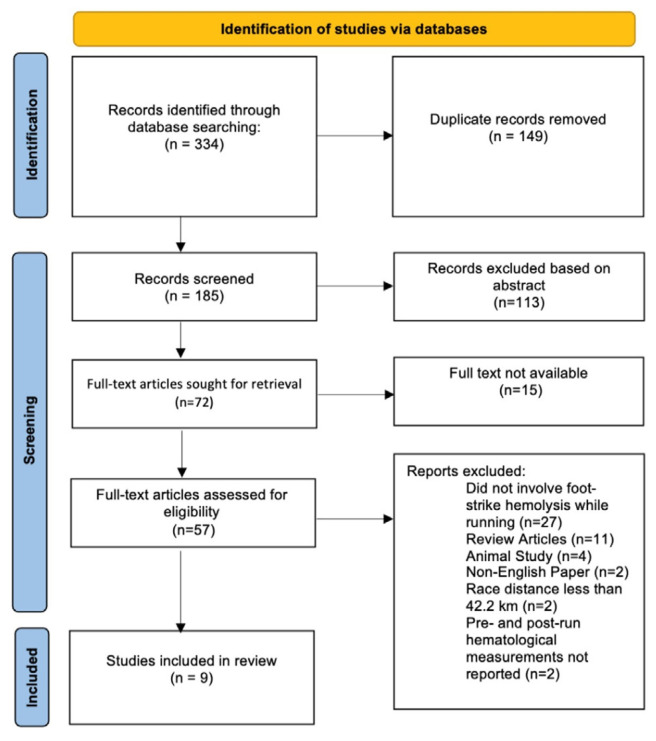
The literature search yielded 334 studies, of which nine met the inclusion criteria, encompassing data from 267 runners. The majority (88%, 236 out of 267) were male, with a weighted mean age of 37 years (SD 8.2). The reticulocyte count demonstrated a 16% increase between pre- and post-race measurements, although still within normal limits, while haptoglobin levels were reduced by 21%. Hemoglobin, hematocrit, and RBC count values remained within accepted normal limits.
Changes in reticulocyte count and haptoglobin levels suggest transient foot-strike hemolysis; however, hemoglobin and hematocrit levels did not change notably. It is unclear whether these associations are influenced by differences in runner demographics, running experience, or race characteristics. Further studies should evaluate hemolytic changes while matching participants by demographic characteristics, level of running experience, and specific marathon course characteristics. Additionally, research should analyze whether intravascular hemolysis occurs at race distances shorter than 42.2 km.
探讨跑步时足部撞击导致的溶血在马拉松和超级马拉松运动员运动相关性贫血中所起的作用。
PubMed、Embase、Cochrane、灰色文献。
纳入标准包括针对完成马拉松或更长距离官方比赛的跑步者的人体研究,研究结果通过赛前和赛后血液学评估来衡量。
三名独立评审员系统地从选定研究中提取数据。数据包括年龄、性别、身高、体重、最佳马拉松成绩以及全血细胞计数、网织红细胞计数和铁代谢研究的赛前和赛后结果。使用非随机研究方法学指数(MINORS)标准对潜在偏倚进行评估。
文献检索共获得334项研究,其中9项符合纳入标准,涵盖267名跑步者的数据。大多数(88%,267名中的236名)为男性,加权平均年龄为37岁(标准差8.2)。网织红细胞计数在赛前和赛后测量之间显示出16%的增加,尽管仍在正常范围内,而触珠蛋白水平降低了21%。血红蛋白、血细胞比容和红细胞计数仍在公认的正常范围内。
网织红细胞计数和触珠蛋白水平的变化表明存在短暂的足部撞击溶血;然而,血红蛋白和血细胞比容水平没有明显变化。尚不清楚这些关联是否受到跑步者人口统计学、跑步经验或比赛特征差异的影响。进一步的研究应在根据人口统计学特征、跑步经验水平和特定马拉松赛道特征匹配参与者的同时,评估溶血变化。此外,研究应分析血管内溶血是否发生在距离短于42.2公里的比赛中。