Mori Tommaso, Nagaraj Nareshkumar Ragavachetty, Surico Pier Luigi, Zhou Wenjing, Parmar Uday Pratap Singh, D'Esposito Fabiana, Gagliano Caterina, Musa Mutali, Zeppieri Marco
Department of Pathology, University of California, San Diego, La Jolla, CA, 92093, United States of America.
Department of Ophthalmology, Campus Bio-Medico University Hospital, Rome, 00128, Italy.
Open Life Sci. 2024 Dec 31;19(1):20221023. doi: 10.1515/biol-2022-1023. eCollection 2024.
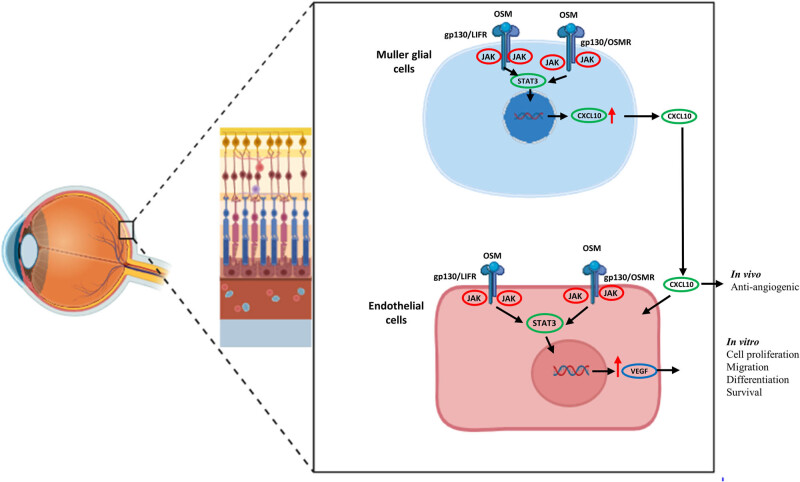
Retinal diseases, which can lead to significant vision loss, are complex conditions involving various cellular and molecular mechanisms. The interleukin-6 (IL-6) family, particularly Oncostatin M (OSM), has garnered attention for their roles in retinal inflammation, angiogenesis, and neuroprotection. This comprehensive review explores the dual nature of OSM and other IL-6 family members in retinal pathophysiology, highlighting their contribution to both degenerative and regenerative processes. The review also examines current research on OSM's interaction with key signaling pathways and discusses the potential of OSM and the IL-6 family as potential therapeutic targets. Understanding these mechanisms could lead to innovative treatments that modulate OSM activity, offering new avenues for managing retinal diseases and contributing to the development of more effective interventions.
视网膜疾病可导致严重的视力丧失,是涉及多种细胞和分子机制的复杂病症。白细胞介素-6(IL-6)家族,特别是制瘤素M(OSM),因其在视网膜炎症、血管生成和神经保护中的作用而受到关注。这篇综述探讨了OSM和其他IL-6家族成员在视网膜病理生理学中的双重性质,强调了它们对退行性和再生过程的贡献。该综述还研究了目前关于OSM与关键信号通路相互作用的研究,并讨论了OSM和IL-6家族作为潜在治疗靶点的潜力。了解这些机制可能会带来调节OSM活性的创新疗法,为视网膜疾病的管理提供新途径,并推动更有效干预措施的发展。