Orellana Federica, Grassi Alberto, Nuss Katja M, Wahl Peter, Neels Antonia, Zaffagnini Stefano, Parrilli Annapaola
Empa - Swiss Federal Laboratories for Materials Science and Technology, 8600, Dübendorf, Switzerland.
Department of Chemistry, University of Fribourg, 1700, Fribourg, Switzerland.
Heliyon. 2024 Dec 7;10(24):e41080. doi: 10.1016/j.heliyon.2024.e41080. eCollection 2024 Dec 30.
The visualization of soft tissues, like the meniscus, through X-ray micro-computed tomography (micro-CT), requires the use of contrast agents (CAs). While other studies have investigated CA diffusion in fibrocartilagineous tissues, this work aimed to optimize iodine staining protocols for meniscal tissue that improve their visualization by micro-CT. Specific objectives included evaluating the diffusion of CAs within meniscal samples over time, assessing volume changes due to staining, and identifying the iodine ions absorbed by the tissue.
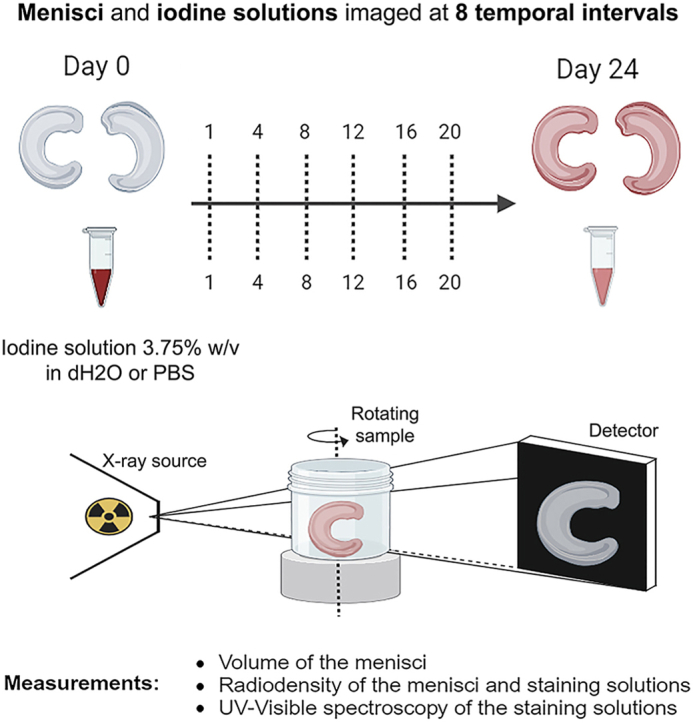
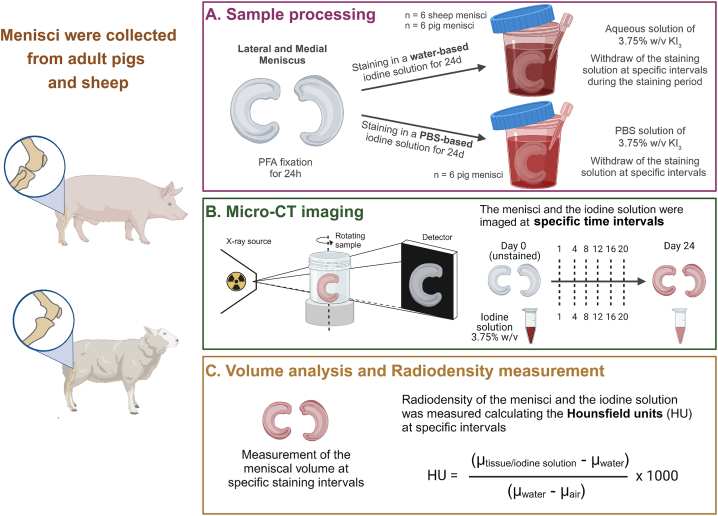
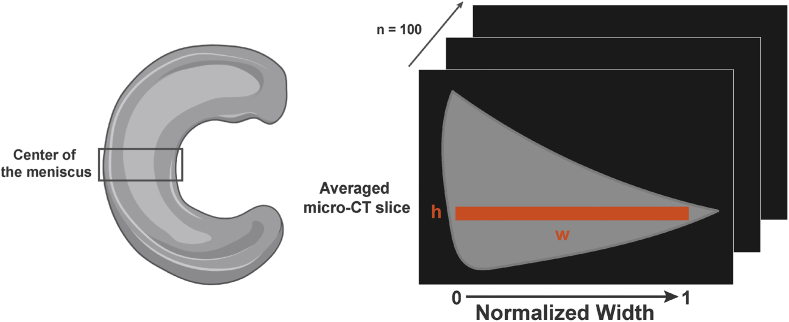
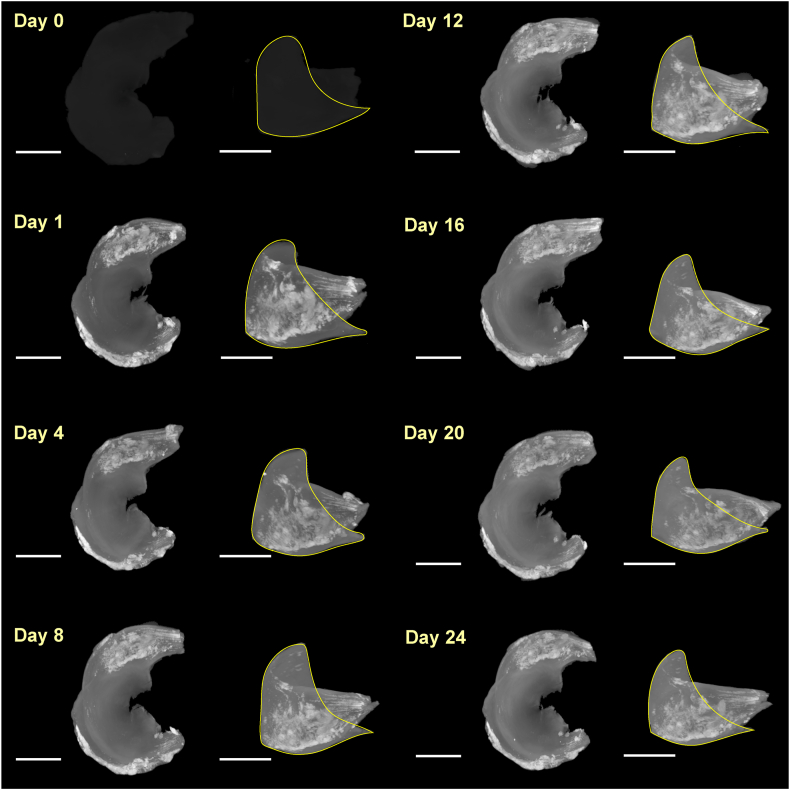
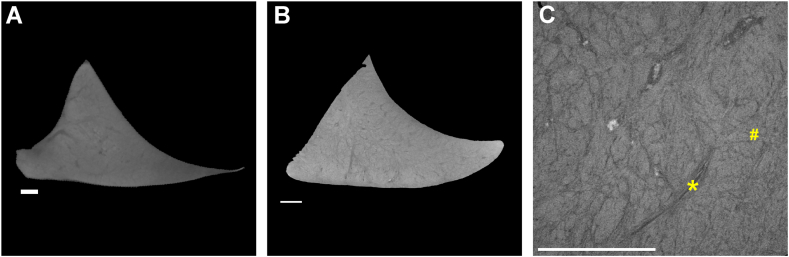
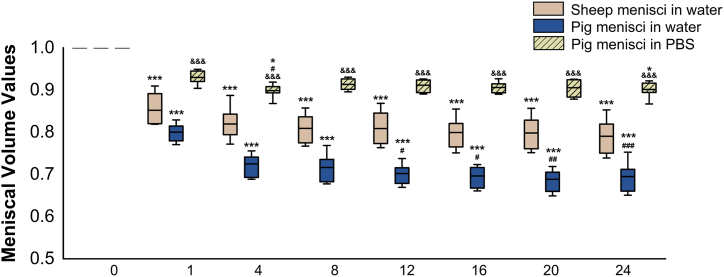
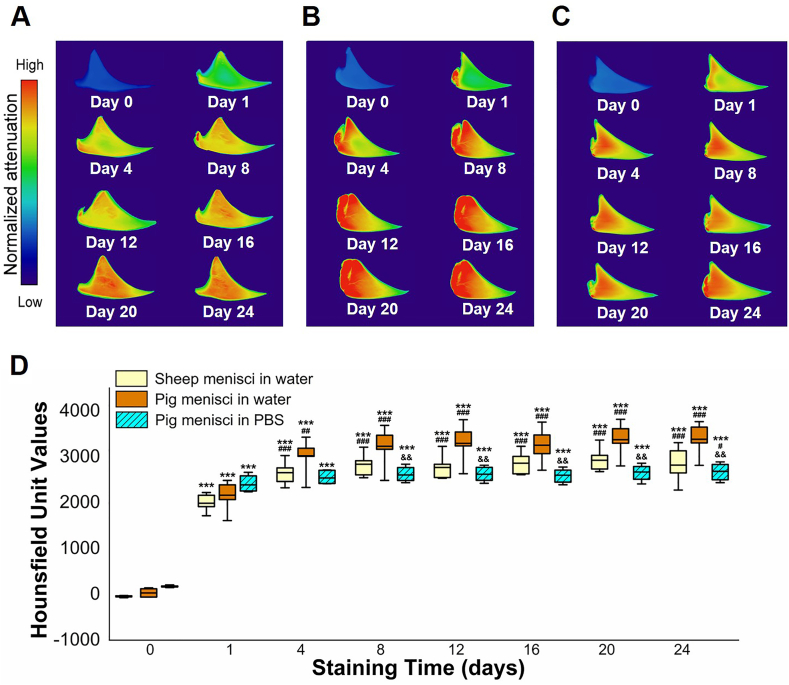
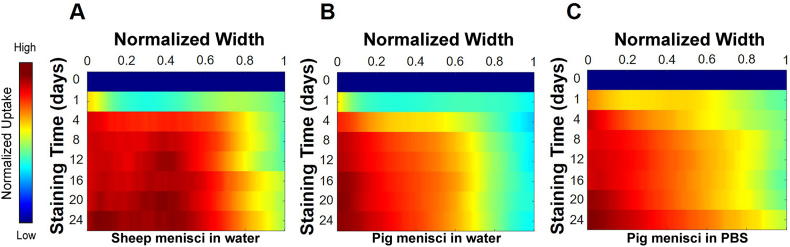
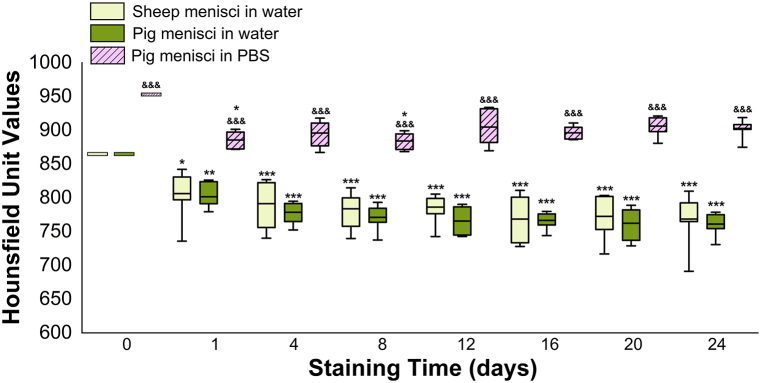
Water-based and PBS-based Lugol solutions (KI) were used to stain sheep and pig menisci for 24 days. Samples were scanned using micro-CT at different time points (0, 1, 4, 8, 12, 16, 20, and 24 days) to monitor CA diffusion and volume changes. Micro-CT provided three-dimensional (3D) visualization of iodine distribution and quantification of volume changes and radiodensity in the menisci. Additionally, UV-visible spectroscopy (UV-vis) analyses were performed to determine the uptake of iodine ions by the meniscus.
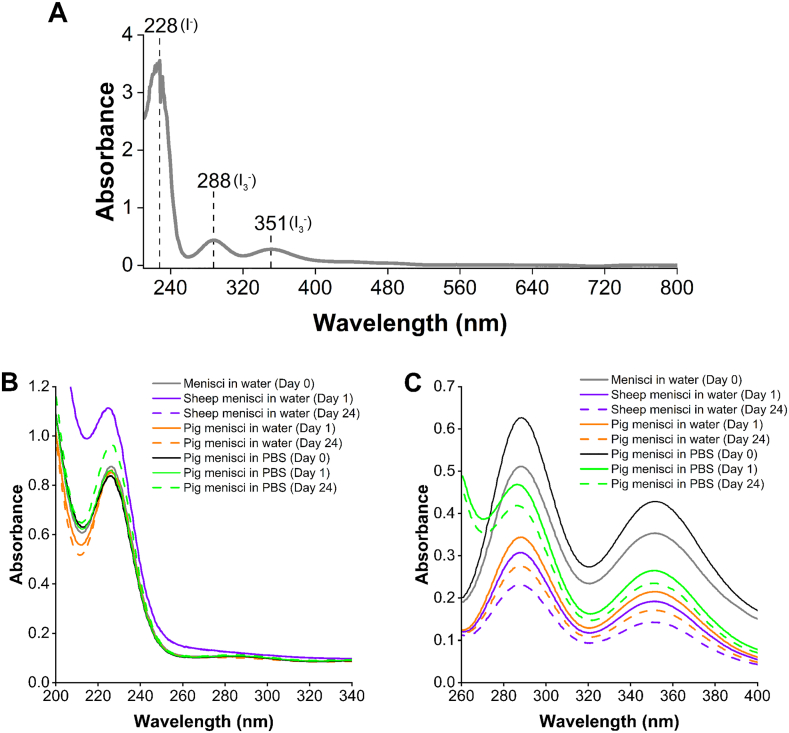
Results indicated volumetric shrinkage and increased radiodensity within the first days of staining, with diffusion primarily occurring from the periphery of the meniscus. UV-visible spectroscopy identified two iodide ions in the CA solution (I and I ) and revealed a preferential absorption of the triiodide ion (I ).
This study demonstrated the utility of iodine-based CAs and micro-CT technique for visualizing and investigating the spatial and temporal iodine diffusion within the meniscal tissue of sheep and pigs. The findings of this study have important implications for using iodine-based CAs in imaging analyses of the meniscus and offer potentially valuable insights into the diffusion patterns of iodine in fibrocartilagineous tissues.
通过X射线显微计算机断层扫描(显微CT)对半月板等软组织进行可视化成像,需要使用造影剂(CA)。虽然其他研究已对造影剂在纤维软骨组织中的扩散进行了调查,但本研究旨在优化半月板组织的碘染色方案,以通过显微CT改善其可视化效果。具体目标包括评估造影剂在半月板样本中的随时间扩散情况、评估染色引起的体积变化,以及确定组织吸收的碘离子。
使用水基和基于磷酸盐缓冲盐水(PBS)的卢戈氏溶液(KI)对绵羊和猪的半月板进行24天的染色。在不同时间点(0、1、4、8、12、16、20和24天)使用显微CT对样本进行扫描,以监测造影剂扩散和体积变化。显微CT提供了碘分布的三维(3D)可视化以及半月板体积变化和放射密度的量化。此外,还进行了紫外可见光谱(UV-vis)分析,以确定半月板对碘离子的摄取情况。
结果表明,在染色的最初几天内,半月板体积缩小且放射密度增加,扩散主要发生在半月板周边。紫外可见光谱鉴定出造影剂溶液中的两种碘离子(I⁻和I₂),并显示出对三碘离子(I₃⁻)的优先吸收。
本研究证明了基于碘的造影剂和显微CT技术在可视化和研究绵羊和猪半月板组织内碘的空间和时间扩散方面的实用性。本研究结果对于在半月板成像分析中使用基于碘的造影剂具有重要意义,并为碘在纤维软骨组织中的扩散模式提供了潜在的有价值见解。