Bergmann Thomas, Ye Wanzhi, Rietz Steffen, Cai Daguang
Department of Molecular Phytopathology and Biotechnology, Institute of Phytopathology, Christian-Albrechts-University of Kiel, 24118, Kiel, Germany.
School of Biological Sciences, The University of Western Australia, Perth, Western Australia, 6009, Australia.
Mol Genet Genomics. 2025 Jan 7;300(1):13. doi: 10.1007/s00438-024-02223-5.
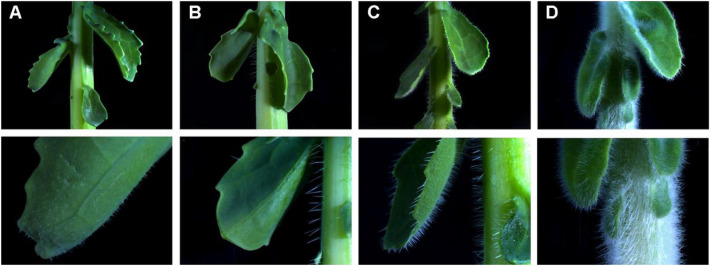
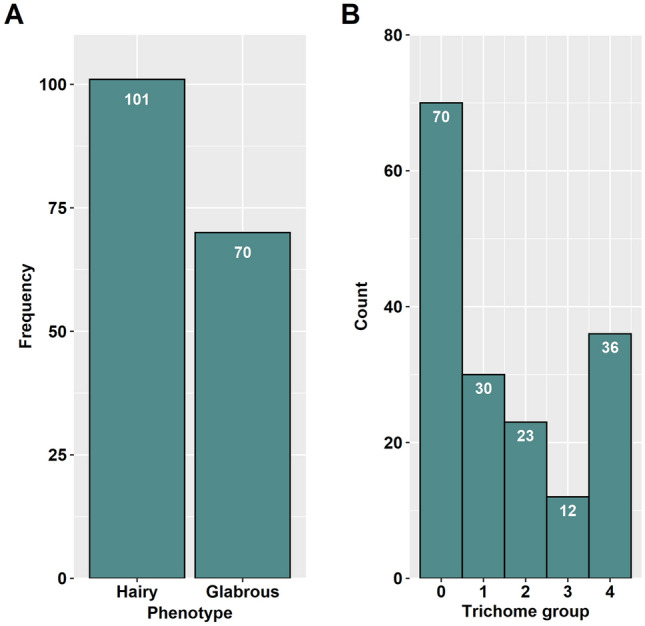
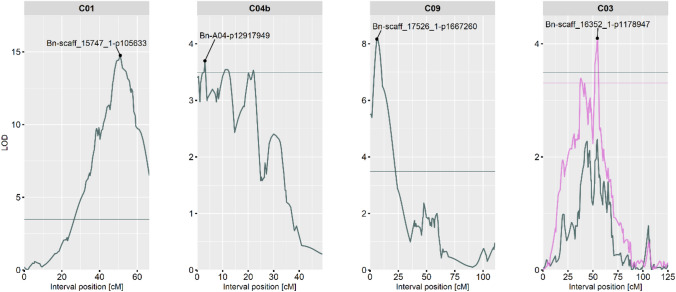
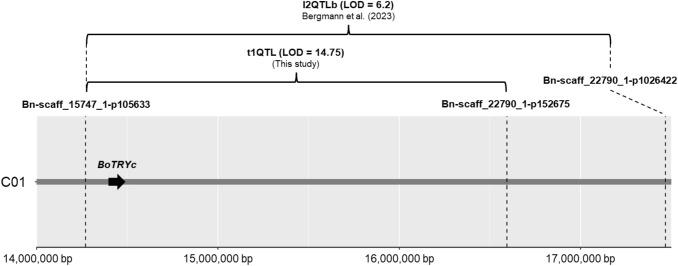
Brassica villosa is characterized by its dense hairiness and high resistance against the fungal pathogen Sclerotinia sclerotiorum. Information on the genetic and molecular mechanisms governing trichome development in B. villosa is rare. Here, we analyzed an F population, derived from a cross between B. villosa and the glabrous B. oleracea by QTL mapping and transcriptomic analyses. As a result, the phenotyping of 171 F progenies revealed a wide range of variation in trichome development. Subsequent genotyping with the 15-k Illumina SNP array resulted in a genetic map with 970 markers and a total length of 812 cM. Four QTLs were identified, which explained phenotypic variation from 3.2% to 40.3%. Interestingly, one of these was partially co-localized with the major QTL for Sclerotinia-resistance previously detected in the same F population. However, only a moderate correlation between trichomes and Sclerotinia-resistance was observed. In total, 133 differentially expressed genes (DEGs) associated with trichome development were identified, from which only BoTRY, an orthologue of Arabidopsis TRY encoding a MYB transcription factor negatively regulating trichome development, was located within the major QTL. Expression of BoTRY was tissue-specific and highly variable between the hairy and glabrous species, suggesting that BoTRY may also act as a master-switch regulator of trichome development in B. villosa. This study provides valuable data for further understanding the genetic architecture of trichome development and identifying related genes and mechanisms in Brassica species. Molecular markers can be developed to facilitate the introgression and selection of this trait in oilseed rape breeding.
绒毛甘蓝的特点是密被绒毛且对真菌病原体核盘菌具有高度抗性。关于绒毛甘蓝中控制毛状体发育的遗传和分子机制的信息很少。在这里,我们通过QTL定位和转录组分析,分析了一个由绒毛甘蓝和无毛甘蓝杂交产生的F群体。结果,对171个F后代的表型分析揭示了毛状体发育的广泛变异。随后使用15k Illumina SNP芯片进行基因分型,得到了一张包含970个标记、总长度为812 cM的遗传图谱。鉴定出了4个QTL,它们解释了3.2%至40.3%的表型变异。有趣的是,其中一个QTL与之前在同一F群体中检测到的抗核盘菌主要QTL部分共定位。然而,仅观察到毛状体与抗核盘菌之间存在中等程度的相关性。总共鉴定出133个与毛状体发育相关的差异表达基因(DEG),其中只有拟南芥TRY的直系同源基因BoTRY位于主要QTL内,BoTRY编码一个负调控毛状体发育的MYB转录因子。BoTRY的表达具有组织特异性,在有毛和无毛物种之间变化很大,这表明BoTRY也可能是绒毛甘蓝中毛状体发育的主开关调节因子。本研究为进一步了解甘蓝物种中毛状体发育的遗传结构以及鉴定相关基因和机制提供了有价值的数据。可以开发分子标记,以促进该性状在油菜育种中的渗入和选择。