
甘油三酯葡萄糖指数(TyG)与体型指数(ABSI)联合与中风发病率的关系:一项全国性前瞻性队列研究。
Joint association of triglyceride glucose index (TyG) and a body shape index (ABSI) with stroke incidence: a nationwide prospective cohort study.
作者信息
Zhang Ruiying, Hong Jianan, Wu Yaoling, Lin Liling, Chen Shuying, Xiao Yingxiu
机构信息
Department of Neurology, the First Affiliated Hospital of Shantou University Medical College, Shantou, Guangdong, China.
Shantou University Medical College, Shantou, Guangdong, China.
出版信息
Cardiovasc Diabetol. 2025 Jan 6;24(1):7. doi: 10.1186/s12933-024-02569-5.
BACKGROUND
Triglyceride glucose index(TyG) and a body shape index(ABSI) are both independent predictor of stroke incidence or adverse prognosis but these two indicators seldom were combined to predict. The purpose of this study is to evaluate whether the combination of TyG and ABSI better predict the incidence of stroke.
METHODS
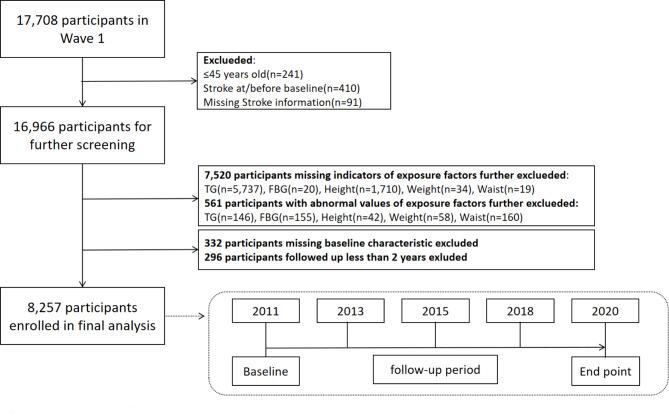
Based on the China Health and Retirement Longitudinal Study(CHARLS), 8,257 people aged 45 years and older without stroke were enrolled and followed up to 9 years. Sociodemographic information, health status, physical examination and blood data were collected retrospectively. Cox regressions were to determine the relationship between different groups and stroke incidence, using receiver operating characteristic curves to evaluate the diagnostic value. Meanwhile, subgroup analysis was performed to investigate the prediction performance among different population.
RESULTS
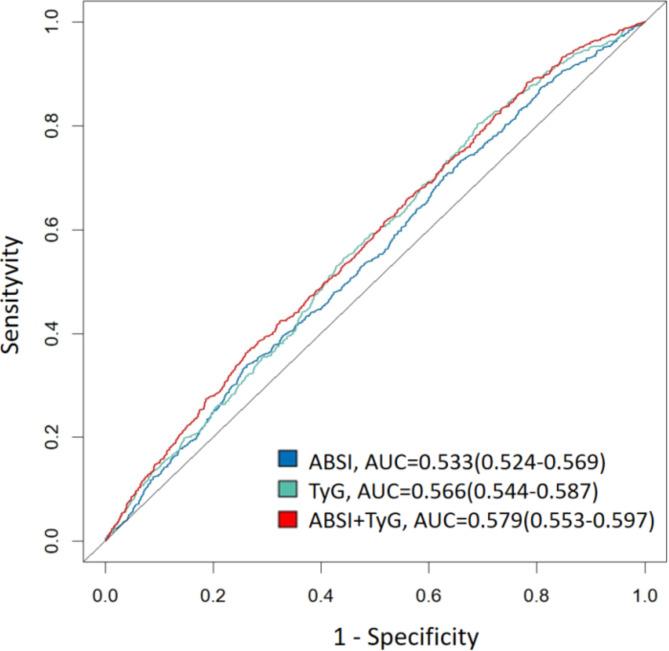
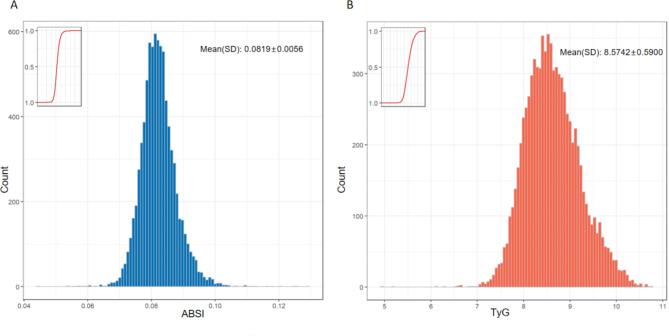
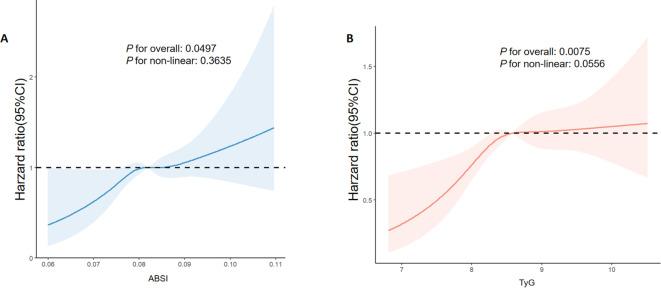
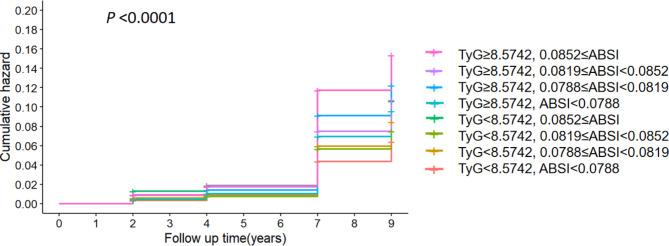
672(8.14%) of 8,257 participants had stroke incidence during 9 years. In the adjusted multivariate cox regression model, both TyG and ABSI were still predictors of stroke. The HR of TyG was 1.25(95%CI: 1.06-1.47) and the HR of ABSI was 1.33(95%CI: 1.06-1.68). Restricted cubic spline regression showed the associations between TyG or ABSI and stroke. The combination of TyG and ABSI had the highest diagnostic efficacy(AUC: 0.579, 95%CI: 0.553-0.597), compared to TyG(AUC:0.566, 95%CI: 0.544-0.587) and ABSI(AUC:0.533, 95%CI: 0.524-0.597). Kaplan-Meier curves showed that the highest cumulative stroke incidence was among people with high TyG and ABSI(TyG ≥ 8.5742, ABSI ≥ 0.0852; P < 0.0001), which had the highest HR of stroke incidence(HR:1.64, 95%CI:1.2-2.24).
CONCLUSION
The combined prediction of TyG and ABSI had higher clinical value and enabled earlier detection of the stroke in the general population, which could be monitored and intervened to reduce the overall burden of stroke.
背景
甘油三酯葡萄糖指数(TyG)和体型指数(ABSI)都是中风发病率或不良预后的独立预测指标,但这两个指标很少被联合起来进行预测。本研究的目的是评估TyG和ABSI联合使用是否能更好地预测中风的发病率。
方法
基于中国健康与养老追踪调查(CHARLS),纳入8257名年龄在45岁及以上且无中风的人群,并随访9年。回顾性收集社会人口学信息、健康状况、体格检查和血液数据。采用Cox回归确定不同组与中风发病率之间的关系,使用受试者工作特征曲线评估诊断价值。同时,进行亚组分析以研究不同人群中的预测性能。
结果
8257名参与者中有672人(8.14%)在9年期间发生了中风。在调整后的多变量Cox回归模型中,TyG和ABSI仍然是中风的预测指标。TyG的风险比(HR)为1.25(95%置信区间:1.06 - 1.47),ABSI的HR为1.33(95%置信区间:1.06 - 1.68)。受限立方样条回归显示了TyG或ABSI与中风之间的关联。与TyG(AUC:0.566,95%置信区间:0.544 - 0.587)和ABSI(AUC:0.533,95%置信区间:0.524 - 0.597)相比,TyG和ABSI联合使用具有最高的诊断效能(AUC:0.579,95%置信区间:0.553 - 0.597)。Kaplan - Meier曲线显示,TyG和ABSI高的人群(TyG≥8.5742,ABSI≥0.0852;P < 0.0001)中风累积发病率最高,其中风发病率的HR最高(HR:1.64,95%置信区间:1.2 - 2.24)。
结论
TyG和ABSI的联合预测具有更高的临床价值,能够在普通人群中更早地检测到中风,可对其进行监测和干预以减轻中风的总体负担。
 Zotero 插件