Gezelle Jeanine G, Korn Sophie M, McDonald Jayden T, Gong Zhen, Erickson Anna, Huang Chih-Hung, Yang Feiyue, Cronin Matt, Kuo Yen-Wen, Wimberly Brian T, Steckelberg Anna-Lena
Department of Biochemistry and Molecular Biophysics, Columbia University, New York, NY, USA.
Department of Plant Pathology, University of California, Davis, CA, USA.
bioRxiv. 2024 Dec 18:2024.12.17.628992. doi: 10.1101/2024.12.17.628992.
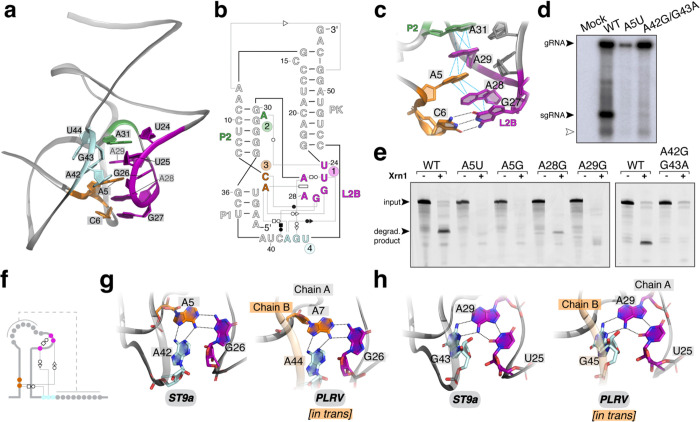
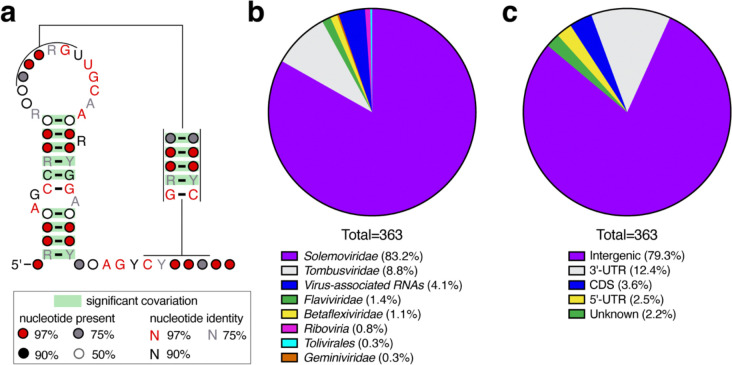
Exoribonuclease-resistant RNAs (xrRNAs) are viral RNA structures that block degradation by cellular 5'-3' exoribonucleases to produce subgenomic viral RNAs during infection. Initially discovered in flaviviruses, xrRNAs have since been identified in wide range of RNA viruses, including those that infect plants. High sequence variability among viral xrRNAs raises questions about the shared molecular features that characterize this functional RNA class. Here, we present the first structure of a plant-virus xrRNA in its active exoribonuclease-resistant conformation. The xrRNA forms a 9 base pair pseudoknot that creates a knot-like topology similar to that of flavivirus xrRNAs, despite lacking sequence similarity. Biophysical assays confirm a compact pseudoknot structure in solution, and functional studies validate its relevance both and during infection. Our study reveals how viral RNAs achieve a common functional outcome through highly divergent sequences and identifies the knot-like topology as a defining feature of xrRNAs.
抗外切核糖核酸酶RNA(xrRNAs)是一种病毒RNA结构,在感染过程中可阻止细胞5'-3'外切核糖核酸酶的降解作用,从而产生亚基因组病毒RNA(subgenomic viral RNAs)。xrRNAs最初是在黄病毒中发现的,此后在多种RNA病毒中都有发现,包括那些感染植物的病毒。病毒xrRNAs之间高度的序列变异性引发了关于这一功能性RNA类别共有分子特征的问题。在此,我们展示了植物病毒xrRNA处于其具有活性的抗外切核糖核酸酶构象时的首个结构。尽管缺乏序列相似性,但该xrRNA形成了一个9碱基对的假结,其拓扑结构类似于黄病毒xrRNAs,呈类结状。生物物理分析证实了溶液中该假结结构的紧密性,功能研究验证了其在体外和感染过程中的相关性。我们的研究揭示了病毒RNA如何通过高度不同的序列实现共同的功能结果,并确定类结状拓扑结构是xrRNAs的一个决定性特征。