Yamada Ana Lúcia Yoshida da Silva, Merenda Mônica Estela Zambon, Pereira Layne Carolina, Bonneti Nayara Maira Dalgallo, Martins Isabela de Oliveira, Komarcheuski Alina Stadnik, Henríquez Lucas Ben Fiuza, Watanabe Eduardo Kato, Coelho Guilherme Bernardo Cornélio, Janeiro Vanderly, Mascarenhas Nilva Maria Freres, Vasconcellos Ricardo Souza
Department of Veterinary Clinics, State University of Londrina (UEL), Londrina 86057-970, Brazil.
Department of Animal Science, State University of Maringá (UEM), Maringá 87020-900, Brazil.
Animals (Basel). 2024 Dec 11;14(24):3574. doi: 10.3390/ani14243574.
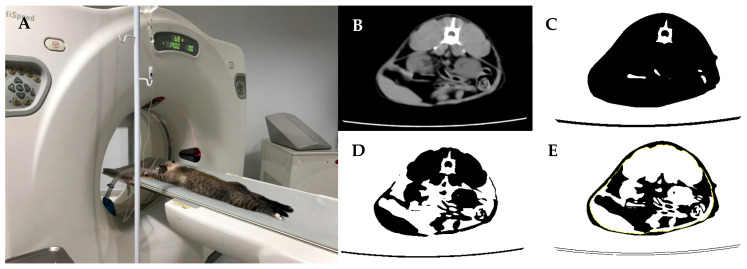
Isoflavones are composed of phytoestrogens (genistein and daidzein), which can be metabolized by cats. These compounds can promote the maintenance of lean body mass and control food intake. These effects are desirable in neutered animals, as they are predisposed to obesity. The objective of this study was to evaluate the effects of dietary supplementation of 1.0% isoflavone on the metabolizable energy intake, serum concentrations of satiety-related hormones and peptides, and body composition of neutered cats. Sixteen neutered adult cats were blocked by gender and divided into two groups (n = 8): the control group (CG) received a commercial diet, while the isoflavone group (IG) received the same diet supplemented by 1% of isoflavone for 99 days. Computed tomography was performed on the first and last experimental days to assess the animals' body composition. Satiety challenges were conducted on days 19 and 44. In the last day of the study, blood samples were collected to determine the concentration of insulin, ghrelin, leptin, peptide YY, and GLP-1. A statistical analysis was conducted using R software 3.5.2, considering both the interaction and individual effects of group and time ( < 0.05). The average intake of genistein in the IG was 0.75 ± 0.10 mg/kg body weight, and daidzein intake was 51.73 ± 7.05 mg/kg. No significant individual or interaction effects were observed for any of the analyzed variables. Therefore, the inclusion of 1.0% isoflavone in the diet did not affect the energy requirements, satiety responses, or body composition of neutered adult cats.
异黄酮由植物雌激素(染料木黄酮和大豆苷元)组成,猫可以对其进行代谢。这些化合物可以促进瘦体重的维持并控制食物摄入量。这些作用在绝育动物中是有益的,因为它们易患肥胖症。本研究的目的是评估在日粮中添加1.0%异黄酮对绝育猫的可代谢能量摄入量、饱腹感相关激素和肽的血清浓度以及身体组成的影响。16只绝育成年猫按性别分组,分为两组(n = 8):对照组(CG)接受商业日粮,而异黄酮组(IG)接受添加了1%异黄酮的相同日粮,持续99天。在实验的第一天和最后一天进行计算机断层扫描以评估动物的身体组成。在第19天和第44天进行饱腹感挑战。在研究的最后一天,采集血样以测定胰岛素、胃泌素、瘦素、肽YY和胰高血糖素样肽-1的浓度。使用R软件3.5.2进行统计分析,同时考虑组和时间的交互作用和个体效应(<0.05)。IG组中染料木黄酮的平均摄入量为0.75±0.10毫克/千克体重,大豆苷元摄入量为51.73±7.05毫克/千克。对于任何分析变量均未观察到显著的个体或交互作用效应。因此,在日粮中添加1.0%异黄酮不会影响绝育成年猫的能量需求、饱腹感反应或身体组成。