
氧化还原稳态在脑与肝通过细胞外囊泡进行通讯中的作用。
Role of Redox Homeostasis in the Communication Between Brain and Liver Through Extracellular Vesicles.
作者信息
Huete-Acevedo Javier, Mas-Bargues Cristina, Arnal-Forné Marta, Atencia-Rabadán Sandra, Sanz-Ros Jorge, Borrás Consuelo
机构信息
MiniAging Research Group, Department of Physiology, Faculty of Medicine, University of Valencia, CIBERFES, INCLIVA, Avenida Blasco Ibáñez, 15, 46010 Valencia, Spain.
Department of Pathology, Stanford University School of Medicine, Stanford, CA 94305, USA.
出版信息
Antioxidants (Basel). 2024 Dec 6;13(12):1493. doi: 10.3390/antiox13121493.
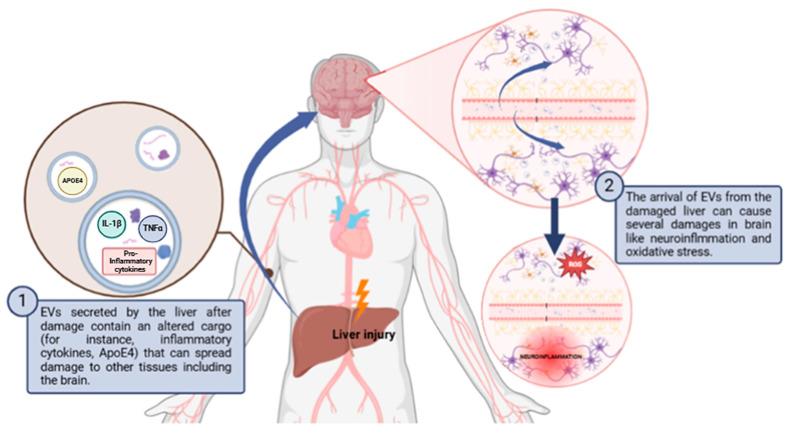
Extracellular vesicles (EVs) are small, membrane-bound particles secreted by cells into the extracellular environment, playing an increasingly recognized role in inter-organ communication and the regulation of various physiological processes. Regarding the redox homeostasis context, EVs play a pivotal role in propagating and mitigating oxidative stress signals across different organs. Cells under oxidative stress release EVs containing signaling molecules that can influence the redox status of distant cells and tissues. EVs are starting to be recognized as contributors to brain-liver communication. Therefore, in this review, we show how redox imbalance can affect the release of EVs in the brain and liver. We propose EVs as mediators of redox homeostasis in the brain-liver axis.
细胞外囊泡(EVs)是细胞分泌到细胞外环境中的小的、膜结合颗粒,在器官间通讯和各种生理过程的调节中发挥着越来越被认可的作用。在氧化还原稳态背景下,细胞外囊泡在跨不同器官传播和减轻氧化应激信号方面起着关键作用。处于氧化应激状态的细胞释放含有信号分子的细胞外囊泡,这些信号分子可影响远处细胞和组织的氧化还原状态。细胞外囊泡开始被认为是脑-肝通讯的促成因素。因此,在本综述中,我们展示了氧化还原失衡如何影响脑和肝中细胞外囊泡的释放。我们提出细胞外囊泡作为脑-肝轴中氧化还原稳态的介质。

 Zotero 插件