Khury Farouk, Karkabi Ihab, Mazzawi Elias, Norman Doron, Melamed Eyal A, Peled Eli
Division of Orthopedic Surgery, Rambam Health Care Campus, Haifa 3109601, Israel.
Antibiotics (Basel). 2024 Dec 1;13(12):1153. doi: 10.3390/antibiotics13121153.
Despite the rising global awareness and improvement of socioeconomic and living standards, the prevalence of diabetic osteomyelitis (DOM) and its complications has been increasing rapidly. This study aims to investigate the long-term prognosis of DOM of the foot treated using antibiotic-impregnated cement spacer (ACS) and the contributing risk factors for reoperation.
We retrospectively reviewed the data of 55 diabetic patients with Meggitt-Wagner Grade IIB wounds diagnosed with osteomyelitis of the foot, treated in our institution with excessive debridement, excision of the infected tissue, and implantation of antibiotic-impregnated cement spacer fixed with a Kirschner wire. Descriptive statistics, including patient demographics, were analyzed. Statistical analysis was performed using point-biserial correlation and a Chi-square test with Cramer's V effect-size estimation to determine the relationship between reoperation and various parameters.
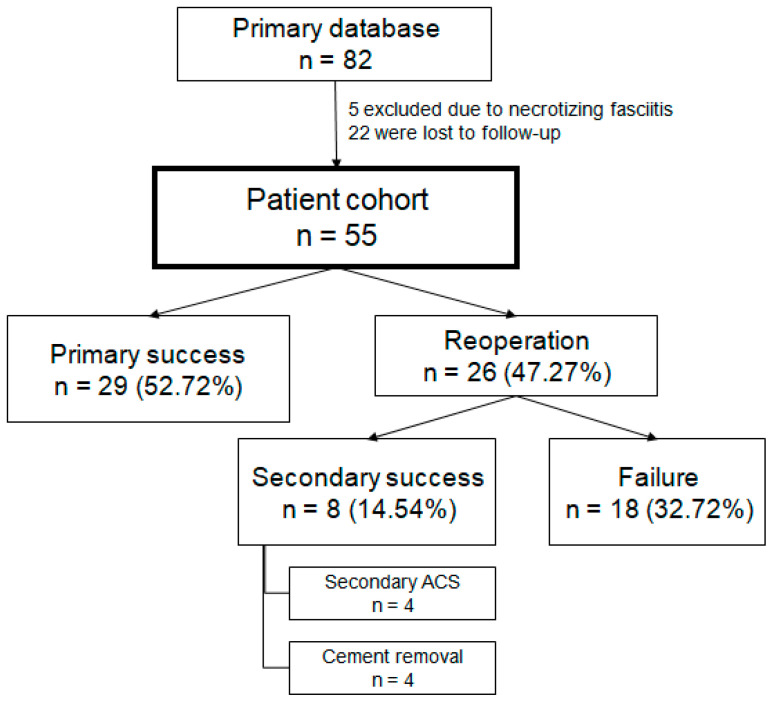
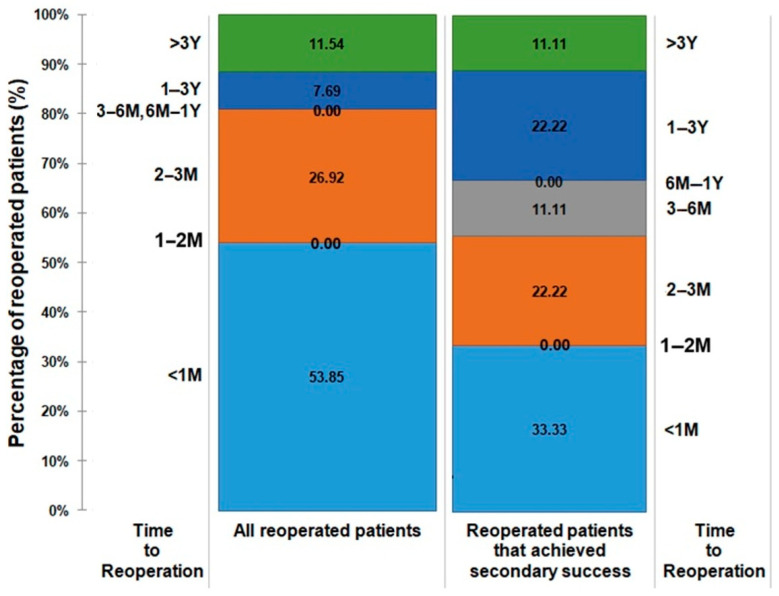
55 patients (36 (65.45%) males and 19 (34.55%) females) with a median age of 64 (39-84) years were thoroughly analyzed throughout a median follow-up of 884 days (2-4671 days). Of the entire cohort, 29 (52.72%) patients achieved primary successful infection eradication without any further intervention, and 8 (14.54%) patients were successfully treated using a secondary procedure. More than half of the reoperated patients underwent the secondary intervention within less than a month after the primary ACS. When assessing correlation, age (r = 0.28, = 0.04), gender (r = 0.31, = 0.02), (r = -0.10, = 0.04), and the use of gentamicin-only antibiotic cement spacer (r = 0.34, = 0.01) demonstrated statistically significant correlation to reoperation. 89.18% of the patients who achieved infection eradication did not undergo cement removal.
ACS has shown excellent results in eradicating bone infection with up to 7.23 years of follow-up, acting as a structural stabilizer, preventing soft tissue contractures, and delivering highly concentrated local antibiotic treatment both to soft tissue and bone. Regardless, specific factors should be thoroughly evaluated prior to surgery, as advancing age, gender, and the use of gentamicin-only antibiotics appear to be positively associated with a higher likelihood of reoperation. Conversely, infections caused by cultured seem to be inversely related to reoperation.
尽管全球意识不断提高,社会经济和生活水平有所改善,但糖尿病性骨髓炎(DOM)及其并发症的患病率仍在迅速上升。本研究旨在调查使用抗生素骨水泥间隔物(ACS)治疗足部DOM的长期预后以及再次手术的相关危险因素。
我们回顾性分析了55例诊断为足部骨髓炎的梅吉特 - 瓦格纳IIB级伤口的糖尿病患者的数据,这些患者在我们机构接受了广泛清创、感染组织切除,并植入了用克氏针固定的抗生素骨水泥间隔物。分析了包括患者人口统计学在内的描述性统计数据。使用点二列相关分析和带有克莱默V效应量估计的卡方检验进行统计分析,以确定再次手术与各种参数之间的关系。
对55例患者(36例(65.45%)男性和19例(34.55%)女性)进行了全面分析,中位年龄为64岁(39 - 84岁),中位随访时间为884天(2 - 4671天)。在整个队列中,29例(52.72%)患者在没有任何进一步干预的情况下实现了原发性感染根除,8例(14.54%)患者通过二次手术成功治疗。超过一半的再次手术患者在初次ACS后不到一个月内接受了二次干预。在评估相关性时,年龄(r = 0.28,P = 0.04)、性别(r = 0.31,P = 0.02)、[此处原文缺失部分内容](r = -0.10,P = 0.04)以及仅使用庆大霉素的抗生素骨水泥间隔物(r = 0.34,P = 0.01)与再次手术显示出统计学上的显著相关性。89.18%实现感染根除的患者未进行骨水泥取出。
在长达7.23年的随访中,ACS在根除骨感染方面显示出优异的效果,它作为一种结构稳定器,可防止软组织挛缩,并为软组织和骨骼提供高浓度的局部抗生素治疗。尽管如此,在手术前应全面评估特定因素,因为年龄增长、性别以及仅使用庆大霉素抗生素似乎与再次手术的可能性呈正相关。相反,由[此处原文缺失部分内容]培养引起的感染似乎与再次手术呈负相关。