Quinteira Sandra, Dantas Rui, Pinho Luís, Campos Carla, Freitas Ana R, Brito Nuno V, Miranda Carla
CIBIO-Research Center in Biodiversity and Genetic Resources, InBIO, Research Network in Biodiversity and Evolutionary Biology, Associated Laboratory, University of Porto, Campus de Vairão, Rua Padre Armando Quintas 7, 4485-661 Vairão, Portugal.
BIOPOLIS Program in Genomics, Biodiversity and Land Planning, Campus de Vairão, Rua Padre Armando Quintas 7, 4485-661 Vairão, Portugal.
Antibiotics (Basel). 2024 Dec 11;13(12):1208. doi: 10.3390/antibiotics13121208.
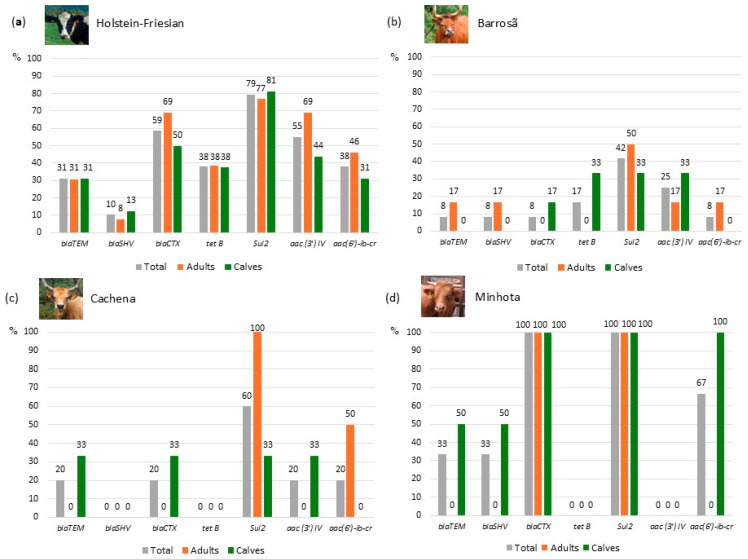
Animals destined for human consumption play a key role in potentially transmitting bacteria carrying antibiotic resistance genes. However, there is limited knowledge about the carriage of antibiotic-resistant bacteria in native breeds. We aimed to characterize the phenotypic profiles and antibiotic resistance genes in isolated from bovines, including three native Portuguese bovine breeds. Forty-nine isolates were selected from 640 fecal samples pooled by age group (eight adult or eight calf samples) from each farm, representing both dairy cattle raised in intensive systems and meat cattle raised in extensive systems in Northern Portugal. The presumptive colonies plated onto MacConkey agar were confirmed using matrix-assisted laser desorption ionization time-of-flight mass spectrometry (MALDI-TOF MS). The antibiotic resistance profiles were screened by antimicrobial susceptibility testing (EUCAST/CLSI guidelines), and the antibiotic resistance genes by PCR. Most isolates showed resistance to ampicillin (69%), tetracycline (57%), gentamicin (55%), and trimethoprim + sulfamethoxazole (53%), with no resistance to imipenem. Resistance to at least one antibiotic was found in 92% of isolates, while 59% exhibited multidrug resistance. Most calf isolates, including those from native breeds, showed a multidrug-resistant phenotype. Among the adults, this was only observed in Holstein-Friesian and Barrosã cattle. None of the Holstein-Friesian isolates were susceptible to all the tested antibiotics. ESBL-producing was identified in 39% of isolates, including those from Holstein-Friesian calves and adults, Cachena calves and Minhota adults. The 2 gene was detected in 69% of isolates, followed by (45%), (3')-IV (41%), and (6')-Ib-cr (31%), with a higher prevalence in adults. This pioneering study highlights the concerning presence of multidrug-resistant in native Portuguese cattle breeds.
供人类食用的动物在潜在传播携带抗生素抗性基因的细菌方面起着关键作用。然而,关于本地品种中抗生素抗性细菌的携带情况,我们了解有限。我们旨在对从牛身上分离出的细菌的表型特征和抗生素抗性基因进行表征,其中包括三个葡萄牙本土牛品种。从葡萄牙北部集约化养殖系统中的奶牛和粗放式养殖系统中的肉牛各农场按年龄组(八个成年或八个小牛样本)汇集的640份粪便样本中选取了49株分离株。将疑似菌落接种到麦康凯琼脂平板上,使用基质辅助激光解吸电离飞行时间质谱(MALDI-TOF MS)进行确认。通过抗菌药物敏感性试验(EUCAST/CLSI指南)筛选抗生素抗性谱,通过PCR检测抗生素抗性基因。大多数分离株对氨苄西林(69%)、四环素(57%)、庆大霉素(55%)和甲氧苄啶+磺胺甲恶唑(53%)耐药,对亚胺培南不耐药。92%的分离株对至少一种抗生素耐药,59%表现出多重耐药。大多数小牛分离株,包括来自本地品种的分离株,表现出多重耐药表型。在成年牛中,仅在荷斯坦-弗里生牛和巴罗萨牛中观察到这种情况。没有一株荷斯坦-弗里生分离株对所有测试抗生素敏感。在39%的分离株中鉴定出产超广谱β-内酰胺酶(ESBL)的细菌,包括来自荷斯坦-弗里生小牛和成年牛、卡谢纳小牛和米尼奥塔成年牛的分离株。69%的分离株中检测到blaCTX-M基因,其次是blaTEM(45%)、blaSHV(3')-IV(41%)和blaOXA(6')-Ib-cr(31%),在成年牛中患病率更高。这项开创性研究突出了葡萄牙本土牛品种中令人担忧的多重耐药细菌的存在。