Rethorst Chad D, Demment Margaret M, Ha Seungyeon, Folta Sara C, Graham Meredith L, Eldridge Galen D, Seguin-Fowler Rebecca A
Institute for Advancing Health Through Agriculture, Texas A&M University, Dallas, TX 75252, USA.
Statistical Consultation Center, Texas A&M University, College Station, TX 77843, USA.
Nutrients. 2024 Dec 17;16(24):4353. doi: 10.3390/nu16244353.
BACKGROUND/OBJECTIVES: Multilevel interventions have demonstrated efficacy in improving obesity and other related health outcomes. However, heterogeneity in individual responses indicates the need to identify the factors associated with responses and non-responses to multilevel interventions. The objective of this report is to identify the potential sources of heterogeneity through the exploration of the moderation effects of participant characteristics (sociodemographic and baseline physical/mental health) in the Strong Hearts, Healthy Communities-2.0 (SHHC-2.0) intervention.
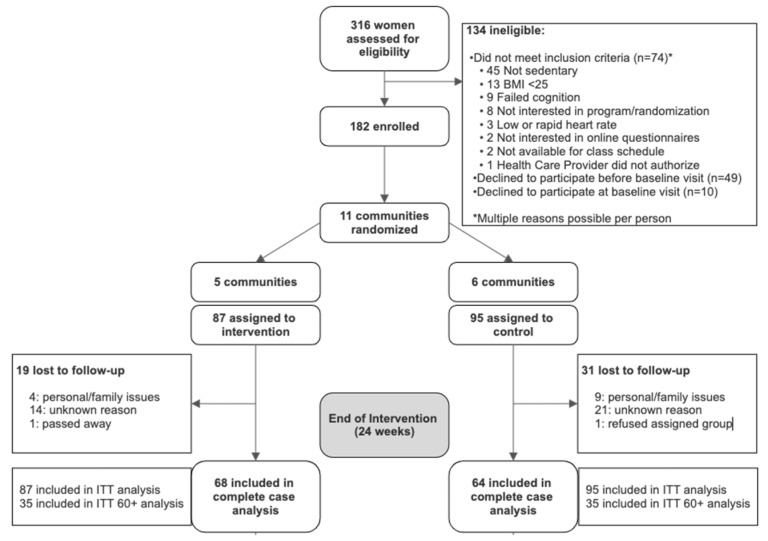
SHHC-2.0 is a 24-week multilevel intervention to improve people's diet and physical activity evaluated using a cluster-randomized, controlled trial design conducted with women aged 40 and older living in rural communities with an elevated risk of cardiovascular disease, defined as having a BMI > 30, or a BMI 25-30 plus < 1 weekly occurrence of 30 min of physical activity during leisure time. Linear mixed models were used to compare the between-group changes in the outcomes (weight, systolic blood pressure, hemoglobin A1c [HbA1c], and triglycerides), with an interaction term included for each potential moderator.
Within the sociodemographic characteristics, there were no differences in effectiveness by age, income, or baseline BMI status, but the participants with a high school education or less experienced less weight loss. Among their health history, only a history of hypertension was associated with differential outcomes; those with a history of hypertension demonstrated a greater reduction in systolic blood pressure. The participants with elevated depressive symptoms demonstrated greater weight loss and a greater reduction in the HbA1c level.
SHHC-2.0 was effective across a wide range of participants. The identified moderators (i.e., education level) may inform the future tailoring of the SHHC intervention to optimize the outcomes among participant subgroups, while more broadly, our findings can serve to inform the development and dissemination of multilevel interventions.
背景/目的:多层次干预已被证明在改善肥胖及其他相关健康结局方面具有成效。然而,个体反应的异质性表明需要识别与多层次干预反应和无反应相关的因素。本报告的目的是通过探讨参与者特征(社会人口统计学和基线身心健康状况)在“强心,健康社区-2.0”(SHHC-2.0)干预中的调节作用,来识别异质性的潜在来源。
SHHC-2.0是一项为期24周的多层次干预,旨在改善人们的饮食和身体活动,采用整群随机对照试验设计,对年龄在40岁及以上、生活在心血管疾病风险较高的农村社区的女性进行评估,心血管疾病风险较高定义为体重指数(BMI)>30,或BMI为25-30且每周休闲时间进行30分钟体育活动的次数少于1次。使用线性混合模型比较各结局指标(体重、收缩压、糖化血红蛋白[HbA1c]和甘油三酯)的组间变化,并为每个潜在调节因素纳入一个交互项。
在社会人口统计学特征方面,年龄、收入或基线BMI状态对干预效果没有差异,但高中及以下学历的参与者体重减轻较少。在健康史方面,只有高血压病史与不同的结局相关;有高血压病史的参与者收缩压降低幅度更大。抑郁症状较高的参与者体重减轻更多,HbA1c水平降低幅度更大。
SHHC-2.0在广泛的参与者中均有效。所识别的调节因素(即教育水平)可为未来SHHC干预的调整提供参考,以优化各参与者亚组的结局,更广泛地说,我们的研究结果可为多层次干预的开发和推广提供参考。