Saitoh Aya, Oku Hiromi, Katsuta Tomohiro, Kamiya Hajime, Ishikawa Yoichi, Takaku Mayumi, Saitoh Akihiko
Department of Nursing, Niigata University Graduate School of Health Sciences, Niigata 951-8518, Japan.
Department of Nursing, St. Luke's International University Graduate School of Nursing Science, Tokyo 104-0044, Japan.
Vaccines (Basel). 2024 Nov 22;12(12):1310. doi: 10.3390/vaccines12121310.
BACKGROUND/OBJECTIVES: Healthcare professionals' (HCPs') accurate knowledge of and positive attitudes toward immunization greatly influence society's acceptance of it. Early and appropriate immunization education for HCP students is vital. This study aimed to understand current immunization education and vaccine hesitancy among medical, nursing, and pharmacy students in Japan.
An anonymous self-administered online questionnaire was administered to final-year medical, nursing, and pharmacy students in Japan between 6 and 31 March 2023. Survey items assessed current immunization education, preparedness for clinical practice, immunization knowledge, and the degree of vaccine hesitancy.
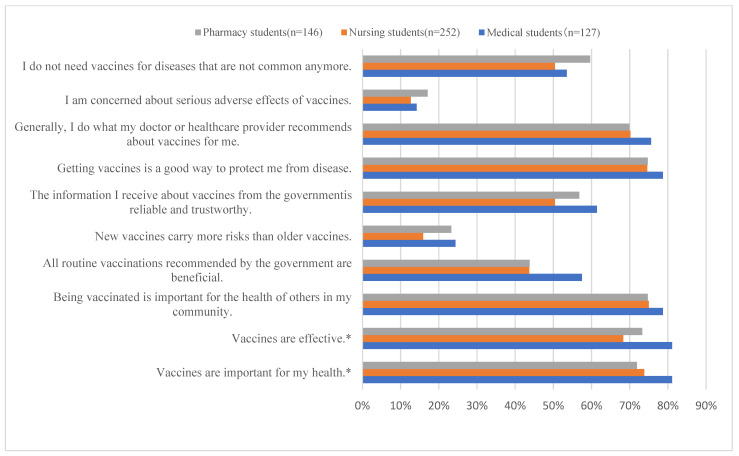
Overall, 525 students (127 (24.2%) medical, 252 (48.0%) nursing, and 146 (27.8%) pharmacy) responded, of whom 39.8% raised concerns regarding new vaccine risks (24.4%,15.9%, and 23.3%, respectively; = 0.22) and adverse effects (14.2%, 12.7%, and 17.1%, respectively; = 0.57), including trust in government information (61.4%, 50/4%, and 56.8%, respectively; = 0.337) or recommended vaccines (57.5%, 4.7%, and 43.8%, respectively; = 0.113). Preparedness for future clinical practice varied significantly among schools, with medical students (54%) feeling more prepared compared to nursing (34.3%) and pharmacy students (39.1%) ( < 0.001). The average correct immunization knowledge rate was 59.9%, with significant differences between schools (medical 62.7%, nursing 57.6%, and pharmacy 59.6%; < 0.001). There was no significant correlation between knowledge level and self-assessed preparedness (r = 0.066, = 0.132). The HCP students wished to receive more immunization education and sought improvements in comprehensive knowledge, communication skills, and practice-based content.
For Japan's HCP students, the enhancement of immunization education focusing on hesitancy and risk-benefit communication is necessary.
背景/目的:医疗保健专业人员(HCPs)对免疫接种的准确了解和积极态度极大地影响着社会对其的接受程度。对HCP学生进行早期且适当的免疫接种教育至关重要。本研究旨在了解日本医学、护理和药学专业学生当前的免疫接种教育情况以及疫苗犹豫程度。
于2023年3月6日至31日对日本医学、护理和药学专业的最后一年学生进行了一项匿名的在线自填问卷调查。调查项目评估了当前的免疫接种教育、临床实践准备情况、免疫接种知识以及疫苗犹豫程度。
总体而言,525名学生(127名(24.2%)医学专业、252名(48.0%)护理专业和146名(27.8%)药学专业)做出了回应,其中39.8%的学生对新疫苗风险(分别为24.4%、15.9%和23.3%;P = 0.22)和不良反应(分别为14.2%、12.7%和17.1%;P = 0.57)表示担忧,包括对政府信息的信任(分别为61.4%、50.4%和56.8%;P = 0.337)或推荐疫苗(分别为57.5%、4.7%和43.8%;P = 0.113)。各学校之间未来临床实践的准备情况差异显著,医学专业学生(54%)相比护理专业(34.3%)和药学专业(39.1%)感觉准备更充分(P < 0.001)。免疫接种知识的平均正确回答率为59.9%,各学校之间存在显著差异(医学专业62.7%、护理专业57.6%、药学专业59.6%;P < 0.001)。知识水平与自我评估的准备情况之间无显著相关性(r = 0.066,P = 0.132)。HCP学生希望接受更多的免疫接种教育,并寻求在综合知识、沟通技巧和基于实践的内容方面有所改进。
对于日本的HCP学生而言,有必要加强针对犹豫态度和风险效益沟通的免疫接种教育。