Toller-Kawahisa Juliana Escher, Viacava Paula Ramos, Palsson-McDermott Eva Margareta, Nascimento Daniele Carvalho, Cervantes-Silva Mariana Patricia, O'Carroll Shane Myles, Zotta Alessia, Damasceno Luis Eduardo Alves, Públio Gabriel Azevedo, Forti Pedro, Luiz João Paulo Mesquita, Silva de Melo Bruno Marcel, Martins Timna Varela, Faça Vitor Marcel, Curtis Annie, Cunha Thiago Mattar, Cunha Fernando de Queiroz, O'Neill Luke Anthony John, Alves-Filho José Carlos
Department of Pharmacology, Ribeirao Preto Medical School, University of Sao Paulo, Ribeirao Preto, Brazil; Center for Research in Inflammatory Diseases, Ribeirao Preto Medical School, University of Sao Paulo, Ribeirao Preto, Brazil; School of Biochemistry and Immunology, Trinity Biomedical Science Institute, Trinity College Dublin, Dublin, Ireland.
Department of Pharmacology, Ribeirao Preto Medical School, University of Sao Paulo, Ribeirao Preto, Brazil; Center for Research in Inflammatory Diseases, Ribeirao Preto Medical School, University of Sao Paulo, Ribeirao Preto, Brazil.
Cell Rep. 2025 Jan 28;44(1):115172. doi: 10.1016/j.celrep.2024.115172. Epub 2025 Jan 7.
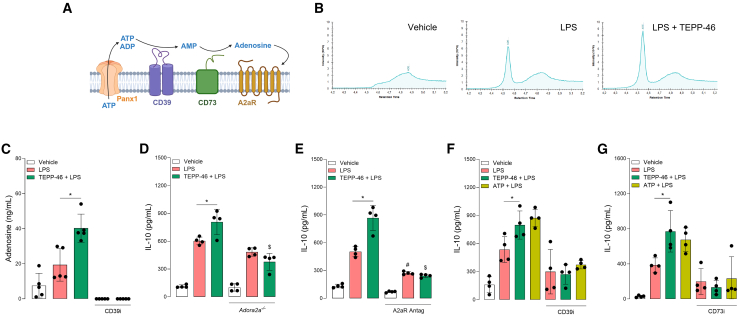
Macrophages play a crucial role in immune responses and undergo metabolic reprogramming to fulfill their functions. The tetramerization of the glycolytic enzyme pyruvate kinase M2 (PKM2) induces the production of the anti-inflammatory cytokine interleukin (IL)-10 in vivo, but the underlying mechanism remains elusive. Here, we report that PKM2 activation with the pharmacological agent TEPP-46 increases IL-10 production in LPS-activated macrophages by metabolic reprogramming, leading to the production and release of ATP from glycolysis. The effect of TEPP-46 is abolished in PKM2-deficient macrophages. Extracellular ATP is converted into adenosine by ectonucleotidases that activate adenosine receptor A2a (A2aR) to enhance IL-10 production. Interestingly, IL-10 production induced by PKM2 activation is associated with improved mitochondrial health. Our results identify adenosine derived from glycolytic ATP as a driver of IL-10 production, highlighting the role of tetrameric PKM2 in regulating glycolysis to promote IL-10 production.
巨噬细胞在免疫反应中起关键作用,并经历代谢重编程以履行其功能。糖酵解酶丙酮酸激酶M2(PKM2)的四聚化在体内诱导抗炎细胞因子白细胞介素(IL)-10的产生,但其潜在机制仍不清楚。在这里,我们报告称,用药物TEPP-46激活PKM2可通过代谢重编程增加脂多糖激活的巨噬细胞中IL-10的产生,导致糖酵解产生并释放ATP。在PKM2缺陷型巨噬细胞中,TEPP-46的作用被消除。细胞外ATP被外核苷酸酶转化为腺苷,后者激活腺苷受体A2a(A2aR)以增强IL-10的产生。有趣的是,PKM2激活诱导的IL-10产生与线粒体健康状况的改善有关。我们的结果确定了糖酵解ATP衍生的腺苷是IL-10产生的驱动因素,突出了四聚体PKM2在调节糖酵解以促进IL-10产生中的作用。