Hall Jennifer, Lever Elliot, Dawkins Nathan, Young Emma, Crowther Jamie, Williams Rachel, Pickavance John, Barber Sally, Daly-Smith Andy, Chalkley Anna
Bradford Institute for Health Research, Bradford Teaching Hospitals NHS Foundation Trust, Bradford Royal Infirmary, Duckworth Lane, Bradford, BD9 6RJ, UK.
Bradford Centre for Qualitative Research, Bradford Teaching Hospitals NHS Foundation Trust, Bradford Royal Infirmary, Duckworth Lane, Bradford, BD9 6RJ, UK.
Int J Behav Nutr Phys Act. 2025 Jan 7;22(1):3. doi: 10.1186/s12966-024-01704-5.
Supportive policy is an important component of a whole-systems approach to increasing physical activity and reducing inequalities. There is a growing body of literature surrounding the design and effectiveness of national policy approaches to physical activity, but evidence related to local-level approaches is lacking. The aim of this study was to examine 'what works', and identify factors underpinning change, focused on work to embed physical activity in local policy and practice in Bradford, UK.
A mixed-methods case study approach involved collecting data from cross-sectoral stakeholders directly or indirectly engaged in the physical activity agenda in Bradford over a period of three years (2021-2024). Data collection included focus groups, semi-structured interviews, researcher observations of key workshops and meetings, and surveys at two time-points (December 2021 and January 2024). Qualitative data were analysed using reflexive thematic analysis. Quantitative data were analysed using descriptive and inferential statistics.
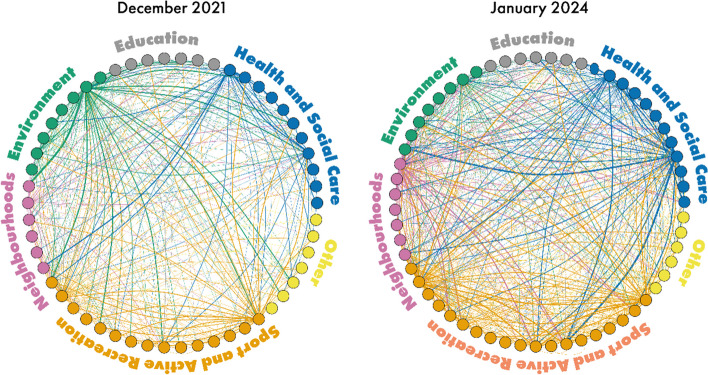
Four themes were identified which embody conditions that appear to be critical for working towards physical activity being embedded in local policy & practice within the Bradford District. These included: collaboration and sector integration, co-productive working, governance and leadership, and cultivating a learning culture. The process of co-producing a district-wide strategy for physical activity was key to facilitating shared ownership of the physical activity agenda across different levels of the system, and for supporting and maintaining cross-sectoral collaboration. On average, survey respondents connected with four more local organisations in relation to the physical activity agenda in January 2024 than in December 2021.
Taking a partnership approach, and fostering a culture of evidence-informed decision making, is key to embedding physical activity into policy and practice at a local level. Investing time to understand the aims and values of each partner, and potential synergies and tensions between them, can support the development of a positive and productive collaboration and, subsequently, more effective whole-system delivery and population-level increases in physical activity.
支持性政策是增加身体活动和减少不平等的全系统方法的重要组成部分。围绕国家身体活动政策方法的设计和有效性的文献越来越多,但缺乏与地方层面方法相关的证据。本研究的目的是研究“什么有效”,并确定促成变化的因素,重点是在英国布拉德福德将身体活动纳入地方政策和实践的工作。
采用混合方法案例研究方法,在三年(2021 - 2024年)期间从直接或间接参与布拉德福德身体活动议程的跨部门利益相关者收集数据。数据收集包括焦点小组、半结构化访谈、研究人员对关键研讨会和会议的观察,以及在两个时间点(2021年12月和2024年1月)进行的调查。定性数据采用反思性主题分析进行分析。定量数据采用描述性和推断性统计进行分析。
确定了四个主题,这些主题体现了对于在布拉德福德地区努力将身体活动纳入地方政策和实践似乎至关重要的条件。这些主题包括:协作与部门整合、共同生产性工作、治理与领导力以及培养学习文化。共同制定全地区身体活动战略的过程是促进系统不同层面共同拥有身体活动议程,以及支持和维持跨部门协作的关键。平均而言,2024年1月参与调查的受访者与身体活动议程相关的本地组织比2021年12月多四个。
采取伙伴关系方法,并培养基于证据的决策文化,是在地方层面将身体活动纳入政策和实践的关键。投入时间了解每个伙伴的目标和价值观,以及它们之间潜在的协同作用和紧张关系,可以支持建立积极且富有成效的协作,进而实现更有效的全系统交付,并在人群层面增加身体活动。