Wang Heng, Zheng Danni, Wang Mengying, Ji Hong, Han Jiangli, Wang Yan, Shen Ning, Qiao Jie
Education Department, Peking University Third Hospital, Beijing, China.
Information Management and Big Data Center, Peking University Third Hospital, Beijing, China.
JMIR Form Res. 2025 Jan 3;9:e58426. doi: 10.2196/58426.
With the development of artificial intelligence (AI), medicine has entered the era of intelligent medicine, and various aspects, such as medical education and talent cultivation, are also being redefined. The cultivation of clinical thinking abilities poses a formidable challenge even for seasoned clinical educators, as offline training modalities often fall short in bridging the divide between current practice and the desired ideal. Consequently, there arises an imperative need for the expeditious development of a web-based database, tailored to empower physicians in their quest to learn and hone their clinical reasoning skills.
This study aimed to introduce an app named "XueYiKu," which includes consultations, physical examinations, auxiliary examinations, and diagnosis, incorporating AI and actual complete hospital medical records to build an online-learning platform using human-computer interaction.
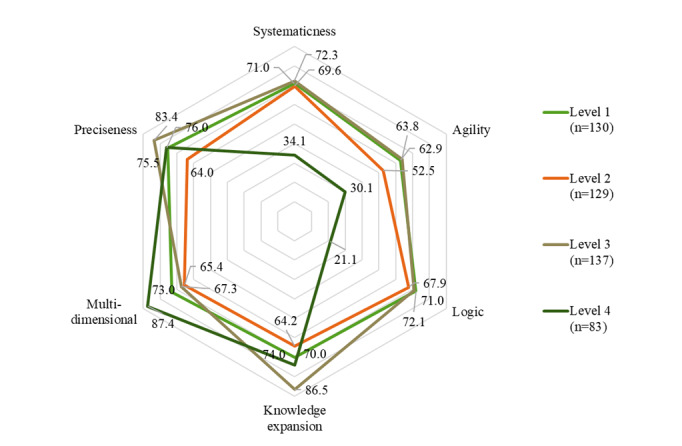
The "XueYiKu" app was designed as a contactless, self-service, trial-and-error system application based on actual complete hospital medical records and natural language processing technology to comprehensively assess the "clinical competence" of residents at different stages. Case extraction was performed at a hospital's case data center, and the best-matching cases were differentiated through natural language processing, word segmentation, synonym conversion, and sorting. More than 400 teaching cases covering 65 kinds of diseases were released for students to learn, and the subjects covered internal medicine, surgery, gynecology and obstetrics, and pediatrics. The difficulty of learning cases was divided into four levels in ascending order. Moreover, the learning and teaching effects were evaluated using 6 dimensions covering systematicness, agility, logic, knowledge expansion, multidimensional evaluation indicators, and preciseness.
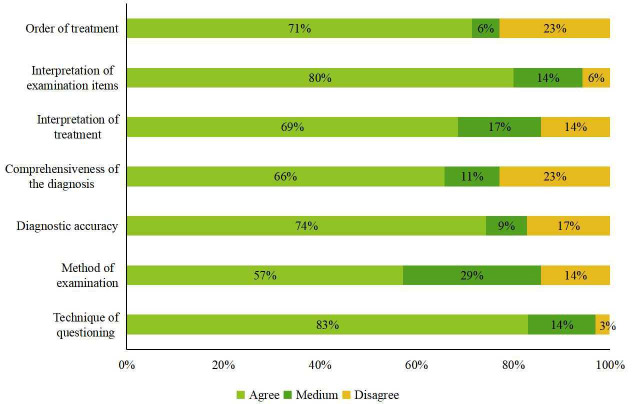
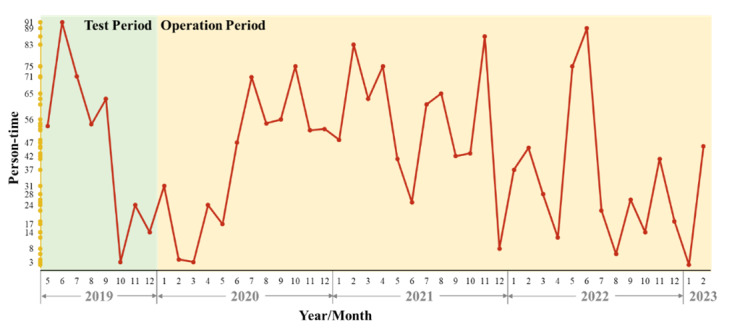
From the app's first launch on the Android platform in May 2019 to the last version updated in May 2023, the total number of teacher and student users was 6209 and 1180, respectively. The top 3 subjects most frequently learned were respirology (n=606, 24.1%), general surgery (n=506, 20.1%), and urinary surgery (n=390, 15.5%). For diseases, pneumonia was the most frequently learned, followed by cholecystolithiasis (n=216, 14.1%), benign prostate hyperplasia (n=196, 12.8%), and bladder tumor (n=193, 12.6%). Among 479 students, roughly a third (n=168, 35.1%) scored in the 60 to 80 range, and half of them scored over 80 points (n=238, 49.7%). The app enabled medical students' learning to become more active and self-motivated, with a variety of formats, and provided real-time feedback through assessments on the platform. The learning effect was satisfactory overall and provided important precedence for establishing scientific models and methods for assessing clinical thinking skills in the future.
The integration of AI and medical education will undoubtedly assist in the restructuring of education processes; promote the evolution of the education ecosystem; and provide new convenient ways for independent learning, interactive communication, and educational resource sharing.

随着人工智能(AI)的发展,医学已进入智能医学时代,医学教育和人才培养等各个方面也正在被重新定义。临床思维能力的培养即使对于经验丰富的临床教育工作者来说也是一项艰巨的挑战,因为线下培训方式往往难以弥合当前实践与理想状态之间的差距。因此,迫切需要迅速开发一个基于网络的数据库,以帮助医生学习和提升他们的临床推理技能。
本研究旨在推出一款名为“学易库”的应用程序,该应用涵盖会诊、体格检查、辅助检查和诊断等内容,融合人工智能和实际完整的医院病历,通过人机交互构建一个在线学习平台。
“学易库”应用程序被设计为一个基于实际完整医院病历和自然语言处理技术的非接触式、自助式、试错系统应用程序,以全面评估不同阶段住院医师的“临床能力”。在医院的病例数据中心进行病例提取,并通过自然语言处理、分词、同义词转换和排序来区分最匹配的病例。发布了400多个涵盖65种疾病的教学病例供学生学习,学科涵盖内科、外科、妇产科和儿科。学习病例的难度按升序分为四个级别。此外,使用涵盖系统性、敏捷性、逻辑性、知识拓展、多维评估指标和精确性的6个维度来评估学习和教学效果。
从该应用程序于2019年5月首次在安卓平台上线到2023年5月的最新版本更新,教师用户和学生用户总数分别为6209人和1180人。学习频率最高的前3个学科是呼吸内科(n = 606,24.1%)、普通外科(n = 506,20.1%)和泌尿外科(n = 390,15.5%)。对于疾病,肺炎是学习频率最高的,其次是胆囊结石(n = 216,14.1%)、良性前列腺增生(n = 196,12.8%)和膀胱肿瘤(n = 193,12.6%)。在479名学生中,大约三分之一(n = 168,35.1%)的成绩在60至80分之间,其中一半以上的学生成绩超过80分(n = 238,49.7%)。该应用程序使医学生的学习变得更加积极主动,形式多样,并通过平台上的评估提供实时反馈。总体学习效果令人满意,并为未来建立评估临床思维技能的科学模型和方法提供了重要的先例。
人工智能与医学教育的融合无疑将有助于教育过程的重塑;促进教育生态系统的演变;并为自主学习、互动交流和教育资源共享提供新的便捷方式。